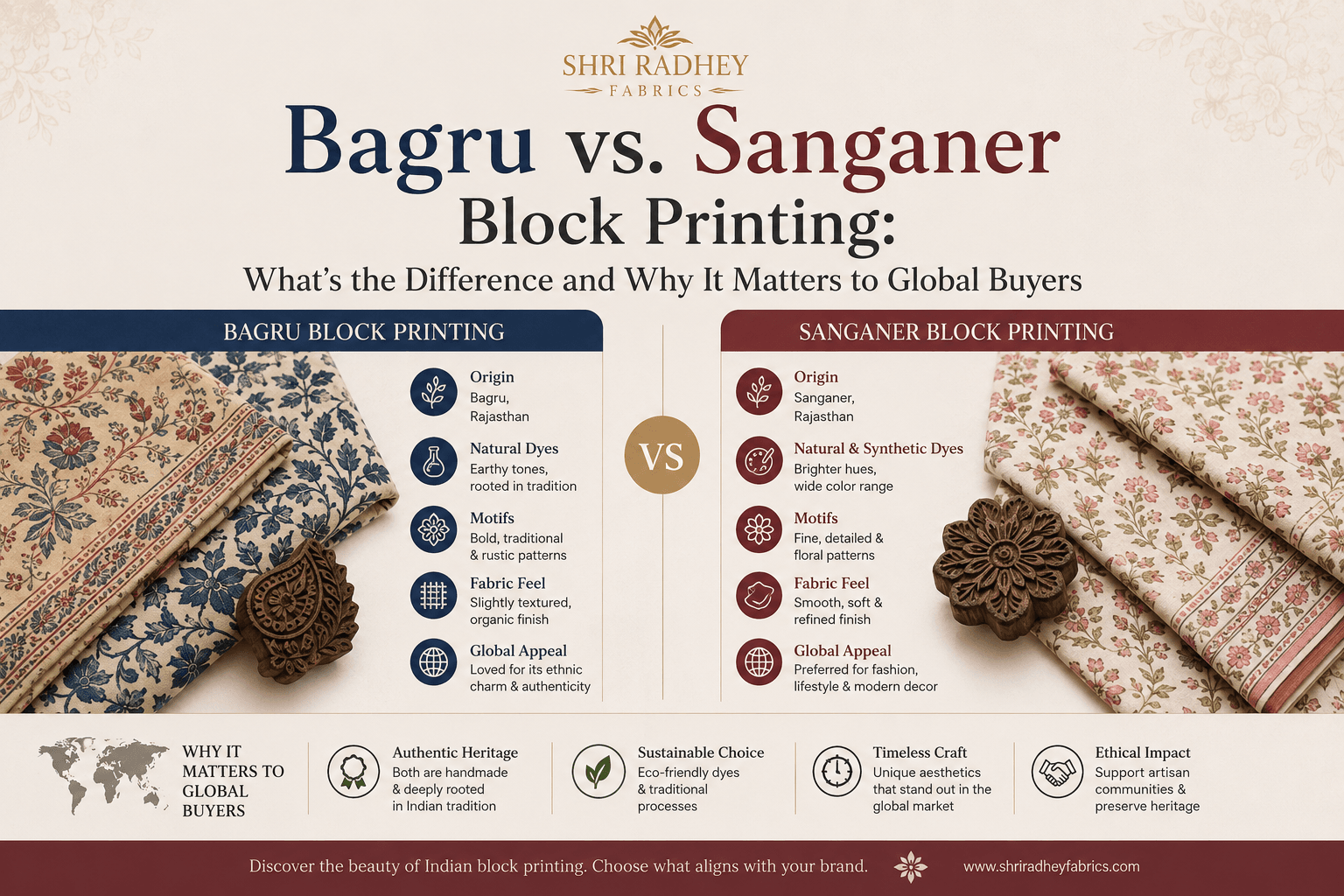
If you’ve ever shopped for Indian block-printed fabric — a bedsheet from Jaipur, a flowy cotton kurta, a tablecloth that looks like it came straight out of an old palace room — there’s a good chance the label said one of two things: Bagru print or Sanganeri print. Most buyers nod and move on. But behind those two names are two completely different worlds — different histories, different techniques, different philosophies of colour and beauty, and, for global sourcing buyers, very different supply chain implications.
Understanding the distinction between Bagru and Sanganer block printing isn’t just academic. In 2026, as India’s textile exports cross ₹3.16 lakh crore and handicrafts emerge as the sector’s fastest-growing export category (up 6.1% year-on-year), buyers from Germany to Japan, from Nigeria to the UAE are increasingly asking their sourcing agents: Which kind of Jaipur print are you actually giving me? The answer shapes everything — from pricing and MOQ to sustainability certifications and long-term design authenticity.
This is the blog that answers that question, completely.
A Tale of Two Towns, Thirty Kilometres Apart
Jaipur sits in the middle of Rajasthan, historically one of India’s richest textile regions. About 16 kilometres to its south lies Sanganer — a town that grew into one of the densest concentrations of block-printing workshops in Asia, famously positioned along the Saraswati River, whose waters were said to possess unique properties that gave Sanganeri dyes their famed brightness and clarity.
About 30 kilometres in the opposite direction, to the west of Jaipur, sits Bagru — quieter, more insular, more rooted in indigenous craft traditions. The Chhipa community of Bagru has practised natural-dye resist printing here for generations, in a village where hard water and scarcity of resources led artisans to develop one of the most complex natural dyeing processes in the subcontinent.
Geographically, they’re practically neighbours. Artistically, they couldn’t be further apart.
Both crafts have earned Geographical Indication (GI) protection — Sanganeri Hand Block Prints received the GI certificate in 2010, and Bagru Hand Block Print followed shortly after in 2011. Both are recognised under India’s Geographical Indications of Goods (Registration and Protection) Act, 1999, which means only products genuinely made in these regions can legally carry these names. This is a critical fact for global buyers: a GI tag on a piece of Jaipur block print fabric is not just a marketing claim. It is a protected intellectual property designation, roughly equivalent to why only sparkling wine from the Champagne region of France can be called Champagne.
The Sanganer School: Royal Refinement, White Grounds, and Mughal Elegance
History and Patronage
Sanganeri printing dates back over 500 years. It rose to particular prominence during the 16th and 17th centuries, a period when the East India Company began exporting these fabrics to European markets — one of the earliest examples of Indian textiles finding a global commercial audience. The craft was heavily patronised by the Jaipur royal court, which encouraged artisans to achieve ever-finer levels of precision and delicacy. That royal pressure for perfection is embedded in the Sanganeri DNA to this day.
The Aesthetic Language
Ask someone to picture “Jaipur block print” and odds are they’re picturing Sanganeri. The hallmark is its pure white or cream background — a fabric that has been bleached before printing, creating the high-contrast canvas that makes the coloured motifs leap off the cloth. On this clean white ground, artisans print using a technique called calico printing, where outlines are stamped first, then filled in, repeated in precise diagonal sections.
The motifs are deeply influenced by Mughal court aesthetics: butis (small floral sprigs), paisleys, delicate botanical illustrations, fine-line florals, intricate geometric lattice work, peacocks, and vines rendered with a precision that can require up to 30 different carved wooden blocks for a single design, involving 20 people over 10 hours to complete. The colour palette runs vibrant and jewel-toned — pinks, blues, reds, teals, greens, saffron — but always on that brilliant white ground, which gives the design its trademark crispness and brightness.
Modern Sanganeri workshops primarily use AZO-free synthetic dyes, which offer superior colourfastness, washability, and a much wider colour range than natural dyes alone. This has made Sanganer the dominant centre for high-volume, commercially reproducible block-print production — the kind that can consistently fulfil large export orders for bedsheets, curtains, dupattas, cushion covers, and dress materials to buyers in Europe, the US, and Japan.
Best Fabrics for Sanganeri Printing
The fine, precise lines of Sanganeri blocks transfer most cleanly on lightweight, tightly woven fabrics. The most popular choices include:
- Mulmul cotton (Indian muslin) — the classic, light and breathable
- Cotton voile — for a transparent, summery quality
- Kota Doria — the iconic lightweight cotton-silk weave from nearby Kota
- Chanderi cotton-silk — for a lustrous, semi-formal feel
- Fine cambric cotton — for sharp, crisp motif transfer
The Bagru School: Mud, Indigo, Earth, and the Wisdom of Resist
History and Craft Community
Bagru’s printing tradition traces back approximately 450 years, rooted in the Chhipa community — artisans whose identity is inseparable from the craft itself. The name Chhipa literally means “one who prints,” and in Bagru, this is not just an occupation. It is a hereditary vocation, a community identity, and a living cultural institution.
Where Sanganer’s story is one of royal patronage driving refinement, Bagru’s story is one of environmental constraint driving innovation. The hard water available in Bagru had different mineral properties from Sanganer’s river water, which made clean synthetic dyeing difficult. This led Bagru’s artisans to develop an extraordinarily sophisticated natural dyeing process — one that works with nature’s chemistry rather than against it. The result is a style of printing that is bolder, earthier, more rustic, and in many ways more technically complex than Sanganer’s.
The Technique: Syahi-Begar and the World of Dabu
Bagru printing is not one technique but a family of interrelated processes, each adding layers of visual richness.
The most distinctive is dabu (also spelled daboo) — a mud-resist printing method in which a paste made from clay, lime, gum Arabic, and wheat chaff is applied to the fabric using carved wooden blocks before the cloth is dipped in dye. The mud resist prevents the dye from penetrating the covered areas, creating patterns that emerge only after washing — with the characteristic organic edge that no digital or screen print can replicate. After dyeing, the cloth is dried in the sun (Rajasthan’s abundant sunshine is a genuine production input here), then washed and dried again, sometimes multiple times.
Before any of this, the base cloth undergoes syahi-begar — a traditional mordanting treatment where the fabric is soaked in a solution of tannin (harda) and then treated with two natural mordants: syahi (an iron-based black mordant) and begar (an alum-based reddish mordant). These mordants react with natural dyes differently — iron produces deep blacks and dark greys, alum produces reds and terracottas — giving Bagru prints their characteristic dual-tone earthy palette before a single block is even pressed.
Natural dyes used in Bagru include:
- Indigo (from the Indigofera plant) — for the iconic deep blue backgrounds
- Madder root — for warm reds and terracottas
- Iron filings and jaggery — for rich blacks and dark greys
- Turmeric — for yellow accents
- Pomegranate rind — for golden-tan tones
The Aesthetic Language
Where Sanganeri is delicate, Bagru is bold. Where Sanganeri whispers, Bagru speaks in a deep, confident voice rooted in the earth. The motifs are comparatively larger and more geometric — folk-inspired designs, animal and bird forms, leaf clusters, and geometric patterns — printed on backgrounds that are never white but almost always a warm natural beige, deep indigo, madder red, or soft cream.
The “imperfections” in Bagru printing — the slight bleeding of dye, the subtle registration shifts where one block impression meets the next, the organic edge of a resist line — are not flaws. They are the signature of the human hand, and in 2026, they are increasingly recognised as a premium feature by global buyers who have seen enough perfectly uniform digital prints to last a lifetime.
Side-by-Side: The Key Differences at a Glance
| Feature | Sanganeri Block Print | Bagru Block Print |
|---|---|---|
| Location | Sanganer, 16 km south of Jaipur | Bagru, 30 km west of Jaipur |
| History | 500+ years; Mughal-era royal patronage | 450+ years; Chhipa community tradition |
| Background colour | White or off-white (bleached) | Indigo blue, madder red, or natural beige |
| Primary technique | Direct block printing (calico method) | Dabu mud-resist + natural dyeing |
| Motifs | Fine floral, paisley, Mughal botanical | Bold geometric, folk motifs, earthy florals |
| Colour palette | Vibrant, jewel-toned, wide range | Earthy, muted, indigo-madder-black spectrum |
| Dyes used | AZO-free synthetic dyes | Natural dyes (indigo, madder, iron, turmeric) |
| Line quality | Fine, precise, intricate | Bold, rustic, intentionally imperfect |
| Complexity | Multiple colour blocks, high precision | Multi-step resist + dye process |
| Best fabrics | Mulmul, voile, Kota Doria, cambric | Unbleached cotton, heavy cotton, linen blends |
| GI tag received | 2010 | 2011 |
| Ideal products | Bedsheets, curtains, dupattas, dress material | Home furnishings, boho apparel, scarves, quilts |
| Market positioning | Mass-premium, commercial export ready | Artisanal, slow fashion, sustainability premium |
Why This Distinction Matters More Than Ever in 2026
Here is where the conversation shifts from heritage to commerce — and it’s a conversation that global buyers, Indian exporters, and Jaipur’s artisan communities are all increasingly paying attention to.
1. The Sustainability Boom Is Bagru’s Moment
The global sustainable fashion market is valued at USD 10.1 billion in 2026 and is projected to reach USD 19.8 billion by 2033, growing at a CAGR of 10.1%. The single biggest driver of that growth is consumer and regulatory demand for traceable, natural, ethically produced textiles.
Bagru printing — with its natural indigo and madder dyes, its zero-synthetic-chemical dabu resist, its sun-drying processes, its deeply rooted community production model — is essentially a ready-made answer to every question a sustainability-focused European or American buyer is now asking. The EU Digital Product Passport, which will by 2027 require every textile sold in the EU to carry machine-readable data on origin, composition, and end-of-life pathways, creates a significant advantage for Bagru products whose process transparency is baked into the craft itself.
Apparel manufacturers in Jaipur are already responding, incorporating eco-friendly materials and organic dyes more broadly across their production. For global brands looking to make credible sustainability claims, a Bagru dabu-printed cotton shirt sourced from GI-certified Chhipa artisans is not just a product. It is a sustainability story with 450 years of provenance.
2. Sanganeri Prints Are Driving Export Volume
While Bagru captures the sustainability premium, Sanganeri is doing the heavy commercial lifting. India leads the world in block-printed cotton fabric exports — ahead of China and Belgium — with exports of handprinted textiles and scarves reaching USD 56.81 million in the April–June 2025 quarter alone according to EPCH provisional data.
Sanganer’s advantage is its scalability. Hundreds of workshops in the Sanganer cluster can handle large orders with consistent colour matching, washfast AZO-free dyes, tight delivery timescales, and competitive pricing. For a European home furnishings retailer ordering 10,000 bedsheets, Sanganer’s production infrastructure is simply more reliable than Bagru’s more artisanal, slower production model.
Buyers from Germany, Netherlands, France, the UK, the US, and Japan have historically been the biggest consumers of Sanganer block print textiles, and that pipeline is growing. India’s textile exports to Germany grew 9.9% and to the UK by 7.8% in FY 2025-26 — and block-print fabrics are a meaningful slice of those categories.
3. The “Artisanal Premium” Is Real and Growing
There is a growing market segment — in the US, UK, Northern Europe, and Japan particularly — that is not looking for the lowest price per metre. They are looking for the most authentic story. For these buyers, the fact that a Bagru print was made by a Chhipa artisan using indigo extracted from plants and a mud resist recipe passed down through four generations is not a curiosity. It is the product. And they will pay a premium for it.
Block-print scarves from Jaipur are already one of the strongest categories for boutique importers in the UK and the US, with demand through fair-trade retailers, specialty importers, and platforms like Ten Thousand Villages. Bagru’s natural dye prints sit at the higher-value end of this market.
4. GI Tags Are an Untapped Commercial Weapon
Both Bagru and Sanganer hold GI tags — a legal protection that functions, internationally, the way Champagne’s GI works in France. Yet research published in 2025 found that a significant majority of artisans in both communities are either not fully leveraging or not fully aware of how to leverage their GI status for pricing, marketing, and export differentiation.
This is a missed opportunity that is starting to close. As the Ministry of Textiles organises export facilitation workshops in Jaipur for textile MSMEs — with nearly 100 participants gathered as recently as June 2026 to understand how to maximize FTAs and government schemes — GI-based product differentiation is increasingly part of the conversation. For global buyers, sourcing GI-certified Bagru or Sanganeri fabric is a more defensible procurement decision than sourcing generic “block print from Jaipur.”
What Global Buyers Should Actually Ask Their Suppliers
If you’re sourcing Jaipur block-print fabrics in 2026, here is the due diligence that separates informed buyers from those getting generic screen-printed fabric sold as handblock:
Ask for the printing village. A legitimate Sanganer supplier will be based in or source directly from the Sanganer cluster. Same for Bagru. Mixing them up — or sourcing from unregistered printers outside these clusters and labelling it as either — is increasingly a GI violation.
Ask about the resist technique. If a supplier claims their product is “authentic Bagru print,” ask specifically: does it use dabu mud-resist? What natural dyes are in use? Is the fabric mordanted with harda before printing? These are questions that a genuine Bagru printer will answer fluently. Someone who doesn’t know what syahi-begar is probably isn’t making authentic Bagru prints.
Ask about the block carvers. In authentic Jaipur block printing, blocks are hand-carved, typically from teak wood. The carvers (saikaris) are a separate artisanal community from the printers. A single complex Sanganeri design can require the carving of up to 30 individual blocks. If your supplier can’t tell you where their blocks are made or who carves them, it’s a warning sign.
Request natural dye certification for Bagru. Several third-party certification bodies operate in India that verify natural dye use and sustainable production. GOTS (Global Organic Textile Standard) and OEKO-TEX certifications are increasingly sought by Jaipur exporters responding to European buyer demands.
Don’t confuse Dabu with Bagru. Dabu is a technique; Bagru is a place. While dabu is the defining technique of Bagru printing, dabu is also practised in Akola, Kutch, and other parts of Rajasthan. Authentic Bagru print specifically refers to dabu and resist printing practised by the Chhipa community of Bagru village. These are related but not identical.
The Outlook: Where Bagru and Sanganer Are Headed
Near-Term (2026-2027)
The implementation of the India-UK CETA from July 2026 — under which 99% of Indian exports will gain duty-free access to the UK market — is a direct tailwind for Jaipur’s block-print export community. The UK is one of India’s most consistent buyers of hand-block printed scarves, home textiles, and fashion fabrics.
The India-EU FTA, concluded in January 2026 and expected to be fully signed by December 2026 with implementation between February-March 2027, is an even bigger prize. Europe is the world’s largest market for sustainable and artisanal textiles, and when tariff barriers on Indian block-print fabric fall, the competitive advantage over rival producers in Turkey and Vietnam will widen meaningfully.
Medium-Term (2027-2030)
The EU’s Digital Product Passport requirement, coming into force by 2027, will structurally reward Bagru’s traceable, natural-dye, craft-documented production model. Brands that can point to a product’s origin village, artisan community, dye materials, and technique will have a major compliance advantage over those who cannot.
At the same time, Sanganer is evolving. Workshops in the Sanganer cluster are increasingly adopting low-water processing techniques, water-efficient discharge printing, and AZO-free certified dye ranges to meet European buyer requirements. The Jaipur Integrated Texcraft Park — established under the SITP (Scheme for Integrated Textile Parks) scheme — provides shared testing labs, R&D infrastructure, and effluent treatment facilities that are helping smaller workshops meet global compliance standards they couldn’t afford to build individually.
Long-Term Vision
India has set a national target of USD 100 billion in textile exports by 2030. Block-print fabrics from Jaipur — both Sanganer’s commercial-scale output and Bagru’s premium artisanal production — are expected to be a meaningful contribution to that number. The sector’s ability to diversify into more than 120 export destinations, including strong growth in new markets like Egypt, Nigeria, Senegal, UAE, and Japan, suggests that the audience for authentic Jaipur textiles is genuinely global and still expanding.
For the Consumer: Which One Is Right for You?
If you’re an individual buyer — whether shopping in Jaipur’s markets or ordering from an online Indian textile brand — here’s a simple framework:
Choose Sanganeri if: You want vivid, high-contrast prints with fine floral detailing. You’re looking for crisp, washable, colourfast fabrics for everyday home textiles — bedsheets, curtains, table covers. You value variety and want a wide range of colour options. You appreciate Mughal-inspired delicacy and precision.
Choose Bagru if: You’re drawn to earthy, organic aesthetics — the indigo blues, madder reds, and natural tans of the natural dye world. You want something that genuinely cannot be replicated by a machine. You care about sustainability and want natural dyes, natural fibres, and a traceable artisan story. You’re looking for statement pieces — a scarf, a throw, a special-occasion garment — rather than mass-production home textiles.
Both are authentic. Both are extraordinary. Both deserve to be understood, named correctly, and paid for honestly.
Closing Thought: The Names on the Labels Matter
In a world flooded with fast fashion and machine-replicated “ethnic prints,” knowing the difference between Bagru and Sanganer is not pedantry. It is the difference between supporting a 450-year-old community dyeing tradition using plants grown in Rajasthan’s soil, and buying a screen-printed approximation of it made in a factory elsewhere with synthetic pigments.
For global buyers, it is the difference between a sourcing decision that holds up to scrutiny and one that doesn’t. For Indian exporters, it is the difference between competing on price alone and competing on the irreplaceable value of provenance. And for the artisans of Bagru and Sanganer — the Chhipa families who wake up every morning and dip carved wooden blocks into dye baths the way their great-grandparents did — it is the difference between a livelihood and a lost craft.
The labels on the fabric matter. The villages on the label matter. And in 2026, as India’s textile sector steps into a new era of FTAs, sustainability mandates, and global craft appreciation, the world is finally starting to pay attention.
This blog is part of our Jaipur Textile Insights series covering India’s craft textile ecosystem, export trends, and artisan communities. All export and market data referenced from Ministry of Textiles, EPCH, Mordor Intelligence, and GI Registry of India.
Tags: Jaipur block print, Bagru print, Sanganeri print, hand block printing India, Indian textile exports 2026, sustainable fashion India, natural dye textiles, GI tag handicrafts, Rajasthan textile, dabu print, Jaipur fabric export, Chhipa community, India textile GI