We get this question from buyers almost every week.
Someone sends us a reference image — a beautiful geometric print on a cotton kurta, or a delicate floral on a rayon dupatta — and asks: “Can you do this in hand block or screen print? Which one should I go with?”
It sounds like a simple question. It isn’t. The answer depends on your design, your quantity, your budget, your timeline, and honestly, what story you want your fabric to tell.
We’ve been manufacturing and sourcing printed fabric in Jaipur since 2017, working with private labels, garment manufacturers, and boutique brands across India and internationally. We do both screen printing and hand block printing in-house. So when we explain the difference, we’re not quoting a textbook — we’re telling you what we see on the printing table every single day.
Here’s the real breakdown.
First, a Little Context: Why Jaipur?
Before we get into the technical differences, it’s worth understanding why this conversation is best had with someone from Jaipur specifically.
Jaipur — and the villages surrounding it, particularly Sanganer and Bagru — is one of the oldest and most concentrated centres of textile printing in the world. The craft of block printing here goes back several centuries. The Chhipa community of artisans, who migrated from Gujarat and Madhya Pradesh under the patronage of the royal family of Jaipur in the 16th and 17th centuries, settled along the riverbanks of Sanganer and Bagru and built what became a living, breathing textile printing tradition that still exists today.
Sanganeri prints are known for their fine lines, delicate florals, and intricate detailing on white or off-white backgrounds — motifs like Buti (small flowers), Buta (larger blooms), Jaal (floral nets), and Bel (creeper patterns) that reflect centuries of Mughal and Rajput aesthetic influence. Sanganeri prints received a Geographical Indication (GI) tag in 2010 — a formal recognition of their unique origin and character.
Bagru prints are something else entirely — bolder, earthier, with geometric motifs, deep indigos, and russet reds produced using traditional natural dyes and a resist-printing technique called Dabu. Bagru printing has its own visual language, one that speaks of the desert, not the palace garden.
We work with artisans from both traditions. And we also run screen printing units. Which means we see, every day, where each technique is the right choice and where it isn’t.
Now let’s get into it.
What Is Hand Block Printing?
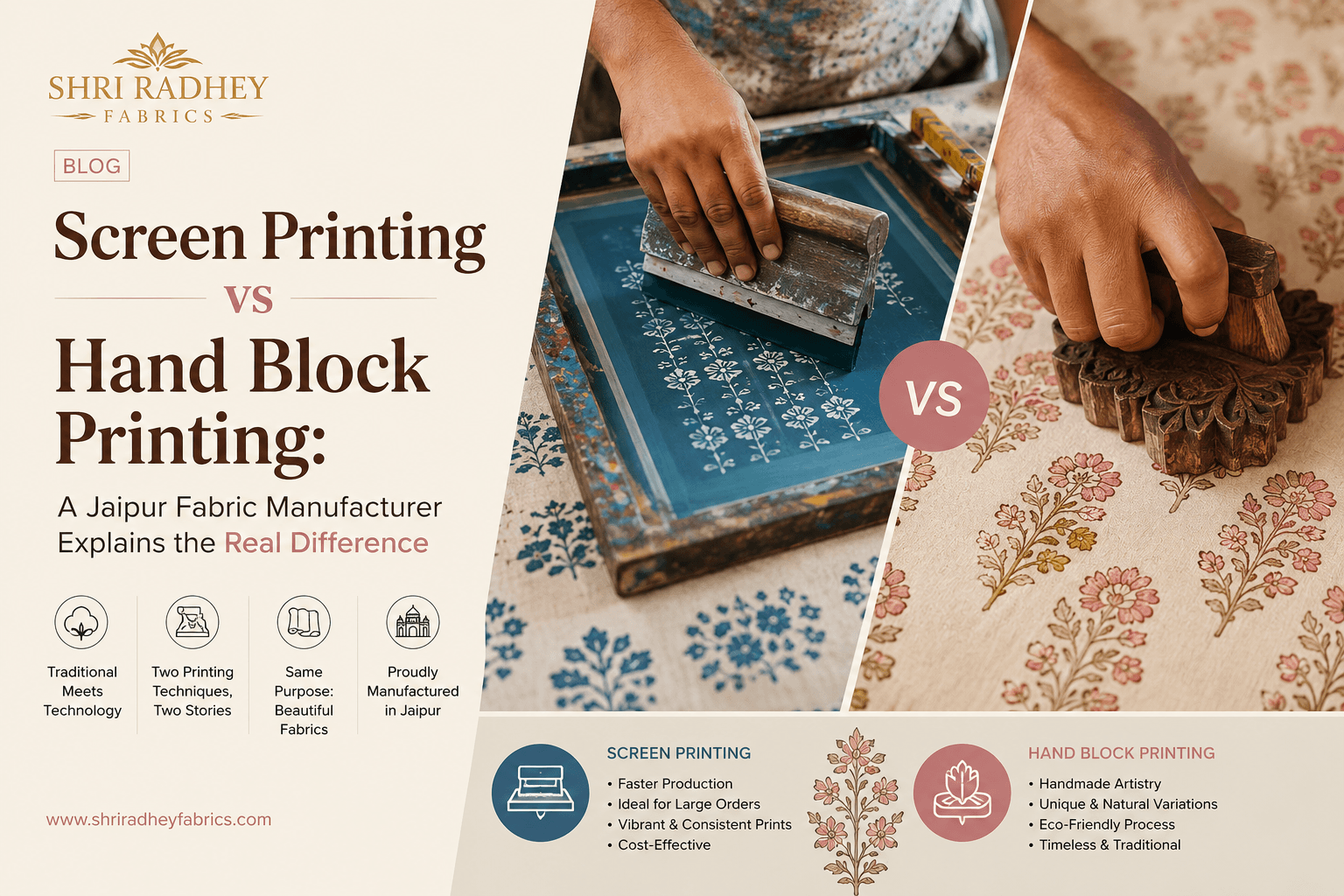
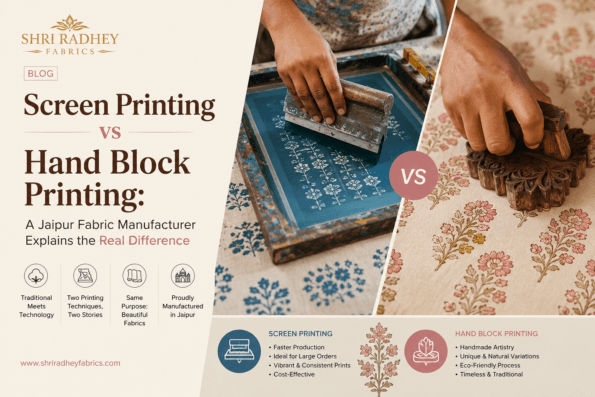
Hand block printing is exactly what it sounds like. A design is carved — by hand — into a wooden block, usually made from sheesham (Indian rosewood) or teak. Skilled block carvers spend anywhere from hours to several days on a single block, depending on how intricate the motif is. These carved blocks are then dipped in dye and stamped, one by one, onto fabric stretched flat across a long printing table.
Every impression is placed manually. The artisan reads the alignment, adjusts the pressure, moves along the table, and repeats — block after block, colour after colour — until the full print emerges across the fabric.
This is not a fast process. A skilled artisan printing a moderately complex two-colour design might cover 25 to 40 metres of fabric in a full working day. For a three or four-colour pattern with tight registration, that number drops further.
But speed is not the point of hand block printing. Never has been.
What makes hand block printing distinctive
Every piece is genuinely one of a kind. When the block is pressed by a human hand, minor variations in pressure, angle, and dye uptake are unavoidable. The result is fabric where two metres of the same print are similar but not identical. The colour might be marginally richer in one impression, slightly lighter in another. The motif might sit a millimetre off the perfect grid in one repeat. These are not defects. They are the fingerprints of the process — and for buyers who value authenticity and handcraft, they are part of what they’re paying for.
The texture is physical. Dye pressed into fabric with a wooden block under human pressure creates a slightly raised, tactile quality that you can feel with your fingertip. Run your hand over a good hand block print and you’ll notice something that screen-printed fabric simply doesn’t have.
The design language is different. Block printing lends itself to certain aesthetics — repeating motifs, geometric arrangements, organic florals, border patterns. The Jaipur tradition in particular has a vocabulary of motifs — Buti, Buta, Ajrak, Dabu, Kalamkari, Bagh — that carry cultural meaning and heritage. You cannot fake this with a machine.
Natural dyes are often used. Particularly in Bagru printing and traditional Ajrak work, natural dyes derived from indigo, madder, pomegranate rind, turmeric, and other plant and mineral sources are used alongside or instead of synthetic ones. This makes block-printed fabric a strong proposition for brands with sustainability commitments.
What Is Screen Printing?
Screen printing — sometimes called silkscreen printing — uses a mesh screen stretched over a frame, with a stencil applied to the screen that blocks dye from passing through in certain areas. A squeegee or blade pushes dye across the screen, and the dye passes through only where the stencil allows, depositing the design onto the fabric below.
Each colour in the design requires a separate screen. A three-colour print needs three screens, printed in sequence. Modern screen printing in fabric manufacturing uses flat-bed screen printing tables or rotary screen printing machines, depending on the production volume and the mill.
Unlike hand block printing, screen printing is a production technique. It’s designed for speed, consistency, and scale.
What makes screen printing distinctive
Consistency is its superpower. Every metre of screen-printed fabric looks identical. The repeat is exact. The colours are matched to specification. The registration between multiple colours is tight and precise. If you need 5,000 metres of a fabric to look exactly the same across every roll — screen printing is your answer.
It handles certain design types better. Fine lines, sharp edges, bold fills, halftone effects — screen printing excels at designs that require clean, hard-edged colour separation. If your reference artwork is more graphic than organic, screen printing will reproduce it more faithfully than a block.
Production speed is significantly faster. Where a hand block printing team might produce 30–50 metres per artisan per day, a screen printing unit can run several hundred metres per hour once the screens are set up. This matters when your timeline is tight or your volume is high.
MOQ logic is different. Screen printing has upfront setup costs — screens need to be made, which involves a cost per screen per colour. Once the screens are made, the per-metre cost drops fast with volume. This means screen printing becomes economical at higher quantities, while hand block printing remains more accessible at lower quantities (no screen setup cost — just the block, which can be reused indefinitely).
The Side-by-Side Comparison
Here’s how the two techniques compare across the factors that actually matter when you’re placing a fabric order:
| Factor | Hand Block Printing | Screen Printing |
|---|---|---|
| Process | Wooden block stamped by hand, repeat by repeat | Mesh screen + squeegee, one colour at a time |
| Output per day | 30–80 metres (varies by complexity) | 300–1000+ metres |
| Consistency | Slight natural variation per piece | Uniform and exact across all metres |
| Colour range | Wide, including natural dyes; subtle tone variations | Vibrant, opaque, consistent; pigment or reactive dye |
| Design suitability | Organic motifs, repeating florals, geometric patterns, heritage prints | Bold graphics, fine lines, sharp edges, commercial artwork |
| Texture | Slight raised texture where block pressed | Flat, smooth finish |
| MOQ | Low — no screen setup cost | Moderate — screen cost makes very small runs expensive |
| Lead time | Longer — artisan work is time-bound | Shorter at scale once screens are ready |
| Cost at low qty | More accessible | Higher per metre (setup cost amortised over fewer metres) |
| Cost at high qty | Higher per metre (labour intensive) | Lower per metre |
| Sustainability | Strong — natural dyes possible, low energy, artisan livelihood | Dependent on dye type; pigment screen printing uses less water |
| Storytelling value | Very high — heritage, craft, authenticity | Lower — commercial process |
| Best for | Heritage brands, sustainable fashion, artisan appeal, ethnic wear, home textiles | Private label basics, commercial fashion, large volume runs, uniform branding |
How to Identify Which Is Which on the Fabric
If you’re buying printed fabric and want to know what you’re actually holding, here’s what to look for:
Look at the back of the fabric. Hand block printing usually shows dye seeping through to the reverse side — not perfectly, but you can see the pattern faintly on the back. Screen printing typically leaves the back of the fabric relatively clean, with little or no dye penetration.
Look at the motif edges. Block printing will have very slightly soft or irregular edges on the printed motifs — this is the wood-to-fabric impression. Screen printing gives you a crisp, hard edge.
Look at the repeat alignment. In hand block printing, if you align two repeats of the same motif, they will be almost — but not exactly — in the same position relative to each other. In screen printing, they will be exactly the same.
Look at the colour consistency. In block printing, the colour might be fractionally richer where the block pressed hardest, and slightly lighter where pressure was less. In screen printing, the colour is flat and uniform within each area.
Feel the surface. Run your fingertip across the printed area. Block printing has a faint physical texture. Screen printing is flat.
Which One Should You Choose?
This is the question we get asked most often, and the honest answer is: it depends on what you’re building.
Choose hand block printing if:
- Your brand or collection is positioned around handcraft, heritage, sustainability, or artisanal value
- You’re making ethnic wear — kurtas, sarees, dupattas, salwar suits — where the traditional aesthetic is part of the product story
- You’re working with home textiles — bedding, table linen, cushion covers — where slight variations add charm rather than look like defects
- Your quantities are lower and you want lower MOQ flexibility
- You want fabric that a buyer can genuinely describe as handmade — because it is
- You’re sourcing for the European or UK market, where sustainability credentials and artisan production stories are increasingly expected
Choose screen printing if:
- You need a large volume of fabric with consistent colour and print across every roll
- Your design is graphic, bold, or modern — sharp lines, large colour fills, contemporary patterns
- You’re on a tight delivery timeline
- You’re producing garments for the mass market where uniformity is a quality indicator rather than a drawback
- Your pricing structure requires lower per-metre fabric cost at volume
And sometimes the answer is both. Several of our clients run two lines — a hand block printed limited-edition range that anchors the brand story, and a screen-printed core range that keeps the margins healthy and the inventory consistent. We help coordinate both from the same production centre in Jaipur.
A Note on the Printing Styles You’ll Encounter in Jaipur
If you’re sourcing block-printed fabric specifically from Jaipur, it helps to know that “hand block printing” here is not one thing. There are distinct regional traditions, each with their own character:
Sanganeri printing — from Sanganer, 16 km south of Jaipur city. Fine, intricate florals on white or off-white backgrounds. Light, elegant, suited to women’s fashion and home textiles. The classic choice for buyers who want the refined, detailed look.
Bagru printing — from Bagru, 35 km west of Jaipur on the Ajmer highway. Bolder motifs, earthy tones, deep indigo and madder red, often using natural dyes and the mud-resist Dabu technique. More rustic, deeply sustainable, and gaining significant international attention.
Ajrak printing — a resist-printing tradition originally from Sindh and Kutch, now practised by artisans in Jaipur as well. Complex geometric patterns in deep indigo, red, and black on cotton. The printing involves multiple stages of resist application and dyeing — some authentic Ajrak pieces go through 14 to 16 separate stages of printing and washing.
Dabu (mud resist) — technically a process rather than a style, Dabu uses a paste of clay, wheat chaff, and lime to block areas of fabric from receiving dye. The result is soft, earthy, and unmistakably handmade. Common in Bagru work and increasingly requested by sustainable fashion brands internationally.
Kalamkari and Bagh prints are also available through our network and are worth discussing if you’re building a collection with a strong craft heritage narrative.
If any of these traditions interest you, we can discuss exactly which artisan community produces them and what that means for your lead time, minimum quantity, and pricing.
Common Mistakes Buyers Make When Choosing Between the Two
Over the years we’ve seen a few recurring errors that cost buyers time, money, or both:
Choosing hand block printing for a design that requires precision. If your print has fine text, thin parallel lines, or complex colour overlaps with tight registration, hand block printing will disappoint you — not because the artisans aren’t skilled, but because the process is not designed for that kind of accuracy. Use screen printing for precise, technical designs.
Choosing screen printing for a design that depends on imperfection. If the whole appeal of your print is its organic, handmade quality, screen printing will flatten it. A screen-printed version of a block-print style motif looks like a copy of handcraft, not handcraft itself. Buyers who care about authenticity will notice.
Underestimating lead time for hand block printing. Because it’s a human, artisan process, it cannot be accelerated by adding more machines. If you need 3,000 metres of a complex four-colour block-printed fabric in three weeks, we’ll tell you honestly that it isn’t realistic. Plan longer lead times for block printed work, especially for multi-colour designs or natural dye treatments.
Not ordering a sample first. This applies to both techniques but especially block printing, where the final look is affected by so many variables — dye batch, fabric base, artisan pressure, and even ambient humidity. Always get a 2–3 metre sample approved before committing to bulk.
How We Work at Shri Radhey Fabrics
We manufacture and source both screen-printed and hand block-printed fabric from our Jaipur base, and we do garment manufacturing as well — so if you need the printed fabric turned into finished pieces, we can handle that under the same roof.
For block printing, we work with artisan printers in the Sanganeri and Bagru traditions, which means you have access to the real craft heritage of this region — not a factory imitation of it.
For screen printing, we run pigment, reactive, and discharge printing, giving you flexibility across fabric types and end uses.
We work with private labels, garment manufacturers, boutiques, and wholesalers. Our MOQs are flexible — we’d rather tell you honestly what’s achievable for your quantity than push you into a number that doesn’t serve you.
If you have a design brief, a reference image, or just a fabric category and a quantity, that’s enough to start a conversation.
WhatsApp us at +91 80057 31155 with your requirement, or fill in the quote request form on our website and our sourcing desk will come back to you — usually the same day.
Quick Reference Summary
If you’ve read this far, here’s the short version to bookmark:
- Hand block printing = artisan process, natural variation, handmade texture, heritage value, lower MOQ, better for organic/ethnic/sustainable aesthetics, longer lead time
- Screen printing = production process, uniform output, precise design reproduction, better at scale, faster, lower per-metre cost at volume
- Both are valid — the question is which one fits what you’re building
- When in doubt, order samples of both and let the fabric tell you
And if you’re sourcing from Jaipur, you’re in the right place. This city has been printing fabric for over four hundred years. We just happen to have made it a little easier to access.
Shri Radhey Fabrics is a fabric manufacturer and sourcing partner based in Jaipur, Rajasthan. We manufacture cotton, rayon, greige, dyed, screen printed, hand block printed and digitally printed fabric, with garment production for private labels and wholesalers. WhatsApp: +91 80057 31155 | Website: www.shriradheyfabrics.com