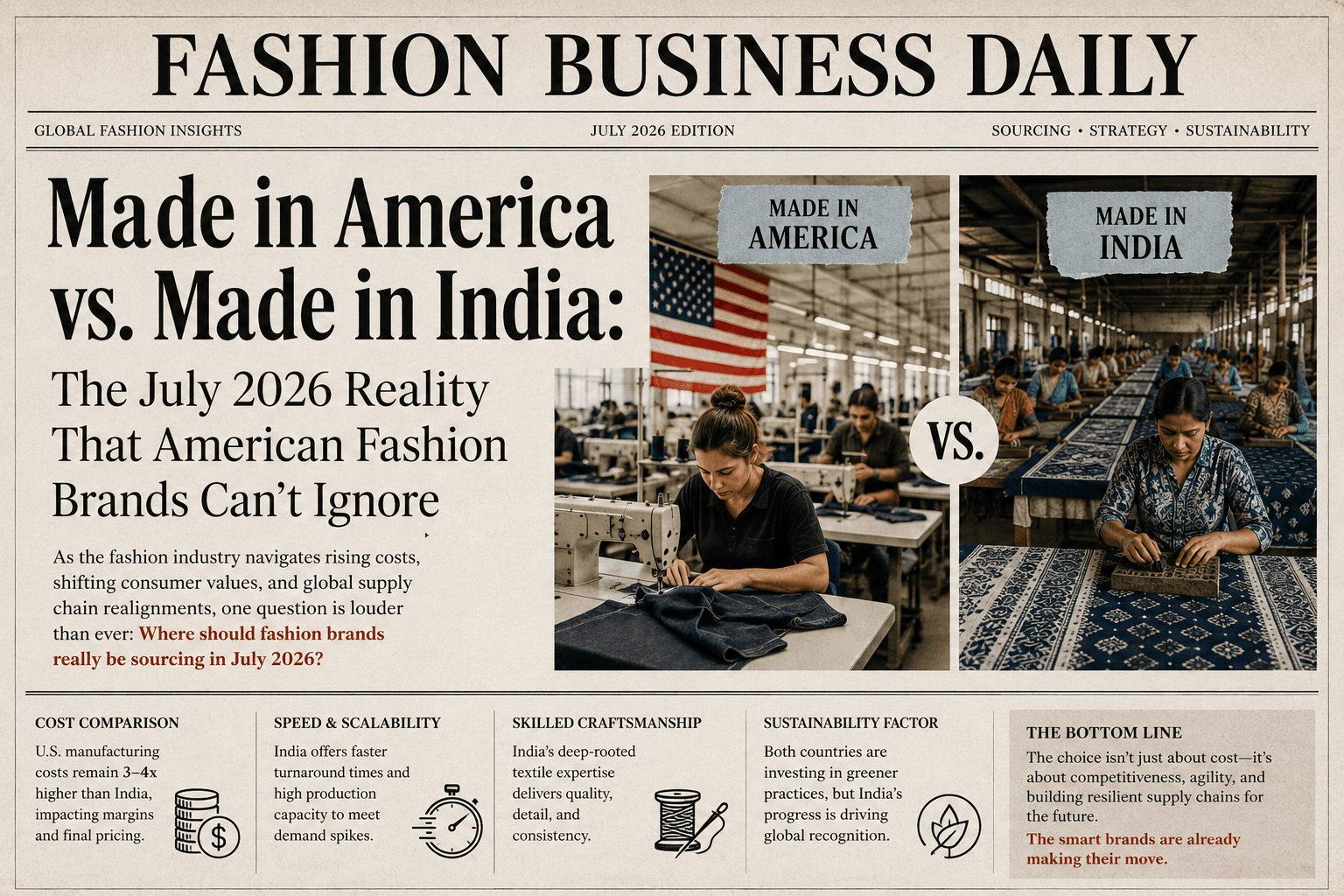
Three days ago, BrightPath Associates released a new industry analysis on the US textile manufacturing landscape for 2026. It is a serious, sober report — the kind that gets circulated in sourcing departments of mid-size American fashion brands, discussed in supply chain strategy meetings, and quietly filed alongside last quarter’s cost-of-goods analysis.
The report acknowledges that domestic US textile manufacturing is responding to the moment: investment in digital transformation, modernisation of production facilities, growing interest in reshoring driven by geopolitical risk and supply chain disruption anxiety. All of this is real and worth watching.
What the report also makes clear — not in its headline, but in its honest analysis of where the industry actually stands — is that American brands are not, in any meaningful commercial sense, reducing their dependence on Asian cotton fabric and garment sourcing. They are managing it more carefully. They are diversifying within Asia rather than away from it. And for cotton fabric specifically — the category that most directly concerns Jaipur’s manufacturing ecosystem — the direction of trade flows in 2026 points unmistakably east.
India specifically. And increasingly, to the craft textile clusters of Rajasthan.
This article is the complete picture of why that is happening in July 2026 — drawn from the latest available data on US textile manufacturing, US sourcing patterns, compliance mandates, sustainability trends, and the specific competitive advantages that make Indian cotton fabric, and Jaipur block-print cotton in particular, the answer that American brands keep arriving at.
The Domestic Revival Story — What Is Real and What Is Not
Let’s start with what American textile manufacturing actually looks like in 2026, because the political narrative and the commercial reality are not always the same thing.
US domestic textile manufacturing does exist and it is not trivial. Companies like Parkdale Mills — one of North America’s largest integrated cotton yarn and fabric manufacturers — operate sophisticated, vertically integrated production systems covering spinning, weaving, and finishing. The US textile industry employs hundreds of thousands of workers and generates significant domestic economic activity.
The Trump and Biden administrations both made domestic manufacturing revival a policy priority, and the current administration has continued this posture. Tariffs on Chinese textile and apparel imports, Buy American provisions in government procurement, and vocal political support for domestic production have all created a favourable policy environment for reshoring.
And yet, the actual pattern of where American fashion brands source their cotton fabric has not shifted dramatically toward domestic production. It has shifted dramatically away from China — but the primary beneficiary of that shift has not been American mills. It has been India.
Why? Because the math does not work for domestic cotton fabric production in most fashion and apparel applications. American textile workers earn wages that are competitive internationally for their skill level but that make the per-metre cost of domestically produced printed cotton fabric multiples of what the same fabric costs from India. The gap is not marginal — it is structural. Domestic cotton woven fabric production at American labour costs cannot compete with Jaipur block-print cambric at Indian manufacturing costs, for the same reason that domestic cotton farming cannot compete on price with Indian cotton without the support of federal subsidies.
This is not a failure of American manufacturing. It is a logical consequence of factor cost differences that no amount of policy enthusiasm eliminates.
The BrightPath report is candid about this: geopolitical risks are encouraging organisations to diversify suppliers and strengthen operational resilience through long-term planning and digital supply chain management. Diversification — not reshoring. The strategy is resilience through geographic spread, not concentration in domestic production.
For American brands sourcing cotton fabric, that diversification strategy has one clear answer in 2026: India.
The UFLPA Effect: How a Compliance Law Rewrote the Global Cotton Map
The single most consequential development in US cotton textile trade over the past three years has not been a tariff or a trade agreement. It has been a piece of compliance legislation: the Uyghur Forced Labor Prevention Act (UFLPA), signed into US law and implemented from June 2022.
The UFLPA creates a rebuttable presumption that goods produced wholly or in part in China’s Xinjiang region — which produces approximately 85% of China’s cotton — were made with forced labour and are therefore prohibited from US import. Crucially, the burden of proof falls on the importer, not on the government. If US Customs and Border Protection identifies a shipment as potentially containing Xinjiang-origin cotton, the shipment is detained until the importer can affirmatively demonstrate otherwise.
The commercial impact has been dramatic and precise. Aggressive enforcement of the UFLPA led to a 20% drop in US cotton-apparel imports from China between 2022 and 2025. That is not a modest decline. It is a structural removal of China as the dominant supplier of cotton fabric and garments to the US market — driven not by price or quality, but by compliance.
The orders that left China had to go somewhere. The primary beneficiaries were India and Vietnam — with India capturing the larger share of the higher-value, printed cotton category specifically. Indian spinners handled a 35% hike in US orders during 2024 alone, demonstrating in concrete terms how compliance mandates reshape global trade flows.
Stable-isotope and DNA testing for cotton provenance — the scientific method that allows customs authorities to verify where cotton was grown — has scaled rapidly. Laboratories processed more than 10,000 samples in 2024 for this purpose. The science now exists to trace cotton from field to finished fabric with forensic confidence. And Indian cotton, grown in Gujarat, Maharashtra, Rajasthan, and Tamil Nadu, traces cleanly to its origin. It is the exact opposite of the opaque, compliance-problematic Xinjiang supply chain that American brands are fleeing.
For American sourcing directors making supply chain decisions in 2026, this compliance reality is not background noise. It is a foundational constraint. The question is not just “which country gives me the best fabric at the best price” — it is “which country gives me a supply chain I can defend in a US customs examination?” India answers that question affirmatively. China, for cotton, increasingly cannot.
The US Market Is Still India’s Largest Textile Buyer — By a Significant Margin
Amid all the talk of diversification, FTA negotiations, and new market corridors, it is worth stating the basic commercial fact plainly.
The United States is India’s largest textile export market. The US accounts for 30% of India’s total textile exports — more than any other single country. India’s total textile and apparel exports (including handicrafts) reached approximately USD 36.55 billion in FY 2024-25, growing approximately 6% year-on-year. Of that, roughly USD 11 billion flows to American buyers.
Some of the biggest names in global fashion and retail have sourced from Indian supply chains for years. Gap, H&M, Zara, Walmart, Target, and Uniqlo have all placed more orders in India as they diversify out of China. Several American retailers have explicitly indicated that they are willing to source more from India as part of their supply chain risk-mitigation strategies — a posture that reflects both the UFLPA compliance driver and the broader geopolitical risk calculus of not concentrating supply chains in a single country.
This is not new business for India — it is scaling existing business. The supplier relationships, quality standards, documentation processes, and logistics infrastructure for US-bound shipments from India are established and functional. The growth in 2024-2025 US orders was absorbed by existing mills and manufacturers who were already operating below capacity — because the infrastructure was there before the demand arrived.
For Jaipur’s block-print fabric manufacturers, the US market has been a consistent buyer of handprinted scarves, home textiles, and printed dress material for years. What is changing in 2026 is the formalisation and scaling of these relationships — buyers who previously placed ad-hoc orders through intermediaries are establishing direct supply partnerships, requesting documentation packages, and building Jaipur into their formal sourcing maps.
What American Brands Are Actually Buying from India in 2026
The US sourcing pattern from India in 2026 is not uniform across product categories. It is concentrated in specific areas where India’s combination of craft tradition, natural fibre strength, and price competitiveness aligns with American consumer demand trends.
Printed Cotton Fabrics and Garments
The SS26 (Spring-Summer 2026) fashion trends in the US are, in their essence, a brief for Indian cotton block-print fabric. US buyers are embracing bold prints, flowing fabrics, vibrant pop-up colours, and dresses with natural fibre bases. The specific print trends driving US retail in summer 2026 — big dots (+55% growth in Europe and growing in the US), romantic florals (+20%), and geometric patterns — are all design languages that Jaipur’s block-print and screen-print manufacturers have been executing for generations.
American boutique buyers, resort wear brands, and online fashion retailers are sourcing printed cotton kurtis, co-ord sets, maxi dresses, and printed fabric yardage from Jaipur specifically because the aesthetic that US consumers are gravitating toward in 2026 cannot be replicated at the right price point anywhere else.
Organic and Sustainable Cotton
The US SS26 fashion market is being shaped by sustainability and style evolution. US buyers are focusing on sustainable sourcing in India. The demand for breathable, eco-friendly, and natural fabrics is growing sharply — linen, lyocell, hemp, and organic cotton blends are all gaining traction in American retail.
India’s position in this category is strengthening structurally. Cotton Trust Protocol membership in India grew 31% through June 2026. More than 47 spinning units have enrolled in COTTON USA’s Mill Performance Index, demonstrating a commitment to quality and traceability standards that American retail buyers require. The Kasturi Cotton initiative — India’s government-backed branding and traceability programme for Indian cotton — is creating a verifiable, documentable identity for Indian cotton that US sustainability-focused brands can stand behind publicly.
Home Textiles
Indian block-print bedsheets, cushion covers, curtains, and table linens have been a consistent American import category for years, and this continues to strengthen. The Home Textiles Sourcing (HTS) trade fair in New York City — one of the most important sourcing events for American home textile buyers — regularly features Indian suppliers prominently. Jaipur’s block-print home textile range aligns precisely with the American consumer appetite for globally sourced, artisan-made, natural fibre home goods.
Denim and Knitwear
Beyond block-print cotton, India’s broader cotton fabric manufacturing sector is capturing US orders in denim and knitwear. Indian denim manufacturers are winning US business with sustainable washes, unique fabric combinations, and organic denim fabric. US buyers are increasingly sourcing denim from India, making it one of the fastest-growing India-to-USA apparel categories. India’s leading knitwear manufacturing clusters — Tirupur in Tamil Nadu, Ludhiana in Punjab — are seeing growing demand for organic cotton knitwear from US retail buyers.
The Compliance Infrastructure That US Buyers Now Require
The 2026 US market for Indian cotton fabric is not just about price and design. It is increasingly about documentation. Retailers now budget 2% to 4% of landed cost for documentation — a real and growing cost of compliance that accelerates adoption of digital traceability.
What does US compliance documentation for Indian cotton fabric actually look like in practice?
Fibre origin certification. Post-UFLPA, US buyers require documentary proof that cotton was not sourced from Xinjiang. For Indian fabric, this means providing origin certificates traceable to the Indian state of cotton origin — Gujarat, Maharashtra, Rajasthan, Tamil Nadu, or similar. The Cotton Trust Protocol and Kasturi Cotton certification frameworks provide this documentation.
AZO-free dye certification. US retail buyers — particularly those selling through major retailers like Target, Walmart, and H&M — require AZO-free dye compliance. Third-party test certificates from SGS, Bureau Veritas, or Intertek confirming the absence of restricted AZO dyes are now standard documentation requirements for US-bound Indian fabric shipments.
OEKO-TEX Standard 100 or GOTS. Major US sustainable fashion brands and a growing number of mass-market retailers require either OEKO-TEX Standard 100 (confirming the fabric has been tested against harmful substances) or GOTS (for organic cotton claims). Indian manufacturers who hold these certifications have a material competitive advantage in the US market over those who do not.
Country of origin documentation. US customs requires accurate country of origin marking on all textile imports. For Indian fabric and garments, this means “Made in India” labelling confirmed by appropriate origin documentation. Given the UFLPA’s cotton-specific provisions, origin documentation for cotton must go deeper than the country of the final manufacturing step — it needs to trace the cotton fibre origin as well.
ISF (Importer Security Filing). US Customs and Border Protection requires all ocean freight shipments to the US to be covered by an ISF filed at least 24 hours before vessel departure from the origin port. For US buyers of Indian fabric, this is an operational requirement that their customs broker must handle on every shipment — late ISF filing triggers $5,000 per violation in penalties.
For Indian fabric manufacturers supplying the US market, having this documentation infrastructure in place is not optional. It is the price of entry. Manufacturers who cannot provide AZO-free certificates, cannot demonstrate cotton origin traceability, and cannot support their US buyers’ compliance filing are manufacturers that US buyers will eventually replace — regardless of price or quality.
The Tariff Headwind: The One Thing India Cannot Fully Fix Right Now
Honesty requires acknowledging the most significant commercial headwind facing Indian cotton fabric exports to the US in 2026: the tariff differential.
India currently has no Free Trade Agreement with the United States. Indian textile and garment exports to the US face a baseline tariff of approximately 10% — with some categories attracting additional duties. Vietnam faces 20% under current trade action tariffs. Bangladesh, similarly, faces higher tariffs than the standard.
Comparative competitor tariffs matter: Bangladesh and Vietnam textile exports to the US face tariffs broadly in the 15-20% range under current trade action schedules, while India’s standard MFN rate sits at 10% — placing India in a relatively competitive position versus its key Asian competitors. However, the absence of an FTA means India does not have the zero-duty access to the US market that it has recently gained for the UK (under CETA) and the UAE (under CEPA).
US-India FTA negotiations have been a recurring diplomatic topic for years without conclusion. In the current geopolitical environment, with both the US and India expressing interest in closer economic engagement, the prospect of an eventual FTA has not disappeared — but it is not imminent either. American brands sourcing from India are making their decisions based on the current tariff reality, and building 10% import duty into their landed cost calculations is simply the cost of accessing the Indian supply chain’s advantages.
At current quality differentials, compliance advantages, and design uniqueness — particularly for printed cotton fabric from Jaipur — the 10% tariff does not reverse the India sourcing decision for most American buyers. It is a cost of doing business, not a dealbreaker.
What PM MITRA Parks Mean for the Next Wave of US Sourcing from India
The structural improvement in India’s textile manufacturing capacity that will most significantly affect US sourcing decisions over the next three years is the PM MITRA (PM Mega Integrated Textile Region and Apparel) Parks programme.
Seven integrated textile parks are being developed across India under PM MITRA, clustering spinning, weaving, dyeing, printing, and garment manufacturing infrastructure under one roof with shared utilities, common effluent treatment, reliable power supply, and logistics connectivity. Early data from factories located within operational MITRA parks shows a 15-20% reduction in operational costs due to shared utilities and streamlined logistics.
For US buyers, PM MITRA parks address two of the most persistent concerns about Indian textile manufacturing at scale: infrastructure reliability (power, water, logistics) and environmental compliance (shared effluent treatment meeting international standards). A vertically integrated supply chain inside a PM MITRA park — from cotton ginning through to finished printed garment — is a supply chain that can be documented, certified, and defended in a US customs examination in a way that fragmented, informal production networks cannot.
The Union Budget 2026-27 allocated ₹405 crore for the PLI (Production-Linked Incentive) Scheme for Textiles specifically to boost manufacturing in man-made fibre apparel, man-made fibre fabrics, and technical textiles — areas where India needs to build capacity to complement its existing natural fibre strength. For US buyers who currently source natural fibre (cotton, linen) from India but synthetics from elsewhere, this investment creates the prospect of a single-country supply chain for a much broader product range.
The Jaipur Piece: Why Artisan Cotton Remains America’s Most Unique Indian Import
Within the broader story of US sourcing from India, Jaipur’s artisan cotton fabric cluster occupies a specific and commercially valuable position. It is not competing on price alone. It is competing on a combination of design, craft heritage, and product uniqueness that American brands cannot source from any other geography.
American buyers who source from Jaipur are not buying the cheapest cotton. They are buying the most differentiated cotton — block-printed by hand using techniques that have been practised in Sanganer and Bagru for generations, in designs that carry the aesthetic authority of India’s most storied textile tradition.
The US consumer in 2026 is specifically moving away from anonymous, factory-identical fashion and toward products that carry a story — a place of origin, a production method, a human craft behind the print. This is the Quiet Luxury impulse applied not just to price point but to provenance. A Jaipur block-print cotton dress carries a provenance story that a digitally printed polyester equivalent simply cannot claim.
For American boutique brands, sustainable fashion labels, resort wear companies, and home textile retailers who have built their brand positioning around authentic, artisan, natural-fibre products — Jaipur is not just a sourcing option. It is a strategic supply chain asset that their brand narrative depends on.
This is why, regardless of tariff levels, policy rhetoric about domestic manufacturing revival, or the temporary disruptions of individual trade policy cycles — American brands keep looking east. And specifically, keep arriving at the same city in Rajasthan.
The Numbers That Tell the Story
Let the data have the final word on where things stand in July 2026:
The global textile market is projected to grow from USD 0.79 trillion in 2026 to USD 1.02 trillion by 2031 at a 5.09% CAGR. Within that market, natural fibres — and cotton specifically — are recovering market share from synthetics as sustainability regulation and consumer preference shift the fibre mix.
India’s cotton production in the 2025-26 season is estimated at 292.15 lakh bales — making India the world’s largest cotton producer and the most abundant source of the raw material that American brands increasingly want their supply chains built around.
The US is India’s largest textile export market at 30% of total exports. American brands are the single largest buyer of Indian textile production by country.
Indian spinners absorbed a 35% increase in US orders in 2024 alone — not because they undercut competitors on price, but because they offered what US brands needed: documented, UFLPA-compliant, AZO-free, certified sustainable cotton at scale.
And in Sanganer, Jaipur — where the block-print tradition has been practised for 500 years and continues to produce some of the world’s most beautiful printed cotton — the orders from American buyers keep coming. Not because the political narrative says to buy domestic. But because the fabric, the craft, the compliance credentials, and the value proposition say something that no domestic alternative yet can: that what India makes, no one else can replace.
For American Brands Sourcing Indian Cotton in 2026
If you are an American fashion brand, wholesale buyer, or retail sourcing professional evaluating your Indian cotton fabric supply chain, the July 2026 picture is clear:
The compliance infrastructure for US-bound shipments from India is established and improvable — get your AZO-free certificates, your OEKO-TEX certification, your cotton origin traceability in order now, before your next shipment.
The design and craft advantage of Indian block-print cotton is durable and non-replicable — build it into your brand positioning explicitly rather than leaving it as an unexplained supply chain detail.
The PM MITRA infrastructure investment is creating better manufacturing conditions for Indian suppliers — reward the manufacturers who invest in compliance and infrastructure with longer-term supply relationships.
And factor the 10% tariff into your landed cost honestly — but recognise that for most US buyers of Indian cotton block-print fabric, the design uniqueness, compliance credibility, and craft authenticity of the product justify the tariff as a cost of sourcing the only product in the world that is genuinely what it claims to be.
Start a sourcing conversation with Shri Radhey Fabrics: Visit shriradheyfabrics.com or DM us on Instagram @shriradheyfabrics. WhatsApp enquiries: +91-9928386747 — we respond within 2 hours.
Also read: Why Global Fashion Brands Are Rushing to Jaipur for Fabric Sourcing in 2026 — the full picture of what’s driving global sourcing decisions toward Jaipur.
And: The Complete Guide to Importing Cotton Fabric from India — Customs, Duties, Documentation & Incoterms — everything American brands need to know about bringing Indian cotton through US customs cleanly.
External Sources & Further Reading:
- BrightPath Associates — US Textile Manufacturing Landscape 2026
- IBEF — Textile Industry in India 2026
- Mordor Intelligence — Global Textile Market Report 2026
- US CBP — UFLPA Enforcement Guidance
- Cotton Trust Protocol
- COTTON USA — Mill Performance Index
- OEKO-TEX Standard 100
- Ministry of Textiles India — PM MITRA Parks
- AEPC — Apparel Export Promotion Council
Shri Radhey Fabrics is a fabric manufacturer and wholesale supplier based in Sanganer, Jaipur — the heart of India’s block-print textile tradition. We supply pure cotton, rayon, and custom printed fabrics to fashion brands across India, the UK, UAE, USA, Germany, Australia, Japan, and beyond. Complete export documentation for US compliance requirements provided. Low MOQ for new brands. Visit shriradheyfabrics.com or DM us on Instagram @shriradheyfabrics for fabric samples and bulk enquiries.