Something has shifted in global fashion sourcing — and if you pay attention to where the buying teams are flying in 2026, Jaipur keeps coming up.
Not just Indian boutiques. Not just the Instagram-era boho labels that discovered block print five years ago. We’re talking about established European fashion brands, American home textile retailers, Japanese lifestyle labels, and sourcing heads from UAE-based fashion houses who are not making a first visit to Jaipur — they are making a third, a fourth, and a fifth. They are coming back. And they are coming back with bigger orders.
The question worth asking is: why now? Jaipur’s textile tradition is five centuries old. The block printing in Sanganer and Bagru has been here for generations. The fabric manufacturing clusters in Sitapura have existed for decades. So what is specifically driving global fashion brands to rush to Jaipur for fabric sourcing in 2026 — and why is this moment different from previous cycles of international attention?
The answer is not one thing. It is seven things happening simultaneously. And understanding all seven is what separates a brand that builds a genuine Jaipur sourcing relationship from one that makes a single order and disappears.
1. The Data Doesn’t Lie: Jaipur Is Delivering Results
Let’s start with the numbers, because they tell the story more clearly than any trend report.
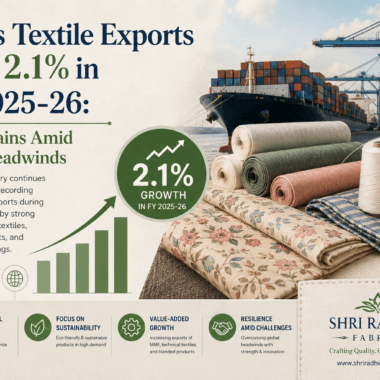
India’s total textile exports grew 2.1% in FY 2025-26, reaching ₹3,16,334.9 crore — the Ministry of Textiles confirmed this in April 2026. Within that number, the most important detail for Jaipur’s sourcing story is buried in the category breakdown.
Handicrafts — the export category that most directly represents Jaipur’s block-print fabrics, printed scarves, hand-embroidered textiles, and artisan home products — grew at 6.1%, the fastest growth rate of any major textile export category in India. Not garments. Not man-made fibre. Handicrafts. The category that Jaipur dominates.
The Week described it directly: “From Jaipur’s block-printed quilts to Lucknow’s chikankari, India’s artisanal products found eager buyers across the world.” That is not editorial embellishment — it is an accurate read of where global demand is pulling India’s textile export basket.
The market geography tells the same story. Export growth was registered across more than 120 countries between April 2025 and February 2026. The fastest-growing individual markets included UAE at 22.3%, Germany at 9.9%, Japan at 20.6%, UK at 7.8%, and Spain at 15.5%. These are precisely the markets with the strongest consumer appetite for sustainable, artisan, craft-heritage textiles — which is exactly what Jaipur manufactures.
Handprinted textiles and scarves alone — a product category where Jaipur is India’s primary supplier — exported USD 56.81 million in a single quarter (April to June 2025, per EPCH provisional data). Annualised, that is a category generating over USD 225 million yearly from a single product type. The demand is real, measurable, and growing.
2. Jaipur Is the Only Place in the World That Does This
This sounds like marketing language. It is not. It is a supply chain fact that global buyers are increasingly recognising and paying for.
Jaipur’s block-print textile tradition — centred in Sanganer and Bagru — cannot be replicated anywhere else at scale. Not in China, which has the manufacturing capacity but not the craft heritage. Not in Bangladesh, which has the garment labour but not the printing tradition. Not in Vietnam, which is efficient for sportswear and technical garments but, as one sourcing analysis noted, “lacks the sheer textile diversity found in India” and “is heavily dependent on imported raw materials.”
India’s craftsmanship is a major competitive advantage because while Vietnam is great at automated assembly, India offers the human touch. Heritage techniques such as hand-block printing — with the specific traditions of Sanganer’s fine Mughal-inspired florals and Bagru’s earthy dabu resist prints — represent a body of knowledge embedded in communities, passed between generations, and impossible to transfer to a factory in a different country.
Jaipur is specifically described as “the global centre for hand-block printing and boho-inspired resort wear” — not by Indian textile boosters but by international sourcing consultants advising global brands on where to go.
The Jaipur textile market is estimated at over ₹10 billion annually, with approximately ₹3,000 crore coming from exports. Within India’s textile ecosystem, Tiruppur handles knitwear, Surat handles synthetics, and Jaipur handles block print, artisan textiles, and craft-based fashion. These are not interchangeable positions. A buyer who needs authentic block-print cotton does not have the option of going somewhere else. Jaipur is it.
Related reading: What is Cambric Cotton 60×60 Fabric? The Complete Guide for Fabric Buyers — the base fabric behind Jaipur’s most prized block-print textiles, explained in full.
3. Five New Trade Agreements Changed the Economics Overnight
The single biggest structural shift driving global brands toward Jaipur sourcing in 2026 is a wave of trade agreements that fundamentally changed the economics of buying Indian fabric and garments.
In an extraordinary twelve-month period:
India-EFTA Trade and Economic Partnership Agreement (TEPA) entered into force on October 1, 2025 — opening preferential trade with Switzerland, Norway, Iceland, and Liechtenstein.
India-UK Comprehensive Economic and Trade Agreement (CETA) was signed in July 2025 and came into force in July 2026 — giving 99% of Indian exports preferential or zero-duty access to the UK market. For Jaipur’s block-print fabric exporters, this is the most commercially significant trade development in years. UK buyers — who have historically been consistent purchasers of Jaipur’s printed cotton — can now source at meaningfully improved economics.
India-Oman CEPA entered into force on June 1, 2026, strengthening India’s position across Gulf markets at a moment when UAE textile imports from India are already growing at 22.3%.
India-New Zealand FTA was announced on December 22, 2025.
India-EU Free Trade Agreement was concluded on January 27, 2026, and is expected to be formally signed by December 2026 with implementation in early 2027. For European buyers — the largest addressable market for sustainable and artisan textiles globally — the forthcoming elimination of tariff barriers on Indian fabric is accelerating sourcing decisions now. Brands are establishing Jaipur supplier relationships today so they are ready to scale volumes the moment FTA implementation cuts their import costs.
The government simultaneously extended the RoSCTL and RoDTEP schemes beyond March 31, 2026, maintaining cost competitiveness for Indian exporters while these FTAs come fully into force.
This is the trade policy environment that global buyers are walking into when they visit Jaipur in 2026. Five new or newly implemented trade agreements in twelve months. The commercial case for sourcing from Jaipur has never been stronger on paper — and what they find when they arrive confirms it in practice.
Also read: India’s Textile Exports Grow 2.1% in FY 2025-26: Steady Gains Amid Global Headwinds — a detailed breakdown of where India’s textile growth is coming from and what it means for international buyers.
4. The Sustainability Mandate Is Driving Brands to Exactly What Jaipur Offers
The European fashion industry in 2026 is operating under the most demanding sustainability regulatory environment in its history.
The EU PFAS (Per and Polyfluoroalkyl Substances) restrictions on textiles came into force in France from January 2026 and Denmark from July 2026. These ban the use of synthetic chemical treatments — commonly found in water-resistant and performance synthetic fabrics — in textiles sold in those markets. The Green Claims Directive, effective September 27, 2026, prohibits vague environmental claims like “eco-friendly” and “sustainable” without substantiated evidence. The EU Digital Product Passport for textiles — requiring QR-accessible data on every garment’s materials, origin, dye processes, and end-of-life pathway — arrives around 2027-28.
For European sourcing directors, these regulations are not future concerns. They are present procurement constraints. Every textile supplier they work with now needs to demonstrate compliance on paper, not just promise it verbally.
This is where Jaipur’s artisan textile tradition becomes an unexpected strategic asset for international brands. Jaipur’s block-printing practices — particularly the natural-dye tradition of Bagru’s Chhipa community using indigo, madder root, and iron mordants — are inherently free of the synthetic chemicals that European regulators are eliminating. The EU’s sustainability framework is, in many ways, describing exactly what Bagru’s dabu print tradition has been doing for 450 years.
More broadly, India’s sustainable textile manufacturing is gaining real institutional support. The government’s five-year Cotton Mission focuses on climate-smart, pest-resistant cotton varieties. The Kasturi Cotton initiative creates a branding and traceability framework for Indian cotton that allows buyers to trace the material from farm to finished fabric. The Scheme for Integrated Textile Parks (SITP) and Production Linked Incentive (PLI) schemes are improving production infrastructure and compliance capabilities across Rajasthan’s textile clusters.
For a brand needing to build a supply chain that can withstand European sustainability scrutiny in 2026 and beyond, Jaipur’s combination of natural fibre, craft tradition, and improving certification infrastructure is a compelling answer.
Dive deeper: Bagru vs. Sanganer Block Printing: What’s the Difference and Why It Matters to Global Buyers — understanding the two traditions that make Jaipur’s sustainability story so compelling.
5. Jaipur Has an Ecosystem That No Single Factory Can Offer
One of the things that surprises international buyers when they first visit Jaipur’s textile clusters is the density of the ecosystem. Within a thirty-kilometre radius, you can find:
Sanganer — home to hundreds of block-printing workshops specialising in fine floral block print on white-ground cotton, plus screen-printing units and digital-printing facilities for larger volumes.
Bagru — the Chhipa community’s natural-dye dabu resist printing village, producing the earthy, artisan-positioned textiles increasingly sought by European sustainable fashion brands.
Sitapura Industrial Area — Jaipur’s garment manufacturing hub, where established export houses like Ma’am Arts run operations of 1,000 sewing machines producing over 2.5 lakh garments per month for buyers across 27 countries including Australia, France, Europe, and Japan.
Wholesale fabric markets — Bapu Bazaar, Johari Bazaar, and the Sanganer fabric lane, where printed fabric yardage is available at wholesale prices across hundreds of suppliers.
The Jaipur textile ecosystem blends centuries-old craftsmanship with new industrial skills — giving it the ability to serve a boutique brand ordering 200 block-print scarves and a global retailer ordering 50,000 printed bedsheets, sometimes from adjacent buildings in the same cluster.
This co-location of craft skill and industrial scale in one city is not something that can be easily assembled elsewhere. It developed organically over centuries, and it gives Jaipur a sourcing versatility that makes it genuinely useful to a wide range of international buyers — from the niche sustainable fashion label to the mass-market home textile retailer.
6. The Jaipur Aesthetic Matches What Consumers Are Buying
Fashion trends are, in the end, what determines where sourcing decisions go — because brands source what their customers will buy.
The consumer movements defining international fashion in 2026 point directly at what Jaipur makes.
The Quiet Luxury movement — the shift toward fewer, better, longer-lasting garments in natural fibres — has elevated heavyweight, high-quality cotton over synthetic fast fashion. Jaipur’s cambric 60×60 block-print fabric, at 80-95 GSM of fine-count combed cotton with reactive dyes, is precisely the quality of natural fibre this movement is looking for.
Explore: Why Cambric Cotton 60×60 Is the Best Fabric for Indian Summers — and why international buyers in warm-weather markets keep coming back for it.
The Resort Wear and Boho Fashion market — where Jaipur block print has always been the dominant aesthetic — continues to grow. Global platforms from Net-a-Porter to ASOS have established Indian block-print resort wear sections that drive consistent consumer demand back through the supply chain to Jaipur.
The Artisan Story market — a growing segment of buyers in the UK, Germany, Japan, and the US who are willing to pay a premium not just for the product but for the story behind it. A Chhipa family in Bagru pressing natural indigo dabu blocks onto unbleached cotton is a story that resonates with these buyers in a way that factory production in any other country cannot replicate.
Gen Z’s ethnic wear embrace — particularly in India’s domestic market but increasingly in diaspora communities globally. Jaipur’s brands are attracting Gen Z who value comfort and modern details in ethnic wear, preferring subtle, expressive styles. The block-print kurta and co-ord set have become genuine youth fashion choices, not just occasion wear — and this domestic demand growth is reinforcing the infrastructure and design evolution that international buyers benefit from.
7. The Sourcing Infrastructure Has Matured
The final piece of the 2026 puzzle is not about what Jaipur makes — it is about how much easier it has become to source from Jaipur professionally.
Five years ago, international buyers sourcing from Jaipur faced real logistical challenges. Payment processes, documentation, compliance certifications, and supply chain transparency were inconsistently available. Small manufacturers struggled with export documentation. Larger manufacturers were not always transparent about subcontracting and production conditions.
In 2026, much of this has been addressed — not completely, but sufficiently that international sourcing relationships are more manageable than they were. Several changes have driven this:
Government support infrastructure — the Rajasthan Textile & Apparel Policy 2025, the Textile Export Facilitation Centre (TEFC), the SITP scheme, and the PLI scheme have collectively improved the institutional support available to Jaipur’s textile manufacturers. The Ministry of Textiles has been organising export facilitation workshops specifically in Jaipur — most recently in June 2026, where nearly 100 participants gathered to understand how to maximise FTA opportunities and export documentation.
Certification accessibility — OEKO-TEX Standard 100 certification, GOTS certification for organic cotton, and AZO-free dye certification are increasingly available to Jaipur’s smaller manufacturers who previously could not afford the testing and compliance process individually. Common facility centres within industrial textile parks share the cost of certification infrastructure.
Digital sourcing tools — platforms that allow international buyers to discover, evaluate, and communicate with Jaipur manufacturers digitally before committing to travel have reduced the friction of initial supplier discovery. WhatsApp-based B2B communication — deeply embedded in Jaipur’s manufacturing community — gives international buyers real-time responsiveness that older supply chains in other countries often lack.
Digital printing technology — the addition of digital fabric printing to Jaipur’s traditional block and screen printing capabilities has expanded the range of products available, the speed of sampling, and the complexity of design that can be achieved. Digital printing allows buyers to test designs in small quantities before committing to block or screen production — dramatically reducing the risk of the initial sourcing relationship.
See how it works: How to Start a Clothing Brand Using Indian Cotton Printed Fabrics — a manufacturer’s practical guide to sourcing from Jaipur for international brands at any scale.
What Global Buyers Actually Find When They Arrive in Jaipur
For buyers making their first sourcing visit to Jaipur in 2026, the experience is typically one of productive surprise — more capability, more variety, and more professionalism than many expected.
They find Sanganer’s block-printing clusters producing at a range of quality levels — from mass-market pigment-printed fabric at competitive prices to premium cambric 60×60 with reactive-dye GI-certified block prints that stand up to the most demanding European buyer requirements.
They find Bagru’s natural-dye community producing fabrics that are genuinely unlike anything available from any other global sourcing destination — earthy dabu prints in natural indigo and madder on unbleached cotton, made by Chhipa artisans whose families have practised this craft for generations.
They find the Sitapura garment manufacturing cluster housing export-scale operations capable of turning printed fabric into finished garments at volumes that can service large retail orders — with established compliance documentation and international shipping experience.
They find wholesale fabric markets where printed fabric yardage is available off-the-shelf or as custom designs in virtually any width, GSM, print technique, or colour palette — at pricing that compares favourably to any other sourcing destination for comparable quality.
And they find manufacturers — large and small — who are increasingly digital, increasingly certification-aware, and increasingly capable of the documentation and communication that international B2B sourcing requires.
The Numbers That Tell You Where This Is Going
The trajectory of Jaipur’s global sourcing relevance in 2026 is clearly upward, and the data suggests the growth will accelerate rather than moderate in the near term.
India’s textile market is expected to grow from USD 248.70 billion in 2025 to USD 656 billion by 2034 at 11.38% CAGR. India has set a national target of USD 100 billion in textile exports by 2030 — more than three times the current export level of approximately USD 32.63 billion. The India-EU FTA implementation in 2027, combined with the India-UK CETA already in force, creates a preferential market access corridor to the world’s two largest premium textile markets that has never previously existed for Indian exporters.
Within this national growth story, Jaipur’s position is specifically advantaged. The segments growing fastest — handicrafts, printed cotton, artisan textiles — are precisely the segments Jaipur dominates. The compliance requirements tightening fastest in export markets — sustainability certification, natural dye verification, fibre traceability — are precisely the areas where Jaipur’s craft traditions already have genuine answers.
Jaipur is not just benefiting from India’s textile growth. It is leading the most valuable part of it.
What This Means If You Are a Fashion Brand in 2026
If you are a fashion brand, wholesale buyer, or retail sourcing head deciding where to place your next fabric or garment order, the case for Jaipur in 2026 can be summarised simply.
You cannot get authentic block-print cotton anywhere else. You cannot find the combination of craft heritage, natural dye tradition, scale capability, and improving compliance infrastructure in any other single city. The trade agreements now make importing from India cheaper than it has ever been for UK and European buyers. The sustainability regulations now make Jaipur’s natural-fibre, artisan-process production more commercially valuable than it has ever been to compliance-sensitive buyers.
And on the ground, in Sanganer’s printing workshops and Sitapura’s garment factories, the supply chain is more capable, more professional, and more internationally oriented than at any previous point in Jaipur’s textile history.
The brands rushing to Jaipur in 2026 are not chasing a trend. They are locking in supply chain relationships for a product category — authentic, artisan, sustainable Indian cotton textiles — that will only become more valuable as global consumer and regulatory pressure toward these exact qualities intensifies.
Sourcing from Jaipur: Where to Start
If you are ready to explore sourcing from Jaipur, here is a practical starting framework.
Decide what you need first: fabric yardage, finished garments, or both. Jaipur supplies all three, but the manufacturer relationships differ. For fabric wholesale, Sanganer’s printing clusters are your starting point. For finished garments, Sitapura’s export-oriented manufacturing units handle the full product.
Be specific about your specification: fabric type, GSM, print technique, dye type, and certification requirements. Vague briefs produce vague quotes. Specific briefs produce accurate pricing and faster sampling.
Request samples before committing to bulk. Any serious Jaipur manufacturer will sample before production. Sampling reveals print quality, GSM accuracy, wash fastness, and fibre composition — the four things you cannot verify from a catalogue photograph.
Ask about certifications before you ask about price. For export to the UK, EU, or UAE, OEKO-TEX Standard 100 is the baseline. For organic cotton claims, GOTS. For AZO-free compliance — mandatory for EU textile imports — ask for a test certificate.
At Shri Radhey Fabrics in Sanganer, we supply pure cotton, rayon, and custom printed fabrics to fashion brands across the UK, UAE, USA, Germany, Australia, and beyond. We work with new brands from their first sample order and established buyers on long-term supply relationships.
Start here: Visit shriradheyfabrics.com or DM us on Instagram @shriradheyfabrics to request samples, discuss your specifications, and get pricing.
WhatsApp us directly: +91-9928386747 — our team responds within 2 hours.
The Bottom Line
The global fashion brands rushing to Jaipur in 2026 are not making a sentimental choice. They are making a commercially rational one, driven by trade agreement economics, sustainability compliance pressure, consumer demand for authentic craft textiles, and supply chain capability that has matured to meet international standards.
Jaipur is not a trend. It is an ecosystem — one that has been building its capabilities for five centuries and has finally aligned with what the global fashion market needs in 2026. The city’s block-print heritage, its natural-dye traditions, its garment manufacturing scale, and its improving export infrastructure have converged at exactly the right moment.
The brands that establish sourcing relationships here now — on the right side of the India-UK and India-EU trade agreements, at the front edge of the sustainability compliance curve — will look back at 2026 as the year they got in early.
External Sources & Further Reading:
- Ministry of Textiles, India — FY 2025-26 Textile Export Data (PIB)
- Apparel Export Promotion Council (AEPC) — Export Statistics
- EPCH — Handicrafts Export Data
- Rajasthan Textile & Apparel Policy 2025
- OEKO-TEX Standard 100 Certification
- Global Organic Textile Standard (GOTS)
Shri Radhey Fabrics is a fabric manufacturer and wholesale supplier based in Sanganer, Jaipur — the heart of India’s block-print textile tradition. We supply pure cotton, rayon, and custom printed fabrics to fashion brands across India, the UK, UAE, USA, Germany, Australia, and beyond. Low MOQ for new brands. Complete technical documentation on all fabric supplied. Visit shriradheyfabrics.com or DM us on Instagram @shriradheyfabrics for fabric samples and bulk enquiries.