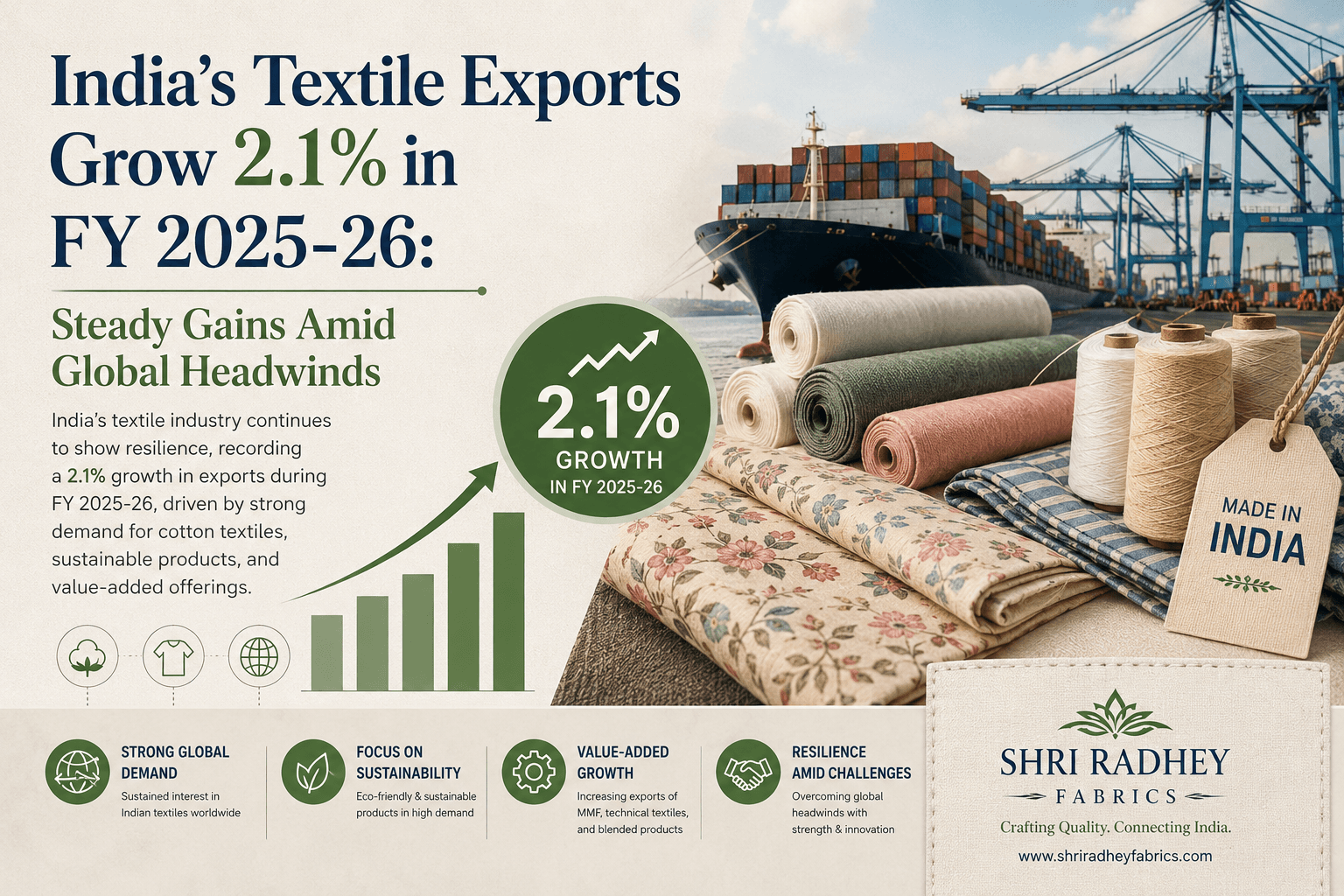
India’s textile and apparel sector closed FY 2025-26 on a note of quiet resilience. According to data released by the Ministry of Textiles, the country’s textile exports, including handicrafts, grew 2.1 per cent over the previous fiscal year, rising from ₹3,09,859.3 crore in FY 2024-25 to ₹3,16,334.9 crore in FY 2025-26. It isn’t a blockbuster number, but in a year marked by tariff uncertainty, freight disruptions, and cautious global buying, holding onto positive growth is itself a meaningful signal — one that points to the underlying strength of India’s textile value chain and the impact of sustained policy support.
The headline numbers
The Ministry’s data shows growth spread across the sector’s major segments, though unevenly:
Ready-Made Garments (RMG) remained, by some distance, the largest contributor to India’s textile export basket. The segment grew 2.9 per cent, rising from ₹1,35,427.6 crore to ₹1,39,349.6 crore. Given that RMG alone accounts for nearly 44 per cent of total textile exports, its performance effectively set the pace for the sector as a whole.
Cotton yarn, fabrics, made-ups and handloom products — India’s traditional textile strength — posted a more modest gain of 0.4 per cent, edging up from ₹1,02,002.8 crore to ₹1,02,399.7 crore. The near-flat performance here reflects ongoing pressure on cotton-based exports from price competition and shifting global sourcing patterns.
Man-made yarn, fabrics and made-ups did better, growing 3.6 per cent from ₹41,196.0 crore to ₹42,687.8 crore, continuing a multi-year trend of synthetics and blended fabrics gaining share as global fashion brands diversify away from pure cotton.
The standout performer, proportionally, was handicrafts excluding handmade carpets, which grew 6.1 per cent — from ₹14,945.5 crore to ₹15,855.1 crore — making it the fastest-growing major category in the entire export basket. This points to rising overseas appetite for India’s artisanal and value-added craft products, a segment the government has been actively trying to promote through export councils and design interventions.
Markets doing the heavy lifting
Perhaps the more interesting story is not the aggregate number but where the growth is actually coming from. The Ministry reported export growth across more than 120 destinations between April 2025 and February 2026, compared to the same period a year earlier — a sign of genuine geographical diversification rather than dependence on one or two large buyers.
Some individual market numbers stand out sharply. The UAE grew 22.3 per cent, the UK rose 7.8 per cent, Germany climbed 9.9 per cent, and Spain jumped 15.5 per cent. Further east, Japan posted 20.6 per cent growth. But the most dramatic gains came from a set of emerging African markets: Egypt grew 38.3 per cent, Nigeria 21.4 per cent, Senegal 54.4 per cent, and Sudan an extraordinary 205.6 per cent. While these African markets are still small in absolute terms compared to the US or EU, the scale of growth suggests Indian exporters are successfully opening up new demand corridors outside the traditional Western markets that have dominated India’s textile trade for decades.
What’s driving the policy tailwind
A large part of this resilience is attributable to deliberate, sustained policy support rather than market forces alone.
On the export-incentive side, the government extended two key schemes — the Rebate of State and Central Taxes and Levies (RoSCTL) Scheme and the Remission of Duties and Taxes on Exported Products (RoDTEP) Scheme — beyond their earlier March 31, 2026 sunset date. Both schemes work by refunding embedded taxes and duties that exporters would otherwise absorb, effectively keeping Indian textile products price-competitive in markets where margins are thin and competition from Bangladesh and Vietnam remains intense.
On the trade-agreement front, FY 2025-26 was an unusually active year for India’s FTA agenda, with direct implications for textiles. The India-EFTA Trade and Economic Partnership Agreement (TEPA) entered into force on October 1, 2025. The India-UK Comprehensive Economic and Trade Agreement (CETA) was signed in July 2025. The India-Oman Comprehensive Economic Partnership Agreement (CEPA) followed in December 2025, alongside the announcement of an India-New Zealand FTA on December 22, 2025. Most significantly, the India-EU Free Trade Agreement was concluded on January 27, 2026 — a deal years in the making, with major consequences for India’s apparel exports to one of its largest textile markets.
Collectively, these agreements are designed to improve preferential market access, reduce tariff disadvantages relative to competitors, support deeper supply-chain integration, and open new opportunities for India’s textile exporters — benefits that, in several cases, will only fully materialize in the coming fiscal years as tariff phase-downs take effect.
Reading between the numbers
A 2.1 per cent growth rate, taken in isolation, might look unremarkable next to the double-digit growth ambitions India’s textile industry has historically set for itself. But context matters. The fiscal year played out against a backdrop of US tariff actions that posed a real setback for segments of Indian textile exports, alongside global apparel demand that remained cautious through much of 2025 as Western retailers worked through excess inventory. Against that backdrop, positive growth — and especially the breadth of that growth across product categories and destination markets — suggests the sector absorbed the shocks reasonably well rather than ceding ground.
Industry voices reflect this mixed-but-hopeful read. Garment manufacturers in hubs like Tirupur point to improved compliance and quality standards as having helped sustain RMG growth, even as they flag intensifying competition from Bangladesh and Vietnam and the need for greater investment in automation and skill development to stay ahead. Others see the explosive growth in markets like Sudan and Senegal as early evidence that new trade corridors, rather than incremental gains in saturated markets, may be where the next leg of export growth comes from.
What to watch next
A few threads from FY 2025-26 are worth tracking into the new fiscal year. First, whether the EU FTA and UK CETA translate into measurable export gains once tariff reductions phase in, given that Europe represents one of India’s largest addressable textile markets. Second, whether the African market momentum — particularly the outsized growth in Egypt, Nigeria, Senegal, and Sudan — proves durable or was driven by one-off factors. And third, whether cotton-based textiles, which grew just 0.4 per cent this year, can find a way to reaccelerate, given that this remains India’s most traditional and politically significant textile segment, tied closely to the livelihoods of millions of farmers and handloom workers.
For now, the Ministry of Textiles’ framing of FY 2025-26 as a year of “resilience” rather than dramatic expansion seems fair. The sector held its ground, diversified its markets, and banked a set of trade agreements whose real payoff is still to come. Whether 2.1 per cent growth becomes the floor for a stronger FY 2026-27, or remains a ceiling in an increasingly competitive global textile trade, will depend on how quickly India converts policy groundwork into export momentum.
Figures cited are based on data released by India’s Ministry of Textiles, as reported in April 2026.