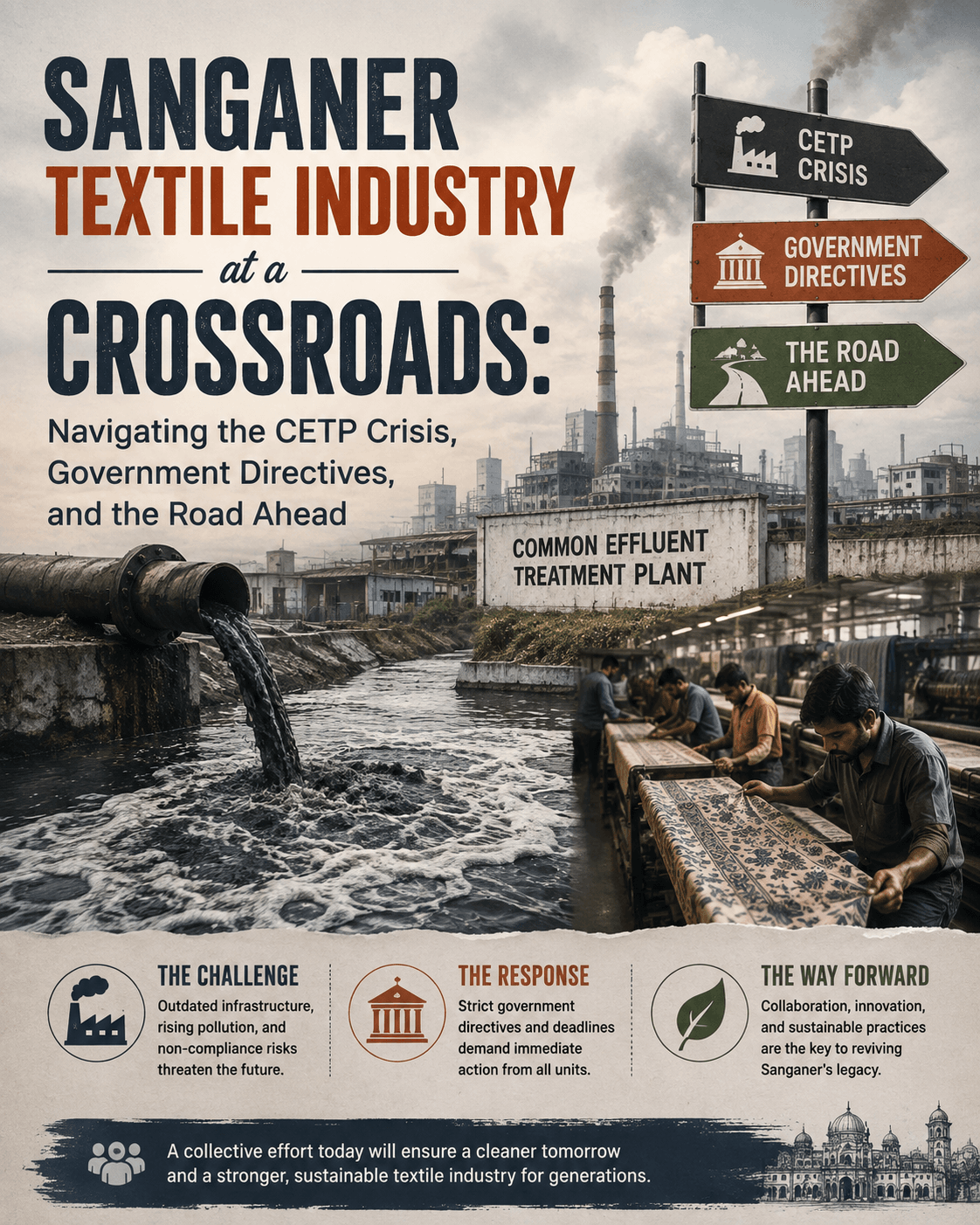
Sanganer, the historic textile hub on the southern edge of Jaipur, has long been synonymous with the artistry of hand-block printing, vibrant dyes, and the distinctive Sanganeri and Bagru prints that have dressed generations and reached markets worldwide. For decades, thousands of dyeing, printing, and processing units here have kept the craft alive, employing lakhs of workers and sustaining a unique cultural-economic ecosystem. Yet in recent years, and particularly through 2025–2026, this cluster has faced one of its most serious tests: a combination of environmental compliance pressures, court orders linked to pollution control infrastructure, supply-chain disruptions, and shifting global trade dynamics.
The Heart of the Crisis: Pollution, CETP, and Court Orders
The core issue revolves around industrial wastewater and the long-delayed full operationalisation of a Common Effluent Treatment Plant (CETP). Sanganer’s textile processing generates large volumes of chemical-laden effluent that historically found its way into local water bodies, including the Dravyavati River. To address this, a 12.3 million litres per day (MLD) CETP project was awarded years ago to Advent Envirocare Technology Pvt Ltd, with contributions expected from central and state governments as well as the industry through a special purpose vehicle.
Disputes over payments and liabilities escalated. In February 2025, a Jaipur commercial court issued sweeping directions in the execution of an arbitral award (linked to unpaid dues reported around ₹33 crore in key proceedings). The order raised the spectre of attachment, sealing, and even auction of properties belonging to hundreds of textile units (around 848 in some reports) if payments were not cleared within a stipulated period. It also sought to involve the state government and association members more broadly.
This created widespread anxiety among small and medium units that form the backbone of Sanganer’s unorganised and semi-organised sector. Many operators argued that the financial burden was being unfairly shifted onto them when infrastructure gaps and funding shortfalls were larger systemic issues. Parallel concerns about untreated effluent and pollution control board actions added to the pressure, with reports of some units facing sealing or operational restrictions.
Relief came in March 2026 when the Rajasthan High Court set aside the commercial court’s sweeping recovery and attachment directions. The High Court held that an execution court cannot go beyond the original award to create new liabilities or lift the corporate veil in the manner done, and remanded the matter for fresh consideration limited strictly to the scope of execution after hearing all parties.
Current Scenario (as of mid-2026)
Progress on the ground has accelerated under the state government’s “mission-mode” push. Of the approximately 892 member textile units in the Sanganer cluster, 758 have already been connected to the CETP network. The remaining units are expected to be linked once a key pumping station at Brahmanon Ki Guwar and associated pipelines are completed—targeted for August 2026. The project is being executed by Sanganer Enviro Project Development (SEPD), an industry SPV, in coordination with the Rajasthan State Pollution Control Board (RSPCB). Construction had faced delays due to land and tribunal issues but resumed after Jaipur Development Authority permissions in June 2026.
Chief Minister Bhajan Lal Sharma has repeatedly reviewed the matter in Raj Unnati meetings, directing phased and time-bound connectivity. Senior officials from the Environment and Forest departments have also inspected progress. At the same time, authorities continue monitoring for illegal discharges, with the Chief Secretary reviewing pollution concerns related to the Dravyavati River and directing joint surveys and action against defaulters.
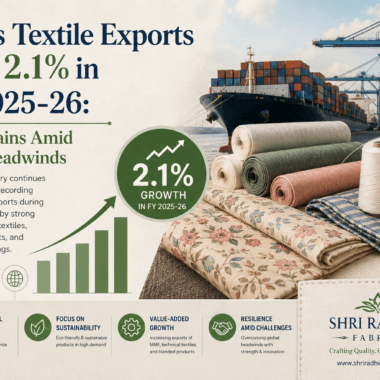
The industry has faced additional headwinds. In early 2026, LPG shortages disrupted dyeing and printing operations, with many units reporting sharply reduced production and temporary shutdown risks affecting workers. Export pressures from higher U.S. tariffs have also impacted orders for traditional Sanganeri printed fabrics, prompting some traders to pivot more strongly toward domestic markets.
Despite these challenges, the cluster retains its strengths: deep artisan skills, established buyer networks, and the enduring global appeal of authentic hand-block and traditional prints (protected under GI tags for Sanganeri and Bagru styles).
Future Projections: Compliance as Opportunity
Looking ahead, full or near-full CETP connectivity by late 2026 should reduce the immediate legal and operational overhang for most member units. However, environmental scrutiny is only expected to intensify. Sustainability standards, traceability requirements from international buyers, and domestic regulations will favour units that invest in proper effluent management, cleaner processes, and documentation.
Rajasthan’s Textile and Apparel Policy 2025 offers a constructive counterbalance. For the first time incorporating garment manufacturing more comprehensively, the policy provides a suite of incentives—capital and investment subsidies, turnover-linked benefits, employment boosters, electricity duty exemptions, green solution reimbursements (up to 50% of environmental project costs subject to ceilings), interest subvention, and support for private industrial parks. A dedicated textile cell has also been set up to drive implementation and address bottlenecks. These measures aim to attract significant investment and position the state as a stronger apparel and textile destination.
In this environment, resilient players are likely to consolidate. Traditional block-printing and dyeing units that adapt—by connecting to CETP, exploring cleaner dyes, improving quality consistency, and leveraging digital marketing or direct-to-boutique channels—can differentiate themselves from purely mechanised or screen-printed competitors. Demand for authentic, story-driven ethnic textiles remains robust in domestic ethnic wear, boutique, and export niches that value craftsmanship over pure volume.
Challenges will persist: rising compliance costs for smaller units, competition from digital printing that mimics traditional aesthetics, and global trade volatility. Yet the combination of infrastructure completion, policy support, and the irreplaceable cultural capital of Sanganer positions the cluster for a more sustainable next phase rather than terminal decline.
Standing with Quality and Continuity: The Role of Local Brands
In times of flux, established local manufacturers and wholesalers who prioritise consistency, authentic processes, and reliable supply become even more valuable partners for buyers, boutiques, and retailers. Brands rooted in Sanganer—such as Shri Radhey Fabrics—illustrate this continuity. Operating from Mahaveer Nagar in Sanganer, the firm specialises in bulk and wholesale supply of printed fabrics (including Sanganeri and Bagru styles), cotton, rayon, modal, and ready ethnic wear such as kurtis and dresses. With in-house capabilities for custom printing, designing, and stitching, and a focus on timely dispatch and quality, such enterprises help keep the ecosystem functional while the larger regulatory and infrastructure transitions play out.
Supporting compliant, quality-focused local producers not only sustains livelihoods but also preserves the distinct identity of Sanganeri textiles that mass-produced alternatives cannot fully replicate.
Conclusion
The Sanganer textile industry is not facing an existential end, but a forced evolution. Government orders and court interventions around pollution control have created real short-term pain and uncertainty. Yet the same pressure is accelerating long-overdue infrastructure (CETP connectivity) and aligning the cluster with the sustainability expectations of the future. With High Court relief already providing breathing room, the near-completion of the pumping station network, and supportive state policy frameworks, the path forward exists for those ready to adapt.
For buyers, designers, and brands seeking genuine Sanganeri and Bagru prints or reliable wholesale ethnic fabrics, the message is clear: the craft and the industry endure. Partnering with rooted local players who understand both tradition and compliance remains one of the surest ways to access authentic quality amid change.
The story of Sanganer continues—not despite the current challenges, but through them.