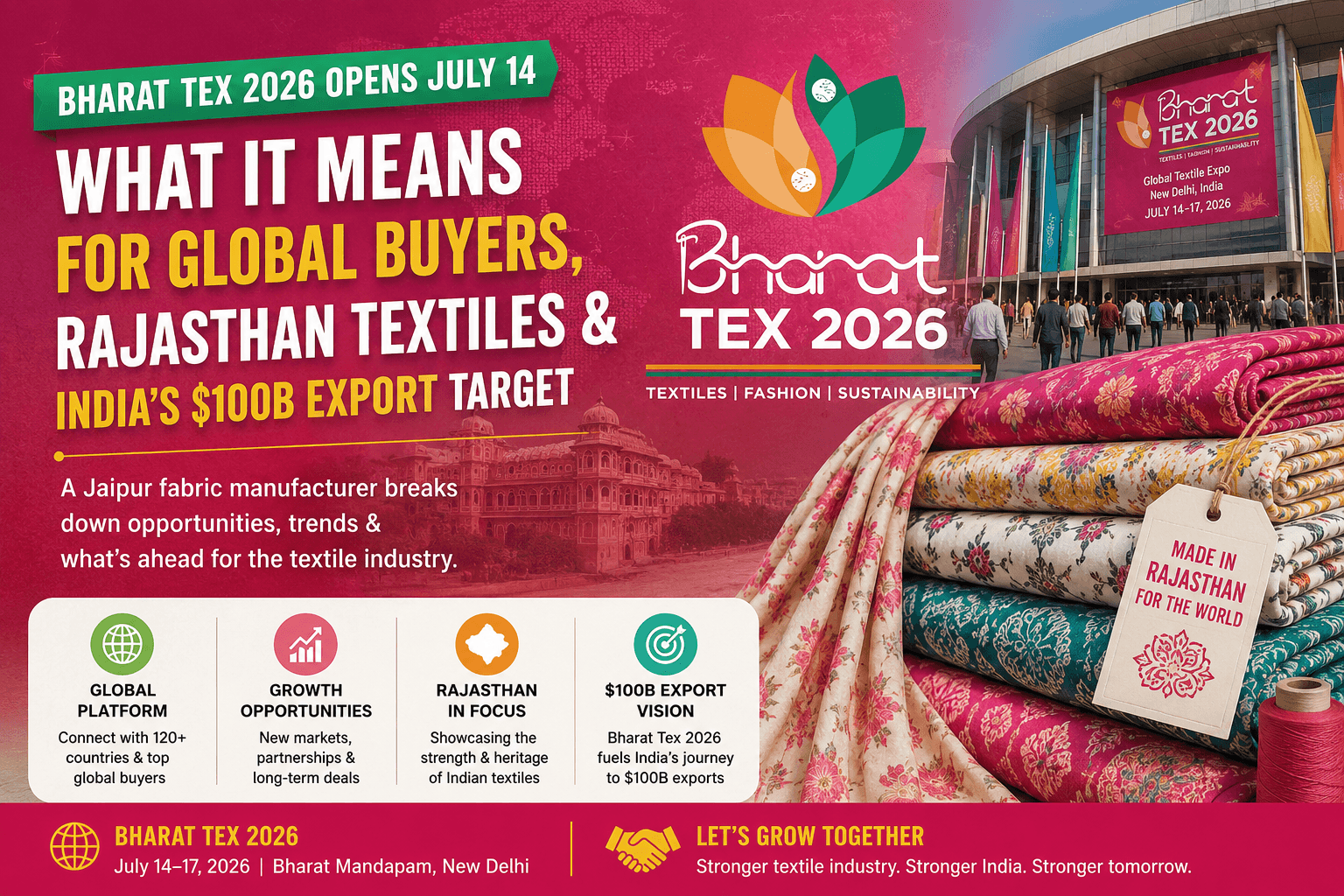
Six days from now, New Delhi will host the single largest gathering of textile professionals, global buyers, fabric manufacturers, policymakers, and fashion brand sourcing heads that India has ever put under one roof.
Bharat Tex 2026 opens on July 14 at Bharat Mandapam, New Delhi — and if you are anywhere in the fabric and textile supply chain, whether you’re a fashion brand in London looking for a new manufacturing partner, a fabric buyer from Tokyo finalising your next season’s sourcing, or a manufacturer in Sanganer, Jaipur wondering how global trade dynamics will shift in the second half of 2026 — this event matters directly to you.
Most of the coverage around Bharat Tex 2026 so far reads like a press release. Event dates. Exhibitor counts. Delegation names. What very few people are writing is the deeper story: what this event means in the context of India’s textile growth trajectory, why the 2026 edition carries more geopolitical and commercial weight than the previous two, what global buyers attending will actually find on the floor, and — from our perspective as a Jaipur-based fabric manufacturer — what Bharat Tex 2026 signals about where Indian cotton, block-print, and artisan textiles are headed next.
This article tells that story.
What Bharat Tex Actually Is — And Why 2026 Is Different
Bharat Tex began as an ambitious idea: create India’s own version of a global textile trade fair, comparable to Première Vision in Paris or Intertextile Shanghai — but built entirely around India’s unique position as both the world’s largest producer of cotton and one of the world’s most diverse textile ecosystems.
The first two editions proved the idea worked. Bharat Tex 2025 — the second edition — saw over 5,000 exhibitors, 6,000 international buyers from 120 countries, and 120,000 visitors walk through its halls. The commercial outcomes were estimated at approximately USD 2.5 billion in export opportunities generated. Not bad for an event that was only a few years old.
The third edition, Bharat Tex 2026, is substantially bigger in almost every dimension. The official theme says it all: “Weaving Indian Textiles Excellence into Fabric of Global Growth.” That is not just event branding. It is a statement of national commercial intent — and the numbers behind the event back it up.
Over 7,000 international buyers are expected. 1,600+ exhibitors will be present. 1.3 lakh trade visitors are anticipated across the four days. 20,000+ textile products will be displayed across 1.6 million square feet of exhibition space. Over 350 speakers from more than 20 countries will take to the stage. The event will host 39 panel discussions, 16 roundtables, 37 master classes, and 8 dedicated State sessions — over 100 knowledge events in total.
But the numbers, impressive as they are, are only part of the story. What is genuinely different about the 2026 edition is the geopolitical backdrop it is opening into.
The Timing Could Not Be More Consequential
Bharat Tex 2026 is not opening into a business-as-usual textile market. It is opening into the most consequential moment for Indian textile trade in at least a decade, shaped by four forces converging simultaneously this July.
The India-UK CETA is now live. The Comprehensive Economic and Trade Agreement between India and the United Kingdom took effect in July 2026, giving 99% of Indian exports preferential or duty-free access to the UK market. The UK is one of India’s most significant textile buyers — particularly for hand block-printed fabrics, home textiles, and artisan fashion. For UK buyers attending Bharat Tex 2026, the commercial calculus of sourcing from India has fundamentally improved. Lower tariffs mean more margin for both the buyer and the Indian exporter. Bharat Tex 2026 is the first major meeting platform after this deal went live — making it the natural first place to formalise new sourcing relationships under the new terms.
The India-EU FTA was concluded in January 2026. The deal is expected to be formally signed by December 2026 with implementation in early 2027. European buyers at Bharat Tex 2026 are attending knowing that the tariff barrier separating them from Indian textile exports is about to fall significantly. For sourcing heads from Germany, France, Spain, and the Netherlands — all countries with strong home textile and fashion import communities — Bharat Tex 2026 is essentially the preview event for post-FTA sourcing decisions.
The US 25% tariff situation is creating sourcing uncertainty. American buyers are attending Bharat Tex 2026 in a more complicated position than their European counterparts — facing a 25% tariff on Indian exports, compared to 20% for Bangladesh and Vietnam. The dedicated India-US Cotton Partnership sessions at Bharat Tex 2026 reflect the industry’s awareness of this gap and the diplomatic effort to address it. Even under current tariff conditions, the quality differentiation of Indian cotton — particularly premium fabrics, artisan textiles, and certified sustainable products — continues to attract American buyers willing to pay for what India uniquely offers.
The UAE is India’s fastest growing textile export market. India’s textile exports to the UAE grew 22.3% in FY 2025-26 — the fastest growth of any major destination. The India-Oman CEPA, which came into force on June 1, 2026, further strengthens India’s position in Gulf markets. UAE and Gulf business delegations attending Bharat Tex 2026 are coming with real buying power and an established appetite for Indian textiles that is growing, not slowing.
Who Is Actually Attending — The Complete Picture
The international participation profile at Bharat Tex 2026 tells you a great deal about where Indian textile trade relationships are going.
Ministerial delegations from New Zealand, Sri Lanka, Jordan, Cambodia, and Brunei have formally expressed interest in attending. These are not just courtesy visits — they represent government-level commitment to deepening bilateral textile trade with India.
Business and industry delegations are confirmed or expected from: United States, Japan, Spain, United Kingdom, Portugal, Russia, South Africa, New Zealand, UAE, Thailand, Bangladesh, Sri Lanka, Myanmar, and Uganda. This list spans four continents and includes both India’s traditional textile trading partners and several newer, faster-growing relationships.
International exhibitors from 14 countries — including the US, UK, Japan, Portugal, Spain, New Zealand, South Korea, South Africa, and Nepal — will be present on the exhibition floor.
United Nations and European Union both have confirmed institutional representation, giving the event a level of multilateral legitimacy that very few trade fairs in any sector can claim.
Across these international participants, dedicated bilateral sessions have been structured around: the India-US Cotton Partnership, the India-New Zealand Wool Ecosystem, India-UK FTA in Action, and Japan-India textile collaboration. These are not generic panel discussions — they are structured, agenda-driven sessions designed to produce real commercial and policy outcomes.
The Knowledge Sessions: What Is Actually Being Discussed
With 100+ knowledge events across four days, the content programme at Bharat Tex 2026 is as ambitious as the exhibition itself. Here is what the most commercially significant sessions are focused on.
Sustainability and Circular Economy. This is the event’s single largest thematic cluster. The CITI Textile Sustainability Awards 2026 will be hosted at Bharat Tex for the first time, structured around seven core focus areas: resource efficiency, energy and emissions, circular economy, sustainable materials, social responsibility, responsible business, and industry collaboration. The fact that these awards are being housed at Bharat Tex reflects how central sustainability has become to India’s textile export positioning — particularly with European buyers whose home markets are now subject to the EU Green Claims Directive (live from September 2026) and the PFAS ban.
Industry 5.0 and Intelligent Manufacturing. Sessions on AI-driven quality control, digital textile printing, smart supply chains, and automated manufacturing will address how Indian manufacturers are integrating technology without abandoning the craft expertise that differentiates Indian textiles globally.
Fibre Security and Cotton Mission. Sessions connected to India’s five-year Cotton Mission — launched December 2025, focused on climate-smart, pest-resistant, and high-yielding cotton varieties including extra-long staple (ELS) cotton — will be directly relevant to cotton fabric manufacturers and buyers who want to understand where India’s cotton production capacity is heading.
Export Readiness for MSMEs. Dedicated sessions for small and medium manufacturers — the backbone of Jaipur’s block-print cluster and hundreds of similar artisan-scale manufacturing communities across India — will cover FTA leverage, documentation, certification, and how to build the kind of export-ready supply chain that serious international buyers demand.
Technical Textiles and PM MITRA Parks. India’s ambitious PM MITRA (PM Mega Integrated Textile Region and Apparel) Parks programme — with seven integrated textile parks being developed across the country — will feature prominently. The Tamil Nadu PM MITRA Park already allocated 190.44 acres to 23 investors in February 2026, with committed investment of nearly Rs. 2,192 crore and potential for 15,000 jobs.
Rajasthan Is an Exhibitor State — What This Means for Jaipur
This detail matters for anyone sourcing from Jaipur, and it is worth highlighting specifically.
Rajasthan is one of nine Exhibitor States and Union Territories at Bharat Tex 2026. The others are Andhra Pradesh, Assam, Chhattisgarh, Jharkhand, Jammu and Kashmir, Odisha, Manipur, and West Bengal.
For a state whose textile identity is rooted in some of India’s most distinctive and globally recognised craft traditions — Sanganer block print, Bagru dabu print, Leheriya, Bandhani, Kota Doria weaves — Rajasthan’s presence at Bharat Tex 2026 as an exhibitor state is a significant platform. It means Rajasthan’s textile clusters, artisan communities, and manufacturers will have structured, prominent representation in front of the 7,000+ global buyers walking the floor.
The eight Sponsor States — Madhya Pradesh, Bihar, Uttar Pradesh, Punjab, Maharashtra, Gujarat, Karnataka, and Tamil Nadu — represent India’s larger industrial textile manufacturing hubs. Rajasthan’s position as an exhibitor state reflects its craft-and-culture textile identity rather than its industrial scale. And in 2026, that distinction is commercially valuable. International buyers increasingly come to India not just for industrial textile capacity — they come for what only India’s artisan traditions can offer.
For Jaipur’s fabric manufacturers, Bharat Tex 2026 is an opportunity to put Rajasthan’s craft textile ecosystem in front of the world’s most serious buyers at a moment when demand for authentic, traceable, artisan textiles is genuinely growing.
The CITI Textile Sustainability Awards 2026 — Why This Is a Big Deal
The Confederation of Indian Textile Industry’s Sustainability Awards are being hosted at Bharat Tex 2026 for the first time. This is worth paying attention to, because the framework these awards use reflects exactly what global buyers are now demanding as standard.
The seven focus areas of the 2026 awards are: resource efficiency, energy and emissions, circular economy, sustainable materials, social responsibility, responsible business practices, and industry collaboration. Taken together, this is essentially the full checklist that a European compliance team, a UK ethical sourcing manager, or an American sustainable fashion buyer would run through when evaluating an Indian supplier.
The fact that these awards are structured around international sustainability standards — and hosted at India’s largest global textile event — signals the maturation of India’s sustainability positioning. This is not India claiming to be sustainable in broad, unmeasurable terms. This is India creating a structured, competitive, verifiable sustainability framework that individual manufacturers and entire clusters can participate in and be recognised through.
For Jaipur’s block-print community — with its natural dye traditions, artisan employment model, and low-water processes — this framework is, in many ways, built around exactly what Jaipur already does. The challenge is documentation and certification, not practice. Bharat Tex 2026 creates the national stage on which that story can be told credibly and at scale.
What the Bharat Tex 2026 Mobile App Means for Modern Sourcing
For the first time at scale, Bharat Tex 2026 has launched a comprehensive mobile app that transforms how buyers and sellers interact at the event. The app provides AI-powered buyer-seller matchmaking, B2B meeting scheduling before the event begins, real-time floor navigation, digital badge access, QR-based lead capture, and live agenda updates.
This is more significant than it might appear. One of the persistent criticisms of large trade fairs — including previous Bharat Tex editions — is that the sheer scale of the event makes meaningful connection difficult. A buyer with three days and 1,600 exhibitors to explore cannot do so efficiently without digital tools. The matchmaking app essentially solves this — connecting buyer requirements with exhibitor profiles before the event even begins, so that floor meetings are confirmations of pre-existing interest rather than cold introductions.
For manufacturers exhibiting at or watching Bharat Tex 2026, the digital infrastructure signals where the industry is heading more broadly. The buyers of 2026 are sophisticated, data-driven, and time-efficient. They arrive at trade events with shortlists, not open minds. The manufacturers who win their business are the ones who have their documentation, certifications, digital profiles, and product specifications ready to share instantly.
India’s Textile Market in the Bharat Tex 2026 Moment
To understand what Bharat Tex 2026 is actually celebrating and where the energy in the hall will be focused, it helps to have the macro numbers in mind.
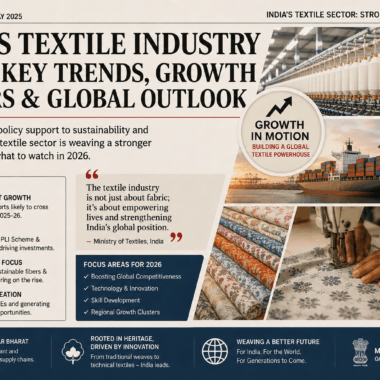
India’s textile and apparel market reached USD 248.70 billion in 2025 and is growing at 11.38% CAGR — projected to reach USD 656.31 billion by 2034. The sector employs over 45 million people directly and contributes 2.3% of India’s GDP and 12% of India’s total export earnings.
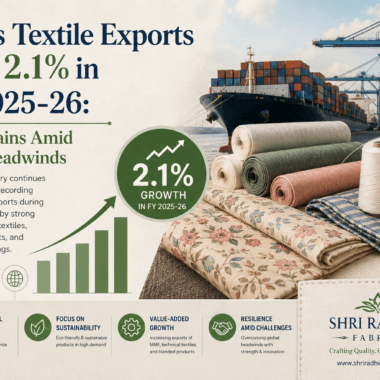
In FY 2025-26, India’s total textile and apparel exports (including handicrafts) stood at USD 32.63 billion. Ready-Made Garments accounted for 45% — USD 14.53 billion. Cotton textiles followed at 29% — USD 9.36 billion. Man-Made Textiles contributed 15% — USD 4.82 billion.
India has set a national target of USD 100 billion in textile exports by 2030. At Bharat Tex 2026, that target is not a distant aspiration — it is the operating assumption around which every session, every bilateral meeting, and every exhibitor strategy is organised.
The India-UK CETA, the India-EU FTA, the India-Oman CEPA, and the India-EFTA TEPA (all signed or implemented in 2025-26) collectively represent the most significant expansion of India’s preferential market access in the textile sector in decades. Bharat Tex 2026 is the platform where these agreements begin to translate into actual commercial relationships.
What Global Buyers Should Actually Look For at Bharat Tex 2026
If you are a fashion brand sourcing head, a wholesale importer, or a retail buyer attending Bharat Tex 2026, here is a practical guide to making the most of four days across 1.6 million square feet.
Go for craft first. India’s industrial capacity in textiles — large-scale garment manufacturing, technical textiles, man-made fibre processing — is well-documented and accessible through many channels. What Bharat Tex 2026 offers that no other global trade fair can is direct access to India’s artisan textile ecosystem: the handloom clusters, the block-print traditions, the natural-dye communities, the GI-tagged craft textiles. These are the products that are most differentiated, most sustainable, and most difficult to source from anywhere else in the world. Start here.
Look for the Rajasthan pavilion specifically. As an exhibitor state, Rajasthan will have a dedicated presence. This is your direct access point to Sanganer block-print manufacturers, Bagru dabu-print artisan suppliers, Kota Doria weavers, and Jaipur’s home textile production cluster.
Attend the India-UK FTA in Action session. If you’re a UK buyer, this is the most directly commercially relevant knowledge session at the event. Understanding exactly how preferential tariff treatment works under the new CETA, what documentation you need, and how to structure supply contracts to benefit from the new terms will save you significant cost from your first post-CETA import onwards.
Ask every supplier about certifications before you ask about price. The EU Green Claims Directive comes into effect September 27, 2026. PFAS restrictions are already live in France and Denmark. The EU Digital Product Passport for textiles arrives around 2027-28. Suppliers who cannot provide OEKO-TEX Standard 100, GOTS for organic claims, or basic fibre composition lab certificates are suppliers who will create compliance problems for you within 12-18 months. Bharat Tex 2026 is the perfect place to separate compliance-ready suppliers from those who are not.
Use the pre-fair directory and app before you arrive. The Bharat Tex 2026 mobile app (downloadable at onelink.to/zcrm4s) allows you to schedule meetings before July 14. Given that 3,500 B2B meetings are expected across four days, the best meeting slots will fill quickly. Register and schedule in advance.
What This Means for Jaipur’s Fabric Manufacturers
We are a Jaipur-based fabric manufacturer. Our unit is in Sanganer — the village that is, in many ways, the geographic centre of India’s block-print cotton tradition. So when we say Bharat Tex 2026 matters to us, we mean it in a direct and specific way.
Here is what we see as the most significant implications of Bharat Tex 2026 for Jaipur’s fabric manufacturing community:
The sustainability conversation is now a commercial conversation. The CITI Sustainability Awards, the EU pavilion, the dedicated circular economy sessions — all of this signals that sustainability is no longer a nice-to-have for international buyers. It is a procurement criterion. For Jaipur manufacturers whose craft traditions are inherently sustainable — natural dyes, artisan labour, low-water processes, traceable handmade techniques — the task is not to change what we do. It is to document, certify, and communicate what we already do in the language that international compliance teams understand.
The India-UK FTA changes the economics of Jaipur block-print exports to Britain. UK buyers have historically paid significant import duties on Indian fabric and garments. With those barriers falling, the price competitiveness of Jaipur’s block-print cotton in British boutiques, home textile retailers, and online fashion brands improves meaningfully. We expect the second half of 2026 to see a meaningful uptick in UK sourcing enquiries for exactly this reason.
The growing UAE market is directly relevant to Rajasthan textiles. UAE buyers have a deep, longstanding appreciation for Rajasthan’s textile traditions — the colours, the craft, the cultural resonance. The 22.3% export growth to UAE in FY 2025-26 and the India-Oman CEPA strengthening Gulf market access together point to a corridor that Jaipur manufacturers should be actively cultivating.
Digital readiness is no longer optional. The Bharat Tex app, the pre-fair directory, the AI matchmaking — these tools reflect the expectations of 2026’s buyers. A Jaipur manufacturer without a professional website, updated product catalogue, GSM certificates, and clear digital presence is invisible to the buyers who will book their meetings two weeks before the event even starts.
Bharat Tex 2026 at a Glance — Everything You Need to Know
| Detail | Information |
|---|---|
| Event | Bharat Tex 2026 — 3rd Edition |
| Theme | Weaving Indian Textiles Excellence into Fabric of Global Growth |
| Dates | July 14–17, 2026 |
| Venue | Bharat Mandapam, New Delhi |
| Organiser | Bharat Tex Trade Federation + Ministry of Textiles |
| Exhibitors | 1,600+ from India and 14 countries |
| Expected buyers | 7,000+ international buyers |
| Trade visitors | 1.3 lakh (130,000) |
| Exhibition area | 1.6 million sq ft |
| Products displayed | 20,000+ |
| Knowledge sessions | 100+ (39 panels, 16 roundtables, 37 masterclasses) |
| Speakers | 350+ from 20+ countries |
| B2B meetings | 3,500 curated |
| MoUs expected | 20+ |
| Rajasthan’s role | Exhibitor State |
| Special awards | CITI Textile Sustainability Awards 2026 |
| Official app | Available at bharat-tex.com |
| Bilateral sessions | India-UK FTA, India-US Cotton, India-NZ Wool, Japan & Russia |
The Bottom Line
India’s textile industry has been building toward a moment like this for years. The FTAs are signed. The export numbers are growing. The craft traditions are globally recognised. The sustainability credentials — particularly for natural-fibre, artisan-made textiles from clusters like Jaipur — are better positioned than ever in the market that is forming around transparency, traceability, and authenticity.
Bharat Tex 2026, opening in six days, is the platform where all of that converges for the first time at full scale. For global buyers, it is the most efficient four days they will spend in sourcing decision-making this year. For Indian manufacturers — including the block-print and cotton fabric producers of Jaipur — it is the largest and most consequential showcase India has ever provided.
Whether you attend in person, follow from your studio in Sanganer, or track the outcomes as a fashion brand planning next season’s sourcing, the outcomes of Bharat Tex 2026 will shape Indian textile trade for the next several years. Pay attention.
Shri Radhey Fabrics is a fabric manufacturer and wholesale supplier based in Sanganer, Jaipur — the heart of India’s block-print textile tradition. We supply pure cotton, rayon, and custom printed fabrics to fashion brands across India, the UK, UAE, USA, and beyond. For bulk enquiries, fabric samples, or custom manufacturing, visit shriradheyfabrics.com or DM us on Instagram @shriradheyfabrics.
Tags: Bharat Tex 2026, India textile expo 2026, Bharat Tex July 2026, India textile industry news, India textile export 2026, Jaipur textile Bharat Tex, global textile trade fair India, India UK FTA textile, India EU FTA 2026, sustainable textile India 2026, Rajasthan textile exhibition, fabric manufacturer India 2026, cotton textile export India, Jaipur block print export, India textile market 2026