There is one number that decides more about your fabric than colour, pattern, or even fibre content. It affects how your garment feels on skin, how it drapes on the body, how it survives the first ten washes, whether your customer feels like they got value for money or got shortchanged — and whether your manufacturer can even produce what you actually imagined when you designed the piece.
That number is GSM.
And the surprising thing? Most fashion brand owners, first-time buyers, and even many experienced retailers either don’t know what it means or don’t ask for it when placing fabric orders. They describe what they want in words — “something light and flowy,” “a bit heavier, more premium feeling,” “not too thick but not see-through” — and hope the manufacturer understands.
Sometimes they get lucky. Often they don’t.
This is the article that changes that. Written from the floor of our fabric manufacturing unit in Sanganer, Jaipur — where we work with cotton, rayon, and printed fabrics across the full weight spectrum every single day — this is the complete, practical guide to GSM in cotton fabric. What it means, why it matters, what the right numbers are for different products, how to measure it yourself, and what questions to ask your supplier before a single metre gets cut.
What GSM Actually Means
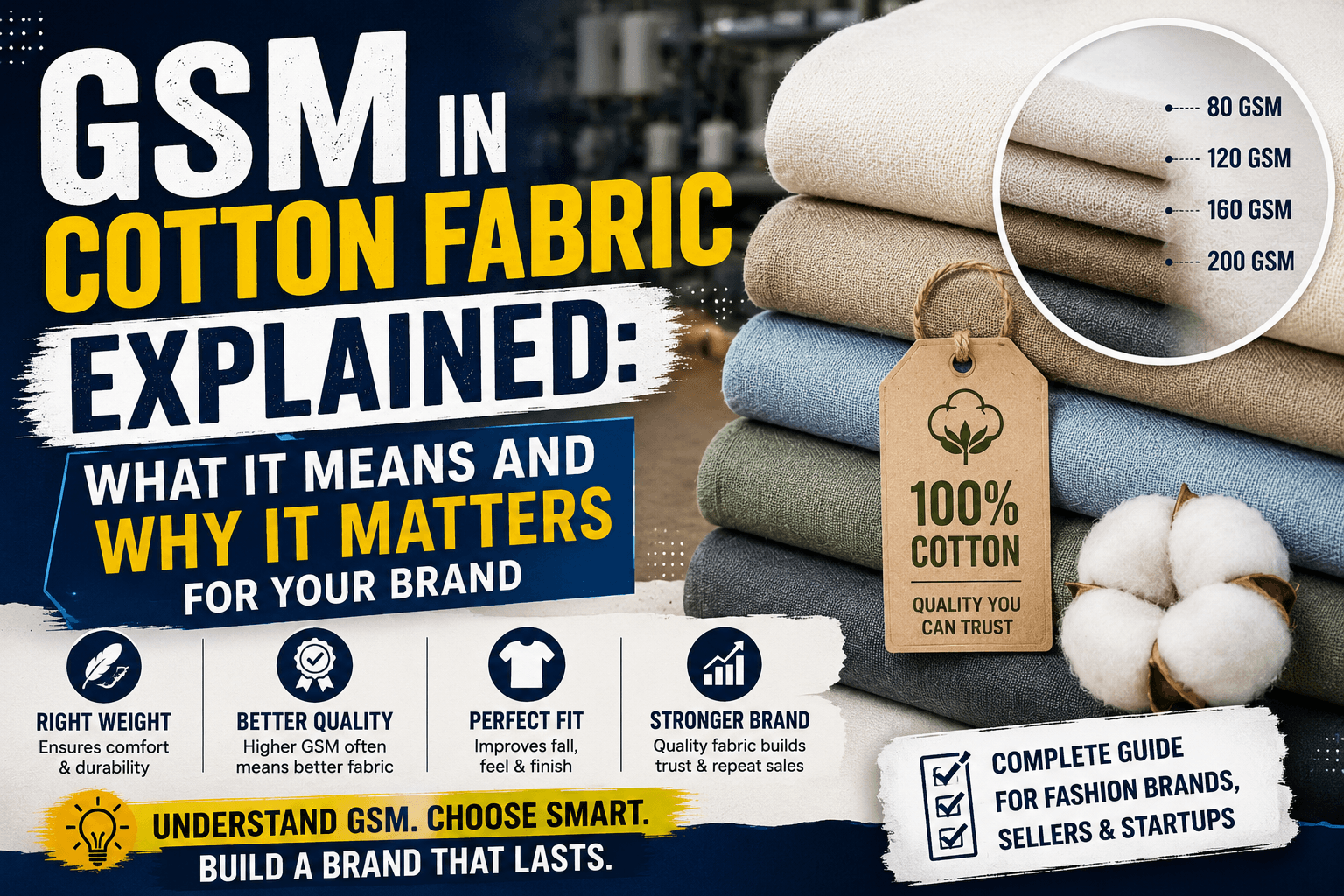
GSM stands for Grams per Square Metre. It is a measure of how much a one-metre-by-one-metre piece of fabric weighs in grams.
That’s it. That’s the whole definition.
But packed inside that simple number is an enormous amount of information about a fabric’s character. A 70 GSM cotton mulmul is feather-light, semi-sheer, and floats in the breeze. A 300 GSM cotton canvas is stiff, structured, and could survive a monsoon. Both are 100% cotton. The GSM number tells you everything about which one you’re dealing with.
Think of it this way. If you pour the same amount of water into a wide shallow tray versus a narrow deep glass, the water feels and behaves completely differently. Same substance, different density. GSM is essentially the textile equivalent of measuring that density — how much material is packed into each square metre of cloth.
GSM is not the same as thickness, though they are related. A fabric can be thick but low-GSM if it has a loose, open weave. A fabric can be thin but high-GSM if it has an extremely tight, dense weave. GSM measures mass per area, not physical depth. Understanding this distinction saves buyers from one of the most common sourcing errors — assuming a heavier-feeling fabric always has higher GSM.
Why GSM Matters More Than Most Buyers Realise
Here is a scenario that plays out in fabric sourcing conversations every week.
A fashion brand owner sends a reference garment to a manufacturer and says: “Make me this, but in our block-print cotton.” The manufacturer produces 500 pieces. The brand receives them, puts them in a shoot, launches the collection — and starts getting returns. Customers say the fabric feels cheap. It’s see-through in direct light. It doesn’t hold its shape after the first wash. The brand blames the manufacturer. The manufacturer points to the fact that they matched the colour, the print, and the construction exactly as requested. The problem? Nobody specified the GSM. The manufacturer used whatever cotton stock they had available — 90 GSM instead of the 130 GSM in the original reference. The garments look the same on a hanger. They feel completely different on a body.
This happens constantly. GSM is the missing specification in more fabric orders than any other single factor.
Here is what GSM actually controls in your final garment:
Opacity. A 70 GSM cotton voile is semi-sheer. A 120 GSM cotton cambric is opaque. If your customer needs to wear something underneath or holds the garment up to light and sees straight through it, your GSM was too low for the product.
Drape. Lighter GSM fabrics flow and float. Heavier GSM fabrics hold structure. A maxi dress needs a different drape from a structured shirt. The GSM number drives this difference more than any other single specification.
Durability. In general, higher GSM fabrics have more material per area, which means more fibre, which means more resistance to tearing, pilling, and wear. A 200 GSM cotton twill bedsheet will outlast a 120 GSM one by years if everything else is equal.
Feel and warmth. Heavier fabrics feel more substantial against skin. In cooler climates or air-conditioned environments, a 180 GSM cotton shirt feels noticeably warmer than a 110 GSM one.
Price. More fabric per square metre means more raw material, which means higher cost. When manufacturers quote prices for fabric without specifying GSM, they can give you a number that sounds competitive and then deliver something lighter than you expected. Always get the GSM in writing before you agree to a price.
Printing quality. This is one that even experienced buyers often miss. Lighter fabrics absorb dye differently from heavier ones. Block printing on a 70 GSM mulmul requires more pressure control and less dye paste than the same design on 130 GSM cambric. At Shri Radhey Fabrics, every printing specification we prepare begins with the base fabric’s GSM, because the technique needs to match the weight.
The Complete GSM Chart for Cotton Fabrics
Here is the full GSM spectrum for cotton fabrics, with real-world product applications for each range:
30–70 GSM — Ultra Lightweight
This is the territory of cotton mulmul, muslin, and fine voile. Fabrics in this range are translucent to semi-sheer, extremely soft, and breathe exceptionally well. In India’s summer heat, these are the fabrics people reach for without thinking — the thin cotton dupatta, the gossamer inner lining, the breezy beach kaftan.
Best uses: dupattas, scarves, inner linings, sheer summer kurtis, nursing covers, lightweight infant garments, bridal inner layers.
What to watch: fabrics below 50 GSM can be difficult to sew consistently and may shift during printing. If you’re block printing on mulmul, specify your GSM minimum to your manufacturer.
80–120 GSM — Lightweight
Cotton voile, lawn, and light cambric sit here. This is the working zone for lightweight everyday apparel — the kind of fabric that feels soft against skin all day without trapping heat. In this range the fabric is typically opaque enough to wear alone but still has that light, comfortable quality that makes summer clothing pleasant.
Best uses: summer shirts, lightweight kurtis, co-ord sets for warm climates, baby clothing, light cotton sarees.
120–160 GSM — Medium Weight
This is the single most commercially important GSM range in cotton fabric manufacturing. Cotton poplin, regular cambric, and standard screen-print and block-print cotton all typically fall here. It’s the sweet spot that works across four seasons for most Indian climate zones and exports well globally.
The industry’s own data confirms this: the sweet spot for hot weather comfort sits at 150–180 GSM, balancing breathability with durability — and the industry standard for retail T-shirts globally is 160–180 GSM, offering good drape, opacity, and durability without excessive heat retention.
Best uses: kurtis, kurtas, printed cotton dress material, bedsheets, light curtains, everyday shirts, co-ord sets, ethnic wear.
160–220 GSM — Medium-Heavy
As you move into this range, fabric develops noticeable body. Cotton oxford weave, heavier printed cotton, and quality home textiles live here. At 200 GSM you can feel a fabric’s substance simply by picking it up — it has presence, not just softness.
International B2B buyers targeting European and North American markets are showing a clear trend toward this range in 2026, with heavyweight fabrics in the 240–300 GSM range gaining traction driven by the Quiet Luxury movement, where buyers prioritise quality and longevity over fast fashion turnover.
Best uses: premium kurtis, structured shirts, quality bedsheets, upholstery-weight home textiles, jackets, structured trousers.
220–300 GSM — Heavy Weight
Cotton twill, heavy drill, canvas, and premium denim sit in this range. These are fabrics built for durability, structure, and workwear-adjacent uses. At 280 GSM a cotton twill has real weight and presence — it would make a beautiful structured blazer but would be entirely wrong for a summer kurta.
Best uses: trousers, workwear, structured outerwear, heavy home furnishing fabric, bags, structured jackets, premium hoodies.
300 GSM and Above — Structural/Heavy
Pure canvas, heavy denim, and technical cotton fabrics. These are specialist materials — not everyday apparel fabrics.
Best uses: canvas bags, heavy workwear, industrial textiles, structured accessories.
The GSM Quick Reference Table
| GSM Range | Fabric Type | Best Products | Season |
|---|---|---|---|
| 30–70 | Mulmul, muslin, voile | Dupattas, sheer kurtis, linings | Summer |
| 80–120 | Voile, lawn, light cambric | Summer shirts, baby clothes | Summer |
| 120–160 | Cambric, poplin, cotton prints | Kurtis, kurtas, bedsheets, shirts | All seasons |
| 160–220 | Oxford, heavy cambric, canvas-cotton | Premium apparel, home textiles | All seasons |
| 220–300 | Twill, drill, heavy cotton | Trousers, jackets, workwear | Winter/structured |
| 300+ | Canvas, heavy denim | Bags, industrial, accessories | Specialty |
The Most Common GSM Mistakes Fashion Brands Make
After working with hundreds of fashion brands sourcing from our Jaipur manufacturing unit, we see the same GSM errors over and over. Here are the five most expensive ones.
Mistake 1: Not specifying GSM at all
This is the most common error. A brand describes what they want visually — the print, the colour, the style — but never mentions GSM. The manufacturer produces to whatever fabric is in stock. The brand receives something different from what they imagined. Specifying GSM takes ten seconds and prevents this entirely.
Mistake 2: Choosing GSM based on price alone
Lower GSM = lower cost per metre. This is true. It is also a false economy if the GSM is wrong for the product. A 90 GSM bedsheet costs less per metre than a 130 GSM one, but a customer who buys it, washes it three times, and watches it become see-through will not come back. The cost of a return and a lost customer always exceeds the saving on fabric weight.
Mistake 3: Assuming higher GSM always means better quality
This is a persistent myth worth busting directly. GSM does not automatically equal strength or comfort. A 280 GSM cotton fleece may feel thick but pill quickly after a few washes, while a 200 GSM polyester interlock can last much longer. The quality of the fibre, the tightness of the weave, and the finishing treatment all work together with GSM to determine a fabric’s real performance. GSM is one specification, not the whole story.
Mistake 4: Using the same GSM across different product categories
A fashion brand that orders all its cotton at 150 GSM regardless of product type will end up with bedsheets that feel too light, dupattas that feel too heavy, and shirts that are fine but kurtis that are slightly stiff. Different products genuinely need different GSM. The GSM table above is a practical starting point for getting this right.
Mistake 5: Not accounting for shrinkage
Pure cotton fabric shrinks 3–5% in the first wash. This affects both the effective weight and dimensions of the garment. A fabric specified at 150 GSM before washing will typically measure slightly higher GSM after washing because the fabric shrinks while the fibres remain the same weight. Build shrinkage into your specifications and always request pre-shrunk fabric or shrinkage test data from your manufacturer.
How to Measure GSM Yourself
You don’t need expensive equipment to measure fabric GSM. Here is the method any buyer can use to verify what they’ve received.
The GSM cutter method (most accurate):
A GSM cutter is a circular die-cutter that cuts a precise circle of exactly 100 square centimetres from the fabric. You weigh this circle on a precision scale and multiply by 100 to get GSM. These cutters are available on Indiamart for ₹1,500–₹3,000 and are worth owning if you source fabric regularly.
The estimate method (no tools needed):
Cut a 10cm x 10cm square from the fabric, as precisely as you can. Weigh it on a kitchen scale that measures in grams. The result will be in hundredths of a GSM, so multiply by 100 to get the approximate GSM.
Example: your 10cm x 10cm square weighs 1.5 grams. 1.5 × 100 = 150 GSM.
This method has a margin of error of around 5–10% because of imprecise cutting and scale sensitivity, but it gives you a reliable ballpark to verify whether what you’ve received is close to what you ordered.
The feel method (experienced buyers):
With enough time handling fabrics across the GSM range, you develop an intuition for weight. A 100 GSM cotton feels noticeably different from a 160 GSM one in the hand — the lighter fabric has less resistance when you crumple it, and when you hold it up to light, more light passes through. This is not a substitute for measurement but it is a useful quick check.
GSM Standards That International Buyers Now Require
In 2026, the global B2B buyer has become significantly more technically demanding about fabric specifications. Here is what serious buyers from the UK, EU, UAE, and the US are now asking for as standard.
GSM certificates with every shipment. Lab-tested GSM data from a third-party testing body like SGS, Intertek, or Bureau Veritas. Not estimated — tested. For export orders, this is fast becoming a baseline requirement rather than an optional extra.
GSM tolerance specification. Serious buyers specify GSM with a tolerance, typically ±5%. This means a 160 GSM specification accepts fabric between 152–168 GSM. This protects both buyer and manufacturer from minor production variation while catching genuinely wrong deliveries.
Pre-wash and post-wash GSM data. As European buyers in particular require pre-washed garments or shrinkage data, some are starting to request both pre-wash and post-wash GSM measurements. A fabric that is 160 GSM before washing and 165 GSM after washing (due to shrinkage) tells you a lot about its construction.
OEKO-TEX certification for all GSM ranges. Retailers like Zalando and C&A now require OEKO-TEX or GOTS certifications for all cotton garments. This applies regardless of GSM — a 70 GSM mulmul and a 220 GSM twill both need the same safety certification for EU retail entry.
GSM and Printing: What Every Jaipur Fabric Buyer Needs to Know
This section is specific to block-print and screen-print cotton fabrics — which is the heart of what we make in Sanganer, and where GSM has a particularly direct impact on print quality.
Block printing works best between 90–180 GSM. Fabrics below 90 GSM are challenging to block print because the light base fabric moves under the pressure of the block, causing registration issues and uneven dye absorption. Fabrics above 180 GSM absorb more paste, which can blur fine lines.
Natural dye block printing (Bagru dabu style) works best between 100–160 GSM. The dabu mud-resist process and natural indigo overdye need a fabric with enough body to hold the resist cleanly but light enough to allow dye penetration. 120–150 GSM unbleached cotton is the sweet spot most Bagru artisans prefer.
Screen printing on cotton is more forgiving of GSM variation because the squeegee-applied paste is applied with more consistent pressure than a hand block. Screen printing works well from 90 GSM up to 200 GSM on cotton.
Digital printing works across almost all GSM ranges but produces its best results on medium-weight fabrics (100–180 GSM) where the inkjet droplets can penetrate slightly into the fabric rather than sitting entirely on the surface.
The print changes how GSM feels. This is something buyers rarely consider. A 130 GSM cotton cambric feels noticeably different after screen printing with pigment paste, because the binder coating adds mass and stiffness. The effective weight of the printed fabric is higher than the base fabric’s GSM. When specifying GSM for printed fabric orders, always specify the base fabric GSM — not the finished, printed GSM.
GSM Recommendations by Product — The Shri Radhey Fabrics Working Guide
This is the actual GSM guide our production team uses when working with new fashion brand clients. These are not theoretical ranges — they’re what works in practice, refined across thousands of metres of cotton fabric:
Women’s kurta / kurti: 110–140 GSM for summer; 140–160 GSM for all-season Men’s kurta: 130–160 GSM Cotton saree fabric: 80–120 GSM Dupatta / stole: 60–100 GSM Co-ord set (top and bottom): 120–150 GSM Block print bedsheet: 120–150 GSM Premium bedsheet: 140–180 GSM Curtain fabric: 150–200 GSM Cushion cover fabric: 180–220 GSM Summer shirt / dress material: 100–140 GSM Structured trouser fabric: 180–240 GSM Jacket / structured outerwear: 220–300 GSM Tote bag cotton: 250–320 GSM
Use these as your starting point and adjust based on your specific design, climate, and market positioning.
A Note on GSM and Brand Positioning
Here is something worth thinking about beyond the technical specifications.
GSM is a brand signal. When a customer holds your garment and it feels light, airy, and effortless, that feeling was engineered by a GSM decision made months earlier in a factory. When a customer puts on a shirt and it has that satisfying, substantial quality — that feeling of wearing something that was worth paying for — that too was a GSM decision.
The 2026 Quiet Luxury movement sweeping through European and American fashion markets is, in many ways, a GSM story. Consumers who are tired of fast fashion’s thinness and disposability are consciously seeking out heavier, denser fabrics that feel like they were built to last. Heavyweight fabrics in the 240–300 GSM range are gaining real traction as buyers prioritise quality and longevity.
For Indian fabric manufacturers and the fashion brands that source from us, this is an opportunity. India makes exceptional cotton in every GSM range — from the featherweight mulmul of Rajasthan to the structured twills of Gujarat. The craft of GSM selection is not a technical formality. It is a design decision that sits at the very foundation of your product’s quality story.
Know your numbers. Know what they mean. And the next time you’re sourcing fabric for your collection — whether it’s a block-print kurta destined for London or a cotton bedsheet for a boutique hotel in Dubai — start the conversation with GSM.
Everything else follows from there.
Quick Summary: GSM at a Glance
| Question | Answer |
|---|---|
| What does GSM mean? | Grams per Square Metre — fabric weight per unit area |
| What is a good GSM for summer kurtis? | 110–140 GSM |
| What GSM for bedsheets? | 120–180 GSM |
| What GSM for structured trousers? | 180–240 GSM |
| Is higher GSM always better? | No — match GSM to the product, not to a number |
| How to measure GSM yourself? | Cut 10x10cm, weigh in grams, multiply by 100 |
| What tolerance should I specify? | ±5% is industry standard |
| Does printing affect GSM? | Yes — pigment printing adds mass. Specify base fabric GSM |
Shri Radhey Fabrics is a fabric manufacturer and wholesale supplier based in Sanganer, Jaipur, India. We manufacture pure cotton, rayon, and custom printed fabrics across the full GSM spectrum — from 60 GSM mulmul to 300 GSM canvas — with low MOQ and complete technical documentation including GSM certificates. Visit us at shriradheyfabrics.com or DM us on Instagram @shriradheyfabrics for fabric samples and bulk enquiries.