Let’s start with an uncomfortable truth.
Walk into any fabric market in India — Chandni Chowk in Delhi, Mangaldas Market in Mumbai, or even the famous wholesale lanes of Sanganer in Jaipur — and ask a vendor for “pure cotton printed fabric.” Almost every single one will confidently hand you a piece, tell you it’s 100% cotton, and quote you a price. Some of them will be right. Many of them will not.
This is not always intentional deception. The problem runs deeper than dishonest vendors. It sits in a global textile market where polyester alone accounts for approximately 54% of global fiber consumption, where blended fabrics are aggressively competing on price, and where the difference between a pure cotton fabric and a cotton-polyester blend is nearly invisible to the untrained eye — especially when the fabric has been printed, finished, and treated to feel soft and natural.
For consumers, this means paying cotton prices for polyester blends. For fashion brand owners, it means building collections on a material foundation that will disappoint customers — the wrong hand-feel, unexpected shrinkage, poor breathability, and garments that feel uncomfortable against skin in India’s heat. For B2B buyers sourcing from manufacturers, it can mean receiving shipments that fail quality testing, damage client relationships, and create costly returns.
Knowing how to identify pure cotton printed fabric is not a niche skill anymore. In 2026, it is essential knowledge for anyone who takes fabric seriously.
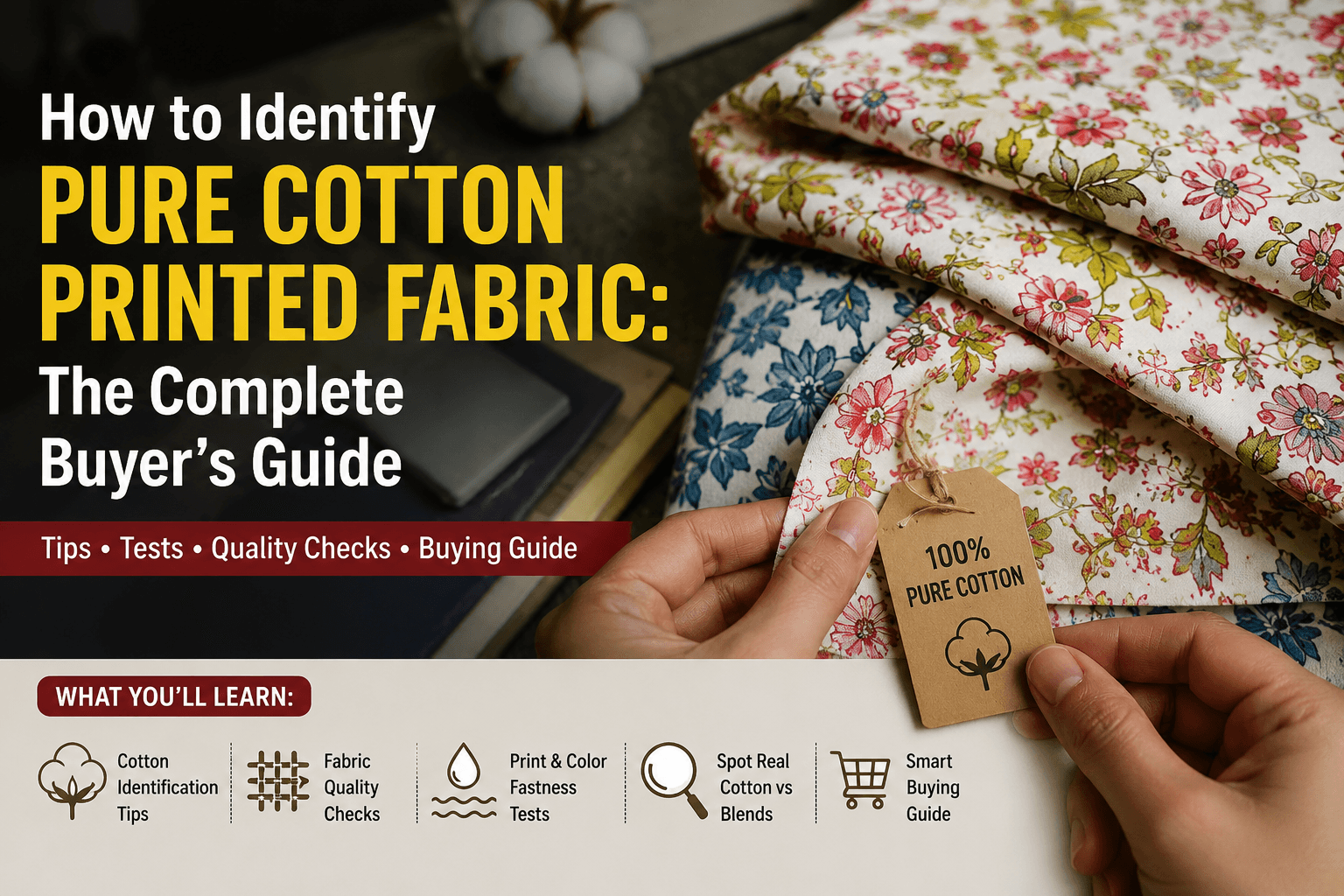
This guide gives you everything — the market reality, the simple tests you can do yourself, the science behind them, and what to demand from your manufacturer before you place a single order.
The Market Reality: Why This Problem Is Getting Worse, Not Better
Before we get into tests and techniques, let’s understand why identifying pure cotton has become harder.
Nearly 66% of textile companies are now investing in sustainable fabrics, 58% are adopting recycled cotton blends, and 47% are introducing organic cotton collections. On paper, this sounds like progress. In practice, it means the market is now flooded with an enormous variety of blended fabrics — cotton-polyester, cotton-viscose, cotton-modal, cotton-linen — all of which can look and even feel very similar to pure cotton, especially in printed form.
The problem is compounded by printing itself. When a fabric gets block-printed, screen-printed, or digitally printed, its surface is covered in dye and finishing chemicals. These finishes can artificially soften a synthetic fabric, give it a more “cotton-like” hand-feel, and make visual identification nearly impossible. A polyester fabric treated with a softening chemical can fool even experienced buyers for the first few seconds of touch.
India leads the world in cotton textile fabric exports with 7,318 shipments, followed by China with 2,924 shipments and Vietnam taking third with 1,704 shipments. With this volume of fabric moving globally, the pressure on buyers to quickly identify and verify what they’re receiving is real and growing.
Cotton textiles accounted for 33% of India’s total textile exports during April–October FY 2024-25, valued at $7,082 million.That is a massive trade category — and within it, the ability to verify cotton authenticity separates smart buyers from those who repeatedly get misled.
A 2025 report on the fashion industry found that brands are undermining the potential of sustainable cotton by relying on uncertified cotton and synthetic fibres.In short, even large brands with dedicated sourcing teams are getting this wrong. Which means individual buyers and small fashion brands need to be even more vigilant.
What Pure Cotton Actually Is — And Why Printed Cotton Is Special
Cotton is a natural fibre grown from the boll of the Gossypium plant. It has been cultivated for thousands of years and remains, to this day, one of the most used natural fibres in the world.
Cotton fabric, derived from the natural fibers of the cotton plant, has been cultivated for centuries, known for its softness, absorbency, and breathability. Pure cotton fabric is highly sought after due to its natural properties and comfort.</cite>
What makes printed cotton fabric different from plain cotton? The printing process — whether block printing, screen printing, pigment printing, or digital printing — adds dye, binder chemicals, and sometimes a finishing coat on top of the base fabric. This changes how the fabric looks and feels on the surface, which is exactly what makes identification harder.
In block printing — the traditional Jaipur craft that Sanganer and Bagru are famous for — wooden blocks carved with intricate motifs are dipped in natural or reactive dyes and pressed onto cotton fabric by hand. The dye penetrates the cotton fibre because cotton absorbs liquid deeply. This is one reason why natural-dye block printing works so well on cotton and so poorly on synthetics — cotton’s absorbency is a structural property of the fibre, not a surface treatment.
Understanding this is the first step to identifying pure cotton. Its properties — absorbency, breathability, the way it wrinkles, the way it burns — all come from the fibre’s natural structure. No finishing chemical can permanently replicate all of them.
8 Ways to Identify Pure Cotton Printed Fabric
Here are eight tests, arranged from the simplest (no tools needed) to the most definitive. Use as many as possible together — no single test is 100% conclusive on its own.
Test 1: The Touch and Feel Test
Tools needed: Your hands. Nothing else.
This is where you start — not where you finish.
Genuine cotton typically has a soft, natural feel and a slightly matte finish. When you touch the fabric, it should feel breathable and comfortable against the skin. If the fabric feels overly slick or has a shiny appearance, it may contain synthetic fibers.
For printed cotton specifically, here’s what to look for:
Run your fingers across the printed area and the unprinted area separately. On pure cotton, both areas should feel relatively similar in texture — slightly matte, with a natural grip. On a synthetic or blended fabric, the printed area often feels slightly stiffer or coated, and the unprinted area may have a slick, almost plastic-like smoothness.
Crush a corner of the fabric in your hand firmly for five seconds, then release it. Pure cotton will crease and hold that crease. It does not spring back. Synthetic fabrics — especially polyester — spring back with barely a wrinkle, because their fibres have memory. Cotton-poly blends tend to wrinkle less than pure cotton. If the fabric you’re holding refuses to crease, be suspicious.
Limitation: Softening finishes can mimic cotton’s touch. Don’t rely on this test alone.
Test 2: The Water Absorption Test
Tools needed: A few drops of water.
This is a quick, clean test you can do at a fabric stall without any equipment.
Drop water on the cloth — it should absorb the water quickly and spread evenly. When cotton is mixed with polyester or synthetic fibres, the fabric doesn’t absorb water well, or causes it to pool.
Place three or four drops of water on a small area of the fabric — ideally on an unprinted section. Watch what happens in the next 10–15 seconds.
Pure cotton: The water is absorbed almost immediately, spreading into the fibres. The fabric darkens where the water lands.
Synthetic or high-blend fabric: The water sits on the surface in a bead or spreads very slowly. The fabric resists absorption.
Cotton-polyester blend: The absorption happens but more slowly and unevenly than pure cotton.
One nuance for printed cotton: the printed area may absorb slightly differently because the dye and binder sit on the surface. Always do this test on an unprinted margin or selvedge edge if possible.
Test 3: The Wrinkle Test
Tools needed: Your hands.
Tightly scrunch a section of the fabric in both hands for 10 seconds. Then open it flat.
Pure cotton will show clear, defined wrinkle lines that remain visible. The fabric does not “recover” from this treatment.
A polyester-dominant fabric will show almost no wrinkles after being scrunched — it recovers because polyester fibres are thermoplastic and have shape memory.
A cotton-polyester blend will show partial wrinkling — some creases, but they fade faster than they would in pure cotton.
This test works especially well for printed fabrics because the printing does not significantly change how the base fibre responds to physical distortion. A printed cotton kurta fabric and a printed polyester fabric will behave very differently in this test.
Test 4: The Breathability Test
Tools needed: Your mouth.
Blow through the fabric — good cotton lets air flow through it easily.
Hold the fabric up to your lips and blow gently but firmly through it. Pure cotton, especially lightweight varieties like mulmul, voile, or cambric, will allow air to pass through clearly — you’ll feel it on the other side of your hand.
Synthetic fabrics and tightly woven blends resist airflow. Dense polyester fabrics in particular will feel like blowing into a wall compared to the easy air passage through cotton.
This test is more effective with lightweight printed cottons than with heavier fabrics like denim or canvas, where the weave density itself restricts airflow regardless of fibre content.
Test 5: The Burn Test
Tools needed: A lighter or matchstick. A small thread pulled from the fabric’s edge.
This is the most reliable home test for fibre identification, and it works beautifully even on printed fabrics because you test the thread, not the print.
Pull out 2–3 threads from the edge or selvedge of the fabric. Take them somewhere safe — away from flammable material — and hold them with tweezers or tongs. Bring a flame to the threads slowly and observe.
What pure cotton does:
- Ignites quickly and continues to burn steadily even after the flame is removed
- Burns with a bright, yellow-orange flame
- Smells like burning paper or dry leaves — this is the unmistakable smell of natural cellulose burning
- Leaves a soft, grey or black ash that crumbles to powder when you touch it
- The ash does not hold its shape
What polyester does:
- Melts before it burns — you’ll see it shrinking and beading away from the flame
- Burns with a black, sooty smoke
- Smells like burning plastic or chemicals
- Leaves a hard, black bead or residue that is solid when it cools
What a cotton-polyester blend does:
- Burns with some of both characteristics — some flame from the cotton, some melting and beading from the polyester
- The smell is a mix — some paper, some plastic
- The ash contains both powdery residue and some hard beads
Important note for printed fabrics: Pull threads from the selvedge edge or an unprinted margin to avoid the dye and binder interfering with the burn test. The result will be cleaner and more accurate.
<cite index=”5-1″>Under a microscope, cotton fibers appear as flat, twisted ribbons</cite> — this structural character is also why cotton burns the way it does. The flat, ribbon-like structure allows the flame to travel rapidly along the fibre, while synthetic fibres melt because they are essentially plastic polymers.
Test 6: The GSM and Weight Test
Tools needed: A kitchen scale (optional but helpful).
GSM stands for Grams per Square Metre. It is the standard measure of fabric weight in the textile industry, and it tells you a great deal about fabric quality and composition.
For pure cotton printed fabrics, typical GSM ranges are:
| Fabric Type | Typical GSM | Common Use |
|---|---|---|
| Mulmul / Muslin | 50–80 GSM | Dupattas, sheer kurtas |
| Voile | 70–100 GSM | Lightweight dress material |
| Cambric | 90–110 GSM | Printed shirts, kurtis |
| Poplin | 100–130 GSM | Shirts, everyday wear |
| Linen-cotton blend | 140–180 GSM | Structured garments |
| Heavy cotton drill | 200–300 GSM | Pants, workwear |
A printed cotton fabric that feels very light for its price but also seems unusually stiff or slick may have synthetic content that has been softened with finishing agents. Pure cotton at a given GSM has a specific weight — you can develop an intuition for this with experience.
Ask your manufacturer for the GSM certificate. Any serious manufacturer will have this data. At Shri Radhey Fabrics, every fabric leaving our manufacturing unit in Sanganer comes with documented GSM specifications. Buyers who don’t ask for this are leaving a major verification point on the table.
Test 7: The Wash Test
Tools needed: Water, mild soap, 24 hours.
This is the most definitive real-world test for cotton printed fabric — but it requires time and a willingness to damage or keep the sample.
Take a sample of the printed fabric (about 20cm x 20cm). Measure its dimensions precisely. Wash it in warm water (around 40°C) with mild soap, the way you would wash a garment. Let it dry naturally in the shade. Once fully dry, measure it again.
What pure cotton does: Shrinks between 3–5% in the first wash. This is normal and expected — it’s called “pre-shrinkage” and is a characteristic of natural cotton fibres. Also check that the print colours have not bled excessively — good quality reactive or block-print dyes on cotton will retain most of their colour.
What synthetic/blend does: Shrinks very little or not at all. High polyester content fabrics are dimensionally stable because the plastic fibre does not absorb water and therefore does not contract when dried.
The colour insight: Block-printed and screen-printed pure cotton fabrics may show slight colour softening in the first wash — especially natural-dye Bagru prints. This is normal and actually a sign of authenticity. Printed synthetic fabrics sometimes release colour more aggressively in the first wash because the dye sits on the surface rather than penetrating the fibre.
Test 8: The Label and Certification Check
Tools needed: Your eyes and a smartphone.
This is the step most buyers skip — but it’s increasingly powerful in 2026.
Check the care label. Any fabric or garment intended for retail sale must carry a care label specifying fibre content. If the label says “100% Cotton,” that is a legal claim in most markets. Ask for lab test certificates (especially for bulk B2B orders) confirming fibre composition.
Ask for OEKO-TEX Standard 100 certification. This is the gold standard for textile safety. An OEKO-TEX certified fabric has been tested for harmful substances and confirms that the fabric is what it claims to be. More and more international buyers — especially from Germany, the UK, and the UAE — are now requiring this as a baseline.
Ask for GOTS certification for organic claims. If a supplier claims their cotton is “organic,” the only internationally recognised proof is a GOTS (Global Organic Textile Standard) certificate. Without it, the claim means nothing.
Scan for QR codes. As India prepares for the EU Digital Product Passport requirements coming into force around 2027-28, leading fabric manufacturers are already embedding digital traceability into their supply chains. QR codes on fabric labels will soon allow buyers to trace the cotton from farm to factory. Forward-thinking manufacturers in Jaipur are already building these systems.
Specific Tips for Identifying Pure Cotton in Printed Fabrics
Printed cotton has specific characteristics that plain cotton doesn’t. Here’s what to look for on the printed surface itself:
Check how the print sits on the fabric. On pure cotton, dye penetrates the fibre, so if you look at the reverse side of the fabric, you’ll see the print — faintly or clearly. On synthetic fabrics with pigment printing, the colour sits entirely on the surface. The reverse side is nearly white or cream. This is a simple, fast, non-destructive test.
Look at the selvedge edges. The unprinted margins at the edges of a fabric roll are the most honest part of the fabric — unaffected by print finishes. Rub these edges between your fingers. This is where the base fibre reveals itself most clearly.
Check the drape. Pure cotton printed fabric drapes softly and naturally. It follows the body when worn. Printed synthetic fabrics have a different drape — slightly stiffer, with less natural flow. Hold a piece up and let it fall from your fingers. Cotton falls in soft, natural folds. Polyester-heavy fabric tends to hold a more rigid shape.
Check the printing registration. This is more relevant for block print specifically. In authentic hand block printing on cotton, you’ll see very slight variations in spacing, pressure, and registration between block impressions — because it’s done by human hands. No two impressions are exactly identical. Digital prints on synthetic fabric are pixel-perfect with absolute uniformity. This won’t tell you the fibre content, but it tells you the printing process, which matters for origin and authenticity.
What the Numbers Tell Us: India’s Cotton Fabric Market in 2026
Understanding the scale of India’s cotton fabric industry gives important context for why quality verification matters.
In FY 2023–2024, India exported cotton yarn, textiles, and handlooms valued at about USD 11.7 billion, a 6.71% increase from the previous year.
According to export data from June 2024 to May 2025, India exported 1,953 shipments of cotton textile fabric to 48 different countries, made by 136 Indian exporters to 418 buyers, marking a growth rate of 8% compared to the preceding twelve months.
The top three importers of Indian cotton textile fabric were Sri Lanka, UAE, and Senegal, collectively accounting for 77% of India’s total cotton textile fabric exports.
At this volume, quality control and fibre verification are not optional extras — they are the difference between a sustainable export business and one that loses buyer confidence after the first few shipments.
Asia-Pacific accounts for 56% market share in global cotton fabric consumption, Europe contributes 18%, North America holds 16%, and Middle East & Africa represent 10%. European buyers in particular — driven by the EU’s increasingly stringent textile regulations — are now among the most demanding in the world when it comes to fibre verification and certification.
What Global Buyers Are Demanding in 2026
The international buyer profile has changed dramatically. Here’s what serious buyers from the UK, Germany, UAE, and Japan are now asking for — and what Indian manufacturers need to be ready to provide:
1. Lab test reports. Third-party fibre composition testing by certified labs (SGS, Bureau Veritas, Intertek) confirming the fabric is 100% cotton. These tests use chemical analysis that is definitive — no burn test or touch test needed.
2. OEKO-TEX Standard 100 certification. This confirms the fabric is free from harmful chemicals and that the fibre content is as claimed. European retailers increasingly require this as a minimum.
3. Wash and shrinkage test data. Pre-washed fabrics or fabrics supplied with documented shrinkage percentages save international buyers from quality complaints after garment manufacturing.
4. Country-of-origin documentation. With the India-UK CETA now in effect from July 2026, British buyers importing Indian cotton fabric can receive preferential duty treatment — but only with correct origin certification.
5. GSM certificates. Every shipment should come with a tested GSM value, not an estimated one.
A Note for Fashion Brand Owners: Why This Matters to Your Customers
If you’re building a fashion brand — whether you’re selling block-print kurtas, printed cotton co-ords, or artisan home textiles — your customers are increasingly educated.
In 2026, sustainability is less about marketing claims and more about material credibility. Your customers know what OEKO-TEX means. They know what “100% cotton” should feel like. And when they wash a garment and it behaves like polyester — pills immediately, doesn’t breathe in summer, holds its wrinkled shape wrong — they will not give you a second chance.
The growing global consciousness towards environmental sustainability and health has significantly elevated the demand for sustainable and organic textiles, positioning cotton fiber as a preferred choice among consumers and manufacturers alike.
Your fabric choice is your brand promise. Pure cotton printed fabric — especially block-printed cotton from India — is not just a material. It is a story: of craft, of natural fibre, of breathability, of tradition, and increasingly, of sustainable production. That story only holds if the cotton is real.
How to Source Verified Pure Cotton Printed Fabric from Jaipur
For B2B buyers and fashion brand owners looking to source authentic pure cotton printed fabrics, here’s a practical checklist before placing any order:
□ Visit the manufacturer's facility or request a virtual factory tour
□ Ask for fibre composition certificates from a third-party lab
□ Request 1-metre samples before bulk order confirmation
□ Conduct burn test and water absorption test on the sample
□ Check the reverse side of the fabric for dye penetration
□ Ask for GSM documentation
□ Verify OEKO-TEX or GOTS certification if relevant
□ Confirm printing technique (block/screen/digital) and dye type
□ Request wash test data or conduct your own
□ Confirm MOQ and lead time in writing
At Shri Radhey Fabrics in Sanganer, Jaipur, we manufacture 100% pure cotton printed fabrics using both traditional block printing and modern screen and digital printing techniques. Every fabric we supply can be backed with composition certificates, GSM documentation, and wash test data. We believe fabric transparency isn’t just good ethics — it’s good business.
Quick Reference: Identifying Pure Cotton at a Glance
| Test | Pure Cotton Result | Synthetic/Blend Result |
|---|---|---|
| Touch | Soft, matte, natural grip | Slick, slightly plastic feel |
| Water drop | Absorbs immediately | Beads or absorbs slowly |
| Scrunch | Clear wrinkles remain | Springs back, few wrinkles |
| Breathability | Air passes through easily | Resists airflow |
| Burn | Burns freely, smells like paper, grey ash | Melts, smells like plastic, hard bead |
| Wash | Shrinks 3–5%, colour softens slightly | Minimal shrinkage |
| Reverse side | Dye visible on reverse | Reverse is white/cream (pigment print) |
| Drape | Soft, natural flow | Slightly stiff, holds shape |
Final Thought: Real Cotton Is Worth Knowing
In a market flooded with blended fabrics, chemical finishes, and marketing claims, knowing how to identify pure cotton printed fabric is your most powerful buying tool. It saves you money. It protects your brand. It builds the kind of product integrity that keeps your customers coming back.
India produces some of the world’s finest cotton printed fabrics — from the natural-dye block prints of Bagru to the vivid Sanganeri florals of Sanganer — and the global demand for these fabrics is growing year on year.The Indian government and the Export Promotion Council have set long-term goals for the textile industry’s exports of USD 100 billion, and authentic, certified pure cotton fabrics are at the heart of that ambition.
But all of that value is only realised if buyers can trust what they’re receiving. The eight tests in this guide give you that confidence — whether you’re standing in a fabric market in Jaipur, receiving a bulk shipment in London, or choosing fabric for your next collection launch.
Cotton is honest. It behaves the way it’s supposed to. It breathes, it wrinkles, it absorbs, it burns true. You just need to know how to ask it the right questions.
Shri Radhey Fabrics is a fabric manufacturer and wholesale supplier based in Sanganer, Jaipur, India — the heart of India’s block-print textile tradition. We supply pure cotton, rayon, and custom printed fabrics to fashion brands across India, the UK, UAE, USA, and beyond. Visit us at shriradheyfabrics.com or DM us on Instagram @shriradheyfabrics for bulk enquiries and fabric samples.
Tags: pure cotton fabric identification, how to identify cotton fabric, cotton vs polyester test, pure cotton printed fabric, block print cotton fabric, cotton fabric test at home, how to check pure cotton, cotton fabric quality check, Jaipur cotton fabric wholesale, India cotton fabric export 2026, cotton fabric buyer guide, burn test cotton fabric, OEKO-TEX cotton fabric India, printed cotton fabric manufacturer Jaipur, 100% cotton fabric test