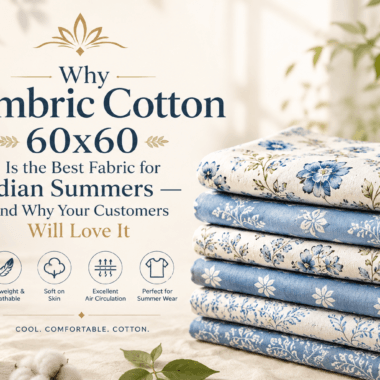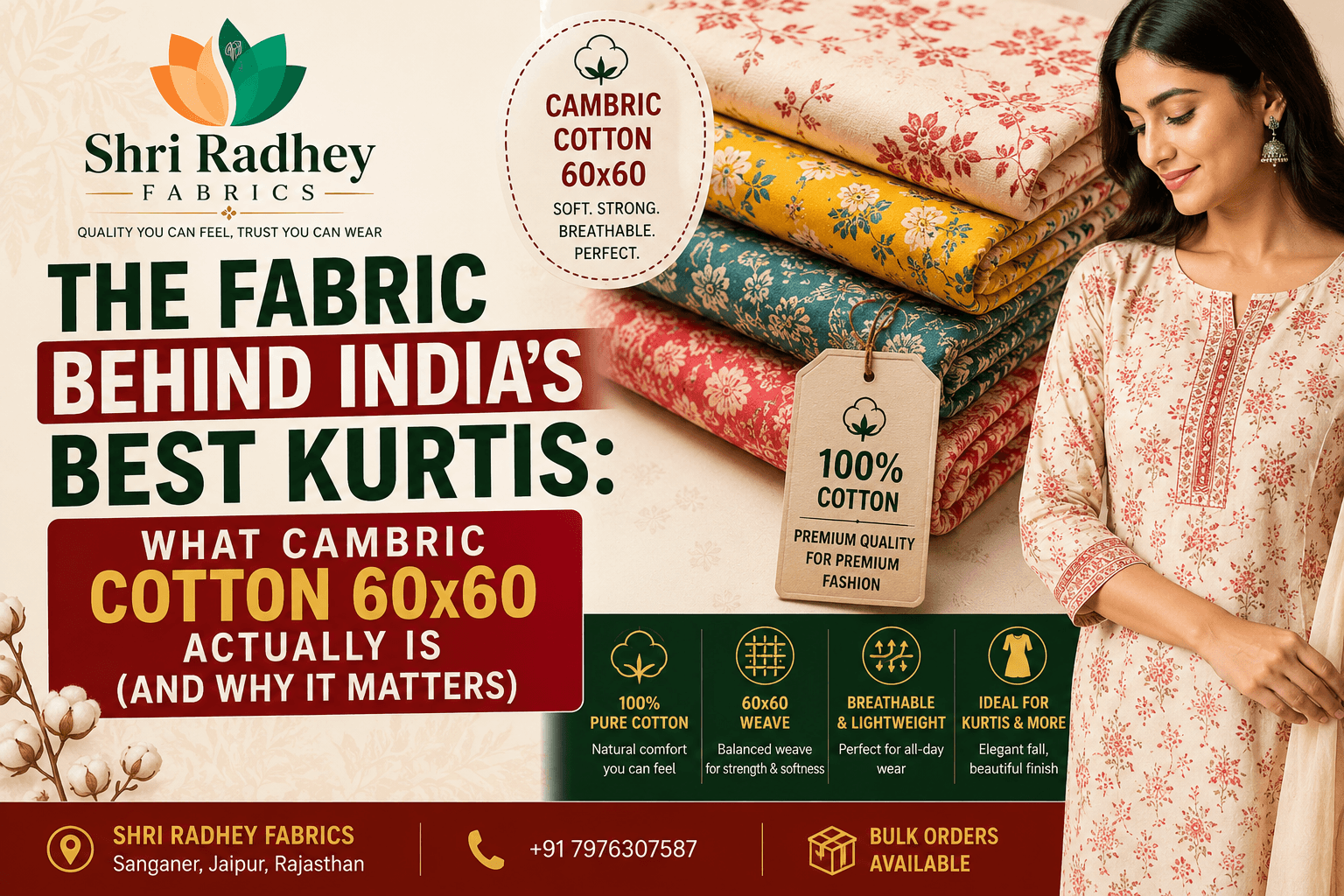
There is a fabric that sits at the heart of India’s ethnic wear market. It is the base on which Jaipur’s most beautiful block prints are pressed. It is the cloth that makes a kurta feel crisp in the morning and comfortable at noon. It is the material that wholesale buyers from London to Dubai keep ordering, season after season, because their customers keep coming back for more.
That fabric is Cambric Cotton 60×60.
If you have ever worn a well-made Indian block-print kurta and thought — this fabric feels different, somehow better — there is a strong chance it was cambric cotton 60×60 underneath that print. And if you are a fashion brand owner, a fabric buyer, or a designer trying to understand why some cotton fabrics perform so much better than others, understanding what those numbers mean and what they actually deliver is one of the most useful things you can know.
This is the complete guide. Written from our manufacturing unit in Sanganer, Jaipur — where we work with cambric cotton 60×60 every single day — this article explains what the fabric is, what the numbers mean, how it is made, what it does well, and why it is the first fabric we recommend to almost every new brand that comes to us asking where to start.
First — What Does “60×60” Actually Mean?
This is the question that most fabric articles dance around without ever answering directly. Let’s fix that immediately.
In textile specification language, “60×60” refers to the yarn count used in the fabric — specifically, that both the warp threads (running lengthwise along the fabric) and the weft threads (running crosswise) are spun from 60-count yarn.
Yarn count is a measure of yarn fineness. It is expressed using the English Ne (Number English) system, which is the standard used across India’s cotton textile industry. In the Ne system, the count number tells you how many 840-yard lengths of yarn can be spun from one pound of cotton fibre. The higher the count number, the finer — and thinner — the yarn.
So a 60-count yarn (written as 60s or Ne 60) is finer than a 40-count yarn (Ne 40) and coarser than an 80-count yarn (Ne 80). When a fabric specification says “60×60,” it means both the lengthwise threads (warp) and crosswise threads (weft) are made from 60-count yarn. This balance gives cambric 60×60 its characteristic uniformity — the fabric looks and feels even in all directions, with no directional difference in texture or weight.
Compare this to cheaper cotton fabrics, which often use unequal count combinations — 40s in one direction and 60s in another — to cut costs while maintaining some surface quality. The result is a fabric that is visibly less even, less smooth, and less consistent under printing. When you specify 60×60, you are specifying balance and quality in both directions simultaneously.
The Construction Behind the Fabric: 92×88
When fabric buyers and textile professionals write out the full specification of cambric cotton 60×60, it typically reads like this:
60×60 / 92×88
You now know what 60×60 means. The second set of numbers — 92×88 — refers to the thread count construction: 92 threads per inch in the warp direction (EPI — Ends Per Inch) and 88 threads per inch in the weft direction (PPI — Picks Per Inch).
Together, that is 180 threads per square inch — a dense, tightly woven structure that gives cambric 60×60 its characteristic smoothness, opacity, and body.
To understand why this matters, consider what happens at a lower thread count. A 60×60 yarn specification on a loosely woven fabric — say 72×68 construction — would produce a lighter, airier cloth with a more open weave. It would be more sheer, less crisp, and would print less cleanly because the open weave would allow ink or dye to bleed beyond the block or screen’s intended boundary.
At 92×88, the weave is tight enough to:
- Hold printed colour crisply without bleeding
- Maintain opacity without needing a lining
- Provide the slight surface tension that gives block prints their clean, defined edges
- Feel smooth and polished rather than rough or textured
This combination — 60-count fine yarn in a 92×88 construction — is what makes cambric cotton 60×60 the preferred block-print base fabric for serious manufacturers in Jaipur.
A Little History: From Cambrai, France to Sanganer, Jaipur
The name “cambric” traces back to Cambrai — a city in northern France (the Flemish called it Kameryk) that was famous for its extraordinarily fine linen weaving as far back as the 14th century. The original cambric was a fine linen cloth so smooth and tight that European nobility prized it for shirts, handkerchiefs, and delicate garments. By the 1700s it had become a status symbol in courts across France, England, and the Netherlands.
As cotton replaced linen in global textile production, the term “cambric” migrated to describe cotton fabrics woven to the same standard of fineness and density. Today, virtually all commercially available cambric is cotton — and the defining qualities that originally made Cambrai’s linen special (tight weave, smooth surface, crisp hand, subtle sheen) are precisely what modern cotton cambric delivers through fine-count yarns and careful finishing.
In India, cambric cotton found its perfect home. The country’s centuries-old block-printing tradition — centred in Sanganer and Bagru, just outside Jaipur — needed a cotton fabric that could hold fine printed motifs cleanly, accept natural and synthetic dyes deeply, and feel refined against skin while remaining affordable for everyday garments. Cambric 60×60 was the answer. Today it is the most widely used base fabric in Jaipur’s block-print manufacturing cluster, used from small artisan workshops to large-scale export units like our own.
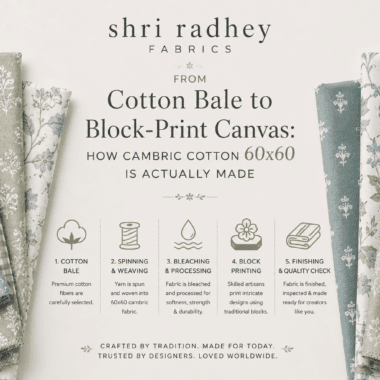
How Cambric Cotton 60×60 Is Made: From Yarn to Fabric
Understanding the production process gives fabric buyers a clearer sense of what they are paying for — and what shortcuts in that process look like when they appear in inferior fabric.
Stage 1: Cotton Selection and Spinning
Cambric 60×60 requires long-staple or medium-long-staple cotton to spin yarn at 60-count fineness. Shorter-fibre cotton cannot be spun fine enough for this specification — it breaks under the tension of fine spinning. In India, Shankar-6 cotton from Gujarat and Maharashtra is commonly used for medium-fine yarns, while extra-long-staple (ELS) varieties from Rajasthan and parts of Andhra Pradesh support the finest counts.
The cotton is carded, combed, drawn, and then ring-spun into 60s yarn. Combing — the removal of short fibres and impurities — is essential for fine-count spinning. A combed 60s yarn is noticeably smoother and more lustrous than a carded 60s yarn made from the same raw cotton, because combing removes the short fibres that create surface irregularity.
Stage 2: Weaving
The yarn is woven on shuttle or shuttleless (rapier or air-jet) looms in a plain weave — the simplest interlacing structure, where each weft thread passes alternately over and under each warp thread. The plain weave produces cambric’s characteristic smooth, even surface. It is the most balanced structure — equally strong in both directions and with no texture variation from one side of the fabric to the other.
The weaving density — 92 ends and 88 picks per inch — requires precise loom tension control. Fabric with inconsistent tension shows up as irregularities in weave density, which are visible under printed designs as variations in dye absorption. A well-woven cambric 60×60 has absolutely consistent density from selvedge to selvedge.
Stage 3: Greige Processing
Fresh from the loom, the raw (greige) cambric is stiff with sizing agents (starch applied to the warp yarn to protect it during weaving) and carries impurities from the fibre and spinning process. The greige fabric goes through:
- Desizing — removing the starch sizing with enzymes or hot water
- Scouring — washing with alkaline agents to remove natural waxes, oils, and impurities from the cotton fibre
- Bleaching — treating with hydrogen peroxide or sodium hypochlorite to achieve the bright white or off-white ground that Sanganeri block-print is famous for
Stage 4: Calendering — The Defining Finish
This is the step that gives cambric its signature character. After bleaching, the fabric passes through a calender — a machine that presses the cloth between heated, heavy rollers under high pressure. The heat and pressure compact the fibres slightly, smoothing the surface to a subtle sheen and giving the fabric its characteristic crisp, slightly polished hand feel.
This calendering finish is what separates true cambric from ordinary bleached cotton. An uncalendered bleached cotton of the same yarn count and construction will feel softer but slightly rougher and more matte. Calendered cambric has that distinctive feel — smooth, slightly firm, with a surface that catches light gently — that experienced buyers recognise immediately.
Stage 5: Printing (In Jaipur’s Context)
In Sanganer’s manufacturing units, the prepared cambric goes to the printing stage. Block printing, screen printing, or digital printing are applied to the smooth, bright white cambric surface. The tight weave ensures that dye or pigment paste sits precisely where it is placed — the fabric does not absorb ink unevenly or allow it to bleed into adjacent areas of the design.
This is why cambric 60×60 gives sharper print definition than lower-count, more loosely woven cottons. The tight construction is essentially a precision printing surface.
The Technical Specifications at a Glance
| Specification | Value |
|---|---|
| Yarn Count | 60s x 60s (Ne count, both warp and weft) |
| Weave | Plain weave |
| Thread Count | 92 EPI x 88 PPI (approximately 180 threads per sq inch) |
| GSM Range | 70–100 GSM (typically around 80–90 GSM) |
| Width | Standard 44–45 inches (112–114 cm); also available 58–60 inches |
| Finish | Calendered — smooth with subtle sheen |
| Fibre | 100% pure cotton |
| Typical Shrinkage | 3–5% first wash (standard for pure cotton) |
| Colour Options | White (bleached), off-white (half-bleached), greige (unbleached), dyed |
| Dye compatibility | Reactive, vat, pigment — all excellent |
| Print compatibility | Block print, screen print, digital print, pigment print — all excellent |
What Cambric Cotton 60×60 Actually Feels Like
Numbers and process descriptions are useful. But what does cambric 60×60 actually feel like in your hand?
Pick up a well-made piece of cambric 60×60 and you notice several things almost simultaneously.
The first is smoothness. The calendered surface has a quality that is distinct from both the soft fluffiness of mulmul and the rougher texture of a lower-count sheeting cotton. It is smooth in the way that the palm of a clean hand is smooth — even, consistent, with no variation.
The second is crispness. Cambric 60×60 has a slight body to it. It does not collapse limply when you hold it up — it holds itself slightly, the way a good dress shirt fabric holds its shape at the collar. This crispness is not stiffness — it is structure. When made into a kurta, it drapes cleanly rather than clinging or wrinkling chaotically.
The third is a subtle sheen. Not the bright, obvious lustre of a silk or a satin, but a gentle surface reflection that makes the white ground of a Sanganeri block-print kurta glow slightly in daylight. This sheen is entirely from the physical compression of the calendering process — no synthetic treatment, no coating.
The fourth is lightness with substance. At 80–90 GSM, cambric 60×60 is not heavy fabric. But it doesn’t feel insubstantial. This is the thread-count effect: the density of the weave adds tactile substance that a more open fabric of the same GSM would not have.
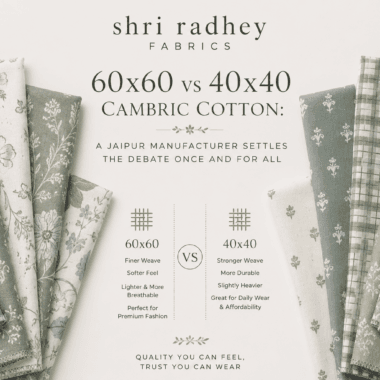
60×60 vs. Other Cambric Grades: What’s the Difference?
Cambric cotton comes in multiple count specifications. Understanding how 60×60 compares to the alternatives helps brands choose the right fabric for their product and price point.
40×40 Cambric (Standard Grade)
Made with coarser 40-count yarn, typically in a 60×60 or 72×68 construction. More common in lower-price-point kurta fabric and general apparel markets. The coarser yarn makes the weave slightly less smooth and less refined. Still a solid, widely-used fabric — but noticeably different to the touch compared to 60×60. This is the grade used in most mass-market printed cotton fabric across India.
60×60 Cambric (Premium Grade)
The focus of this article. Finer yarn, denser construction, better surface, cleaner print definition. The preferred grade for quality block-print fabric, premium export orders, and brands competing on quality rather than purely on price.
80×80 Cambric (Ultra-Premium)
Made with very fine 80-count yarn in a similarly dense construction. Lighter, even smoother, and significantly more expensive. Used in the finest handkerchief fabric, luxury Indian wear, and premium export shirting. The 80-count yarn is more demanding to weave without defects and the fabric is more delicate in wear.
The practical rule: For most fashion brand applications — kurtis, kurtas, co-ord sets, light home textiles — 60×60 is the ideal specification. It delivers a quality level that customers can feel, at a price point that works commercially. Going to 40×40 compromises the hand feel and print quality in ways that discerning customers notice. Going to 80×80 is premium pricing that most mid-range brands cannot justify.
Why Cambric Cotton 60×60 Is the Best Base for Block Printing
In Sanganer’s block-print manufacturing community, cambric 60×60 is the unchallenged standard for premium block-print fabric. Here is exactly why.
Clean print edges. The tight 92×88 weave prevents dye paste from bleeding beyond the block’s contact area. The result is sharp-edged motifs with clean lines — particularly important for fine Sanganeri florals, delicate paisley designs, and intricate geometric patterns where a few millimetres of bleed ruins the design.
Even dye absorption. Because the weave is consistent from edge to edge, the fabric absorbs dye evenly. There are no areas of thicker or thinner thread density that would create light or dark patches in solid-colour backgrounds.
Surface compatibility with wooden blocks. A block printer working with a finely carved teak-wood block needs the fabric surface to receive the block’s impression cleanly. The smooth, slightly firm cambric surface allows the block to make contact evenly across its entire carved face — producing consistent colour depth across the whole motif.
Colour vibrancy on a white ground. The bleached white or off-white surface of cambric 60×60 is the perfect canvas for bright, jewel-toned Sanganeri prints. The clean white ground makes printed colours appear more vibrant than they would on a greige or grey-ground fabric.
Suitable for both reactive and pigment dyes. Cotton’s natural cellulose chemistry bonds excellently with reactive dyes, which penetrate the fibre and become chemically part of it — producing vivid, wash-fast colours. Pigment dyes adhere to the smooth cambric surface cleanly, producing excellent colour without the stiffness that pigment printing sometimes causes on coarser fabrics.
Best Products to Make with Cambric Cotton 60×60
Based on our production experience in Sanganer, here is where cambric 60×60 consistently performs best:
Women’s ethnic wear: Block-printed kurtis, kurtas, salwar suits, co-ord sets, and printed cotton dupattas. The fabric’s combination of opacity, crispness, and drape makes it ideal for these garments. It holds its shape during wear, doesn’t cling uncomfortably, and washes and irons easily.
Men’s kurtas and shirts: The smooth surface and crisp hand make cambric 60×60 an excellent base for men’s ethnic wear. It presses cleanly, holds its shape, and breathes well in India’s warm climate.
Children’s garments: The smooth, non-irritating surface and good durability make it a popular choice for premium children’s ethnic wear.
Light home textiles: Printed cambric 60×60 makes excellent cushion covers, table runners, and decorative napkins — particularly for the export market where buyers want the visual richness of Jaipur block print in a fabric with enough body for home textile applications.
Fabric for resale: Cambric 60×60 in printed yardage — sold by the metre — is one of the most consistently popular wholesale fabric categories in India’s ethnic textile market. Fashion boutiques, tailors, and small garment makers are steady buyers.
What to Ask Your Manufacturer Before Ordering
If you are sourcing cambric 60×60 — from Jaipur or anywhere else — these are the five questions that protect you from receiving inferior fabric under the same name.
1. Can you confirm the yarn count is 60s in both warp and weft? Ask for the fabric specification sheet. The count should be documented, not just claimed verbally. Some suppliers sell 40×60 construction (coarser warp, finer weft) as “60×60” — which is not the same thing.
2. What is the construction (EPI x PPI)? Authentic cambric 60×60 should be approximately 92×88. A construction of 76×68 with 60×60 yarn would produce a much lighter, more open fabric that doesn’t behave like true cambric. Ask specifically for the thread density.
3. What is the GSM? Standard cambric 60×60 falls between 75–95 GSM. Significantly below 75 GSM suggests either the yarn count or construction is not as specified. Request a GSM certificate from a third-party testing lab for orders above 500 metres.
4. Is the fabric combed or carded? Combed yarn produces a smoother, cleaner surface — essential for fine block printing. Carded-only fabric will have more surface irregularity. For premium block print applications, always specify combed yarn.
5. What is the shrinkage percentage? Pure cotton cambric 60×60 shrinks approximately 3–5% in the first wash. A manufacturer who claims zero shrinkage is either pre-shrinking the fabric (which you should ask them to confirm) or misrepresenting the fabric’s fibre content.
Why Shri Radhey Fabrics Works with Cambric Cotton 60×60
We are a fabric manufacturer and wholesale supplier in Sanganer, Jaipur. Cambric cotton 60×60 is one of the foundational fabrics in our range — and it has been for years.
We supply it in several forms:
Greige (unbleached): For buyers who want to bleach, dye, or print themselves. The natural off-white colour of unbleached cambric takes colour beautifully.
Bleached white: The bright white canvas for Sanganeri block print. This is our most commonly ordered base for printed kurta fabric.
Piece-dyed solid colours: Cambric 60×60 dyed to your specified colour before printing — used for coloured-ground block prints.
Printed and ready: Block-printed, screen-printed, or digitally printed cambric 60×60 in our design range or in custom designs. Ready to cut and sew.
We supply in full fabric rolls for garment manufacturers and fabric wholesalers, and in specific print yardage for fashion brands building collections. Our minimum order quantities are kept flexible for new brands — because we understand that a brand’s first order is not its last.
Caring for Cambric Cotton 60×60 — What Your Customers Should Know
When your customers ask about caring for their cambric cotton kurtas or printed fabric, here is the practical guidance:
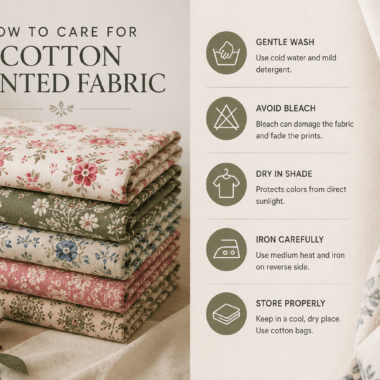
Washing: Machine wash cold or warm (up to 40°C) on gentle cycle. Avoid hot water, which accelerates colour fading and increases shrinkage beyond the first-wash norm.
First wash: Expect 3–5% dimensional shrinkage. This is normal and complete — subsequent washes will not shrink the fabric further.
Drying: Air dry in shade. Direct sunlight over long periods will fade printed colours — particularly reactive-dyed block prints.
Ironing: Cambric 60×60 irons beautifully. Medium heat, slightly damp. The calendered surface recovers its smoothness with ironing, maintaining the fabric’s characteristic crisp look wash after wash.
What not to do: Avoid bleach (it yellows the cotton over time), avoid fabric softener on block-print fabrics (it softens the binder in pigment-printed areas and can accelerate colour loss), and avoid tumble drying at high heat.
Cambric Cotton 60×60 and India’s Export Story
Cambric cotton fabric — particularly in the 60×60 specification — is one of India’s consistently strong textile export categories. It forms part of the cotton textile export basket that generated USD 9.36 billion for India in FY 2025-26, contributing to the country’s total textile export figure of USD 32.63 billion.
The India-UK CETA, which came into force in July 2026, reduces import duties for Indian cotton fabric and garments entering the UK — making Jaipur-sourced block-printed cambric kurtis more price-competitive in British retail than they have ever been. European buyers, similarly, are anticipating the India-EU FTA implementation in early 2027 with the same commercial logic.
For fabric buyers and fashion brands sourcing from Jaipur today, the combination of preferential market access opening up and the sustained global demand for authentic Indian craft textiles makes cambric 60×60 block-print fabric one of the most commercially interesting sourcing decisions available.
The Bottom Line on Cambric Cotton 60×60
Here is everything in plain language:
Cambric 60×60 is a fine-count, tightly woven, calendered plain-weave cotton fabric. The “60×60” tells you the yarn used in both directions is 60-count — fine, even, and consistent. The typical 92×88 thread construction gives it density without excessive weight. The calendering finish gives it its smooth, slightly crisp surface and subtle sheen. The result is one of India’s most commercially important and aesthetically excellent fabrics — the preferred base for Jaipur’s block-printing tradition and the backbone of India’s ethnic wear market.
If you are building a fashion brand and don’t know where to start on fabric: start with cambric 60×60. It is the fabric that has been earning customer loyalty in India’s textile market for generations. It prints beautifully, wears comfortably, lasts well, and tells a story of Indian craft and quality that resonates with buyers from Jaipur to London.
Shri Radhey Fabrics is a fabric manufacturer and wholesale supplier based in Sanganer, Jaipur — the heart of India’s block-print textile tradition. We supply cambric cotton 60×60 in greige, bleached, dyed, and printed form to fashion brands and fabric wholesalers across India and globally. Low MOQ available for new brands. Visit shriradheyfabrics.com or DM us on Instagram @shriradheyfabrics for samples and bulk enquiries.