Every week, someone walks into a fabric market in Jaipur — or lands on a manufacturer’s website at 2am — with the same dream. They have a brand name picked out. They have a logo sketched in their notes app. They have a mood board on Pinterest with a very clear aesthetic. They know exactly what they want their brand to feel like.
What they don’t always know is how to get from that feeling to a finished garment. And more specifically — they don’t know that the single most important decision they’ll make in the first six months isn’t the logo, isn’t the Instagram handle, and isn’t the pricing strategy. It’s the fabric.
India’s textile and apparel market reached USD 248.70 billion in 2025 and is growing at over 11% annually. The global apparel market sits at USD 1.9 trillion and continues to grow. Fashion textiles are growing at 12.6% driven by the D2C revolution and the booming luxury ethnic wear segment. The opportunity is genuinely enormous. But the failure rate for new clothing brands remains high — and a significant portion of those failures trace back to poor fabric decisions made in the early stages, before the brand even had customers.
This guide is written from our factory floor in Sanganer, Jaipur — where we’ve worked with hundreds of fashion brands, from first-time founders with ₹2 lakh budgets to established labels doing international exports. It covers everything a founder needs to know about using Indian cotton printed fabrics to build a clothing brand that actually lasts.
Why Indian Cotton Printed Fabric Is the Right Foundation
Before we get into the how, let’s spend a moment on the why. Because there are a lot of fabric options available to a new clothing brand — polyester from China, rayon from Surat, imported stretch fabrics, synthetic blends in every finish imaginable. So why choose Indian cotton printed fabric as your foundation?
The answer has three parts.
First, the market is moving toward natural fibres and craft. India’s textile market sees natural fibres commanding 56% of total market share, and that share is growing as consumers and brands shift toward sustainable, breathable, and traceable materials. The global sustainable fashion market is on a clear trajectory upward, driven by a generation of buyers who read labels and ask where their fabric came from. Indian cotton — especially printed cotton from Jaipur’s block-print clusters — is one of the most compelling answers to that question.
Second, India’s position is unmatched. India is the world’s largest producer of cotton. It has a craft textile ecosystem — particularly in Rajasthan — that has no genuine equivalent anywhere else in the world. The skills, the traditions, the printing techniques, the artisan communities that make Jaipur’s block-print cotton special cannot be replicated by a factory in Bangladesh or a mill in Turkey. When you build a brand on Indian cotton printed fabric, you are building on a genuine differentiator.
Third, the economics work. Indian cotton printed fabric — sourced directly from manufacturers in Jaipur — offers a combination of quality, price, and minimum order flexibility that is difficult to find anywhere else. A new brand can start with small quantities, test designs, learn what their customers respond to, and scale from there. The Jaipur manufacturing ecosystem — including our own unit in Sanganer — is set up for exactly this kind of phased growth.
Step 1: Get Absolutely Clear on Your Brand Before You Order a Single Metre
This is where most new founders make their first mistake. They’re so excited to have physical fabric in their hands that they order before they’ve made the foundational decisions that should drive the fabric choice.
Your brand needs four things defined before you go near a fabric supplier.
Your customer. Not “women between 20 and 40” — that describes half the planet. Get specific. Is it working women in Bangalore who wear cotton kurtas to office three days a week and brunch on weekends? Is it shoppers in the UK who discovered Indian block print on Instagram and want something that looks authentically handmade? Is it boutique owners in the US who stock South Asian-inspired home textiles? The more specific your customer, the clearer your fabric choice becomes.
Your price point. Your fabric cost needs to fit inside your pricing architecture. A sustainable, OEKO-TEX certified hand block print cotton commanding a premium price point can justify a higher fabric cost than a fast-fashion co-ord set competing on price. Figure out what your customer will pay, work backward at a 3-4x markup on cost of goods, and you’ll know exactly what fabric budget you have to work with.
Your aesthetic. Indian cotton printed fabric comes in an enormous range — from Sanganer’s fine floral block prints on white grounds to Bagru’s earthy natural-dye dabu prints, from vibrant screen-printed geometrics to subtle pigment-print botanicals. Your mood board should point you clearly toward one end of this spectrum. Share it with your manufacturer. A good manufacturer will immediately be able to tell you which fabrics match your aesthetic and which don’t.
Your category. Are you making apparel or home textiles? Women’s wear, men’s wear, kidswear? Kurtas, co-ords, sarees, scarves, bedsheets, cushion covers? Your category determines your GSM range, your fabric type, your printing technique, and your construction requirements. Get this clear before any other conversation with a manufacturer.
Step 2: Understand the Fabric Options You’re Actually Choosing Between
Indian cotton printed fabric is not one thing. It is a family of options, each with different characteristics, different ideal applications, and different manufacturing implications. Here is the practical guide to the main fabric types a new brand will encounter.
Mulmul / Muslin (50–90 GSM)
India’s lightest cotton. Feather-soft, semi-sheer, absolutely breathable. Mulmul is the fabric of summer India — the dupatta that flies in the breeze, the lightweight kurta that feels like wearing almost nothing in 40-degree heat. Block prints on mulmul have a soft, slightly diffused quality because the light base moves slightly under the pressure of the block. This is considered part of the fabric’s charm, not a defect.
Best for: dupattas, sheer kurtis, summer scarves, beach cover-ups, infant garments. Not ideal for structured garments or anything that needs to hold its shape.
Cotton Cambric (100–140 GSM)
The workhorse of Jaipur’s printed cotton industry. Cambric is tightly woven, smooth, opaque, and takes both block print and screen print cleanly. It is the fabric that probably comes to mind when someone says “Jaipur printed cotton” — it has that crisp, clean quality that makes printed motifs look sharp and vibrant. It sews easily, washes well, and works across seasons.
Best for: kurtis, kurtas, printed dress material, light co-ord sets, summer shirts, everyday ethnic wear. This is the starting point for most new brands building around Indian block print.
Cotton Voile (70–110 GSM)
Lighter than cambric but slightly more structured than mulmul. Voile has a gentle drape and a subtle sheen that makes it particularly popular for occasion wear and semi-formal garments. It takes fine-line prints exceptionally well. International buyers, particularly from Europe, love voile for its combination of lightness and elegance.
Best for: occasion wear kurtas, printed saree fabric, summer dresses, stoles, festive wear collections.
Cotton Poplin (110–145 GSM)
Poplin has a characteristic fine horizontal rib in its weave that gives it a slightly crisper hand than plain cambric. It is excellent for shirts and structured tops. Printed poplin — particularly with screen print or digital print — is a strong choice for brands building around Indo-western or fusion wear.
Best for: structured shirts, Indo-western tops, formal-casual shirts, printed co-ord tops.
Rayon / Viscose (110–160 GSM)
Technically not cotton, but worth mentioning because it’s often grouped with cotton printed fabrics in sourcing conversations. Rayon has a beautiful liquid drape that pure cotton can’t match and takes printed colour with exceptional vibrancy. Many brands use rayon alongside cotton — cotton for structured or lightweight pieces, rayon for flowy, drape-heavy designs.
Best for: flowy kurtas, maxi dresses, fluid co-ord sets, occasion wear.
Heavy Cotton / Cotton Canvas (200–300 GSM)
For brands moving into home textiles, bags, or structured outerwear. Heavy cotton takes print differently — the higher GSM requires more printing paste and a firmer block or screen. The resulting print has a slightly different character — more saturated, less delicate.
Best for: bedsheets, cushion covers, curtains, tote bags, structured jackets.
Step 3: Choose Your Printing Technique — This Changes Everything
The printing technique applied to your cotton fabric is not a secondary decision. It defines your brand’s visual language, your production timelines, your minimum order requirements, and your sustainability story.
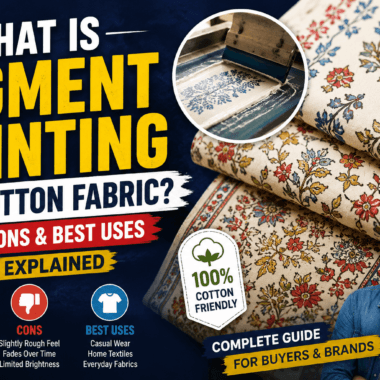
Hand Block Printing
The oldest and most distinctly Indian of the printing methods. Carved wooden blocks pressed by hand onto cotton fabric create prints that are recognisably imperfect — no two impressions exactly identical, with the slight registration shifts and organic edges that no machine can replicate. For brands building around craft authenticity, artisan storytelling, or slow fashion positioning, hand block print is unmatched.
The two main traditions — Sanganer (fine, vibrant, white-ground florals) and Bagru (earthy, bold, natural-dye resist prints) — give brands two very different aesthetic directions to choose from. Block printing has longer lead times than machine printing and is best suited to fabrics between 90–170 GSM.
Best for: premium ethnic wear brands, sustainable fashion labels, export-focused brands targeting UK/EU/US buyers, artisan-story brands.
Screen Printing
Flat bed or rotary screen printing applies colour through mesh screens with squeegee pressure. It is more consistent than block printing, faster in production, and allows more complex multi-colour designs with tighter registration. Screen printing is the most commercially scaled printing method in Jaipur’s manufacturing clusters.
Best for: brands needing consistent large-volume production, fast-fashion-adjacent labels, home textiles, brands with more complex or fine-detail designs.
Digital Printing
Inkjet technology applied directly to fabric. Digital printing requires no screens and no blocks — designs are sent directly from a computer to the printing machine. This means zero setup cost for new designs, the ability to print single metres for sampling, and photographic-quality detail. For new brands still testing designs before committing to bulk, digital printing is genuinely transformative.
The 2026 digital textile printing market is valued at USD 4.43 billion and growing at 15.1% annually — the fastest growth of any printing method in the industry. For new fashion brands, digital sampling before committing to block or screen production is increasingly standard practice.
Best for: design sampling, small-batch initial collections, photographic or highly detailed designs, brands that need to test quickly before scaling.
Pigment Printing
A versatile, cost-effective method that works across all fabric types including cotton-polyester blends. Pigment printing uses surface-adhesion chemistry and produces excellent light fastness. It is the method of choice for mid-market home textiles and casual fashion where production volume and consistency matter more than the artisanal story.
Best for: bedsheets, curtains, casual apparel, blended fabrics, mid-market price points.
Step 4: Sort Out Your Legal Foundation — Don’t Skip This
Before you place your first bulk fabric order, get the legal basics in order. This protects you, makes manufacturers take you more seriously, and enables GST input credits that reduce your costs.
Register your business. For a new clothing brand, a Sole Proprietorship is the fastest start — register it at your local municipal corporation. As you scale, convert to an LLP or Private Limited Company for better liability protection and credibility with larger suppliers and B2B buyers.
Get GST registration. This is non-negotiable from day one. GST registration allows you to claim input tax credit on fabric purchases, which immediately reduces your effective fabric cost. Any manufacturer worth working with will ask for your GSTIN when placing an order.
Trademark your brand name. File your trademark application with the Intellectual Property India portal before you launch publicly. Trademark filing is inexpensive (₹4,500 for a small entity) and protects your brand name from being copied once it builds value. Do not wait on this.
Understand the legal fabric labels requirement. If you’re selling garments in India, the Legal Metrology (Packaged Commodities) Rules require care labels with fibre composition, country of origin, manufacturer details, and washing instructions. For export, EU and UK markets have their own labelling requirements. Build this into your garment specification from the start.
Step 5: Find the Right Manufacturer — And Know What to Ask
The manufacturer you choose in your first year will shape everything. The wrong choice means inconsistent quality, missed deadlines, minimum orders you can’t afford, and a brand built on a shaky production foundation. The right choice gives you a partner who grows with you.
Here is what a genuinely good Indian cotton printed fabric manufacturer should offer:
Transparent fabric sourcing. They should be able to tell you exactly what cotton they’re using — which mill, what GSM, what construction — and provide lab test certificates confirming fibre composition.
Sample capability before bulk orders. Any manufacturer unwilling to provide samples before a bulk order is not a manufacturer you want. Sampling reveals print quality, fabric quality, stitching quality, and GSM accuracy before you’ve committed money to a production run.
Documented GSM specifications. Every fabric in their range should have a documented GSM with a tolerance of ±5%. If they can’t tell you the GSM of the fabric they’re selling you, walk away.
Low MOQ flexibility for new brands. The most important thing for a new brand is the ability to test and learn without overcommitting to inventory. Look for manufacturers who can work with initial orders of 100–300 metres or 50–200 pieces, with the understanding that MOQ flexibility improves with relationship history.
Clear turnaround timelines. Block printing takes longer than screen printing. Custom dyeing takes longer than stock colours. Get realistic lead times in writing before confirming an order.
Certifications relevant to your market. If you’re selling in India to sustainability-conscious buyers, OEKO-TEX Standard 100 is the most recognised certification. For EU export, GOTS (Global Organic Textile Standard) is essential for organic cotton claims. Ask your manufacturer which certifications they hold or can access.
At Shri Radhey Fabrics in Sanganer, Jaipur, we work with new brands from their very first sample order. We supply pure cotton, rayon, and custom printed fabrics across the full range of printing techniques — block print, screen print, digital print, pigment print — with complete technical documentation, GSM certificates, and low MOQ for brands in their early stages.
Step 6: Build Your First Collection the Smart Way
New brands consistently make the same collection-building mistakes. Here is how to avoid them.
Start with three to five fabrics, not fifteen. Every fabric in your collection needs its own sampling run, its own production block, its own care label specification. New brands that try to launch with ten different fabrics dilute their focus, exhaust their budget on sampling, and end up with a collection that has no coherent aesthetic identity. Pick three fabrics that work together harmoniously. Master them. Expand later.
Develop your hero print first. Your hero print is the signature design that customers will associate with your brand — the one that appears in your launch campaign, gets shared on Instagram, and becomes the visual identity of your first collection. Invest the most sampling effort here. Get the colour, the registration, the fabric choice exactly right. Everything else in the collection can be simpler.
Sample on the actual fabric you’ll produce on. This sounds obvious, but many new brands approve a design on a digital printout or a fabric sample of a slightly different GSM, then are surprised when the production fabric looks different. Always approve prints on the exact fabric spec — same GSM, same construction, same pre-treatment — that your production run will use.
Build for three price points within the collection. Having an entry-level piece (a lighter fabric, simpler construction), a mid-range piece (your main collection items), and a premium piece (heavier fabric, more construction detail) gives customers choice and gives you a framework for testing what your market responds to.
Order 30% more fabric than your first production run needs. Fabric runs out. The exact batch match for your first print — same dye lot, same GSM, same block carving — may not be available six months later. Buffer stock gives you the ability to restock bestsellers without a new development cycle.
Step 7: Pricing Your Printed Cotton Collection Correctly
This is where many new brands leave money on the table or price themselves out of the market. Here is the framework.
Your cost of goods sold (COGS) for a finished garment typically includes:
- Fabric cost per metre
- Printing or dyeing cost (if separate from fabric)
- Cut and sew / garment manufacturing cost
- Trims: buttons, threads, zippers, labels
- Packaging: polybag, tissue, hangtag
- Quality checking and finishing
Add these up. This is your total COGS per piece.
For a sustainable, craft-positioned brand selling Indian cotton printed fabric directly to customers, a 3.5x to 4x markup on COGS is the standard range. So if your COGS per kurta is ₹450, your retail price should be ₹1,575–₹1,800.
For export-focused brands selling to wholesale buyers in the UK or EU, the calculation changes. Your selling price to the importer might be 1.5–2x your COGS, and the importer adds their own markup. Understand the full price chain before setting your factory-gate price.
Step 8: Go to Market — Where and How
The Indian fashion brand landscape in 2026 offers more routes to market than ever before. Here are the most effective for a new brand built on Indian cotton printed fabrics.
Direct to consumer via Instagram and your own website. This is where the most successful new Indian brands have been built over the past four years. Instagram allows you to tell the fabric story — the block-printing process, the artisan community, the Jaipur craft heritage — in a way that no marketplace listing can. Your own website (Shopify is the platform most Indian fashion D2C brands use) captures margin that marketplaces take. The combination of Instagram storytelling and website sales is the standard playbook for new Indian craft fashion brands.
India’s fashion marketplaces. Nykaa Fashion, Myntra, Ajio, and Tata Cliq are the four main marketplaces worth considering for Indian cotton printed fabric brands. Myntra in particular has a strong ethnic wear buyer base. Getting listed takes time — expect a 2–4 week onboarding process and be prepared for photography and catalogue standards that are more demanding than your own website.
WhatsApp commerce. Often underestimated by new brands. A well-maintained WhatsApp broadcast list of customers who have already bought from you or enquired is one of the most efficient sales channels available. No algorithm. No platform fees. Direct to your buyer.
Export — the UK, UAE, and US market for Indian craft textiles. If your aesthetic is block print or natural dye, you have a genuinely strong international market available. The India-UK CETA, now in force from July 2026, gives Indian textile exports duty-free access to the UK — a market with established demand for Indian craft textiles and willingness to pay premium prices for authenticity. The UAE is India’s fastest-growing textile export destination at 22% growth year-on-year. For export, connect with the Apparel Export Promotion Council (AEPC) which runs international buyer programmes and trade fairs.
B2B wholesale to boutiques. A model many founders overlook. Selling wholesale to 20 boutique stores — each taking 50–100 pieces per season — is less glamorous than building a D2C brand on Instagram but far more financially stable in the early years. Boutique owners in India, the UK, and the US actively look for authentic Indian printed cotton brands with consistent quality and a clear aesthetic. Your Jaipur manufacturer connection is a genuine selling point here.
Step 9: The Sustainability Story — Your Biggest Brand Asset
In 2026, sustainable fashion is not a niche. It is the direction the entire market is moving.
India’s government has launched Kasturi Cotton — a first-of-its-kind branding, traceability, and certification exercise promoting Indian cotton across domestic and overseas markets. The five-year Cotton Mission focuses on climate-smart, pest-resistant cotton varieties including extra-long staple (ELS) cotton. These government initiatives are creating a framework of traceability and certification for Indian cotton that brands can leverage immediately.
For a clothing brand built on Indian cotton printed fabrics, the sustainability story is genuinely powerful — if it’s true. Natural cotton fibre. Traditional printing techniques. Artisan employment. Low-water processes (particularly for pigment printing). Natural dyes (for Bagru block print). These are not marketing constructs. They are real attributes of the production process, and buyers in the UK, Germany, UAE, and Japan are actively seeking exactly these credentials.
The key is being specific rather than vague. “Eco-friendly” means nothing. “Hand block printed on 100% pure cotton using AZO-free dyes by Chhipa artisans in Bagru, Jaipur” means everything. The more specific your production story, the more powerful your brand credential.
The Honest Truth About Starting Small
Here is what nobody in the fashion industry likes to say out loud: most successful clothing brands started very small, looked very different from what they became, and learned almost everything important from their first collection’s mistakes.
The brands that make it are not the ones with the biggest launch budgets or the most polished initial branding. They are the ones that started with honest curiosity — about their fabric, their customer, their market — and built patiently from there.
Indian cotton printed fabric gives you an extraordinary foundation to build on. The craft is 500 years old. The fabric is exceptional. The manufacturing infrastructure in Jaipur is among the best in the world for what it does. The global market is growing. The sustainability credentials are real.
The question is whether you’re willing to learn the details — the GSM numbers, the printing techniques, the fabric specs, the manufacturer questions — that turn a dream brand into a real one.
Start there. Everything else follows.
Your Starting Checklist
□ Define your customer, price point, aesthetic, and category
□ Choose your fabric type and GSM range
□ Choose your primary printing technique
□ Register your business and get GST
□ File your trademark application
□ Request samples from 2–3 manufacturers
□ Do burn test and water test on all fabric samples
□ Confirm GSM with lab certificate
□ Develop your hero print first
□ Start with 3–5 fabrics maximum
□ Price at 3.5–4x COGS for D2C
□ Choose your primary sales channel
□ Build your sustainability story specifically
□ Order 30% fabric buffer stock with first run
□ Launch and learn
Shri Radhey Fabrics is a fabric manufacturer and wholesale supplier based in Sanganer, Jaipur — the heart of India’s block-print textile tradition. We supply pure cotton, rayon, and custom printed fabrics to fashion brands across India, the UK, UAE, USA, and beyond — with low MOQ for new brands, complete technical documentation, and in-house garment manufacturing. Visit us at shriradheyfabrics.com or DM us on Instagram @shriradheyfabrics to request samples and discuss your first collection.