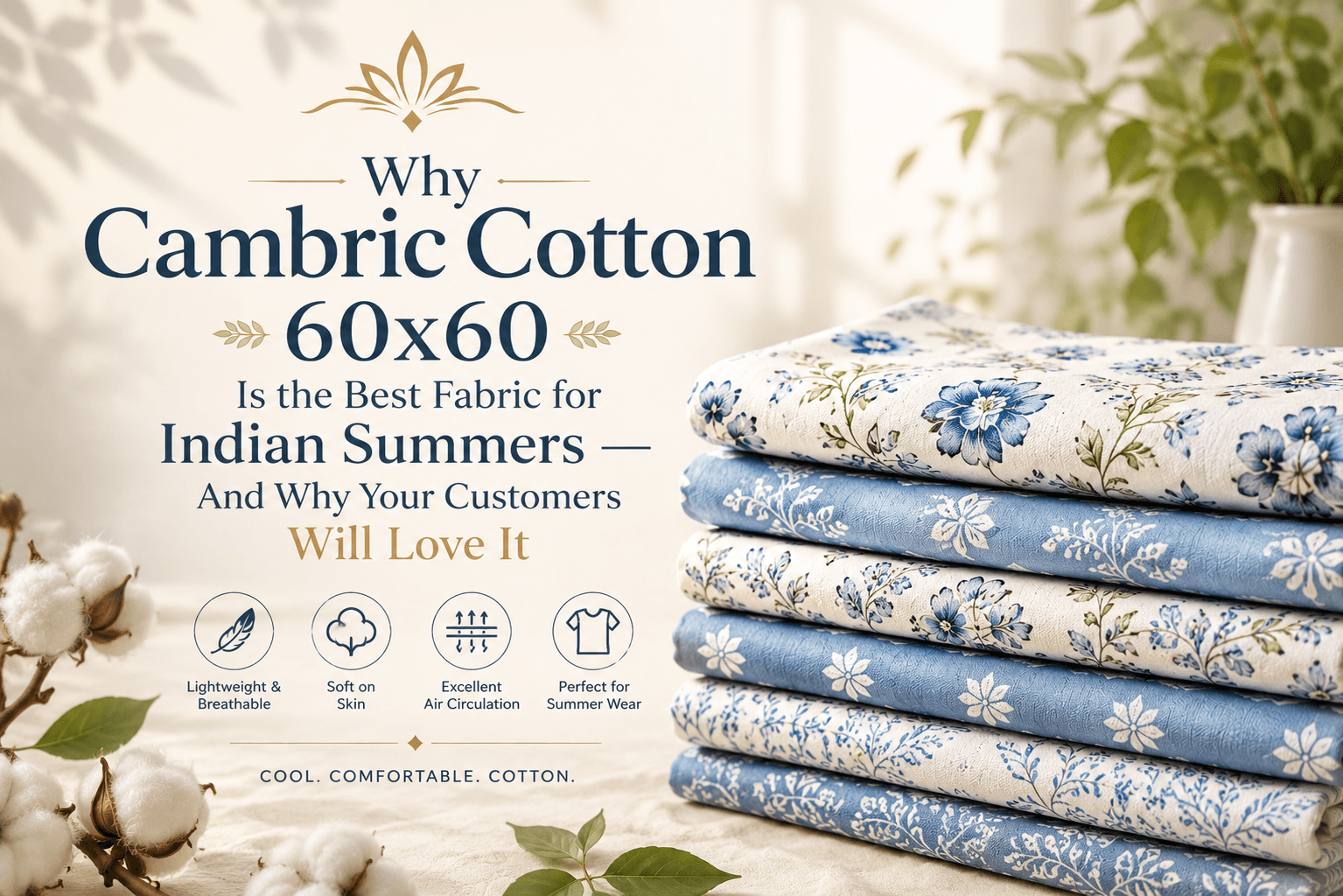
Let’s start with the most honest thing a fabric manufacturer can say about Indian summers.
India is not one summer. It is six or seven different summers happening simultaneously across a subcontinent. The damp, pressing heat of coastal Mumbai where 85% humidity makes even a light fabric feel like a second skin. The searing, bone-dry heat of Jaipur and Jodhpur where 44°C in the shade is an ordinary Tuesday in May. The transitional heat of Delhi and Lucknow — dry one week, humid the next — that catches you off guard every single season. The gentler warmth of Bangalore and Pune where summer is more of a suggestion than an assault.
Each of these climates makes different demands on fabric. And yet across every one of them, one fabric has been worn, trusted, and reached for across five centuries of Indian textile history.
Cambric cotton 60×60.
This is not a coincidence. It is not marketing. It is the outcome of a fibre, a weave structure, and a finishing process aligning almost perfectly with the physiological and practical demands that Indian summers place on the clothes people wear in them. This article explains exactly why — from the science of cotton’s breathability to the specific way the 60×60 specification handles print quality in heat — and why, in 2026, as India’s fashion consumers become increasingly educated about fabric choice, this knowledge translates directly into customer satisfaction and brand loyalty for the brands that source it correctly.
What an Indian Summer Actually Asks of Fabric
Before we talk about why cambric 60×60 works, it is worth being specific about what Indian summer conditions actually require of a fabric. Because “breathable” and “comfortable” are words that get applied to almost every fabric in marketing language, and they have almost lost their meaning.
Indian summer fabric needs to do four specific things simultaneously. It needs to absorb perspiration quickly before it accumulates against the skin. It needs to release that moisture into the surrounding air efficiently, so the evaporation process cools the skin rather than leaving the fabric damp and clingy. It needs to allow air to circulate between the skin and the fabric surface, creating the micro-ventilation that is the primary mechanism of natural cooling. And it needs to do all of this while still looking good — holding its print, maintaining its colour, keeping its shape through a day of movement, heat, and multiple rounds of perspiration and partial evaporation.
Synthetic fabrics — polyester, nylon, most blends — fail the first two requirements. They do not absorb moisture well because their fibres are non-porous. Moisture sits on the surface or accumulates at the skin-fabric interface. The evaporative cooling mechanism that makes natural fibres work in heat simply does not operate. Research consistently confirms that polyester blends trap perspiration against the skin and retain heat — the blend traps perspiration against the skin and retains heat, which reduces comfort in warm conditions. This is why wearing a polyester kurta in Rajasthan in May is an experience that no amount of “moisture-wicking” marketing can make pleasant.
Natural fibres — cotton, linen, khadi — do all four things because they are made of cellulose, a molecular structure with inherent moisture affinity. Cotton fibre can absorb up to 25–27 times its own weight in water before it feels wet to the touch. The moisture wicks from skin into fibre, the fibre releases it into surrounding air through evaporation, and the skin temperature drops. This is natural air conditioning, operating through chemistry and physics, with no electronics required.
Cotton continues to dominate summer 2026 collections globally, largely because of its unmatched breathability and skin-friendly comfort. The fashion market is confirming what Indian consumers have known for centuries: for genuine summer comfort in a warm climate, cotton is the baseline against which everything else is measured.
So the question is not why cotton. The question is: among cotton fabrics, why 60×60 cambric specifically?
The 60×60 Specification: Built for Summer Without Knowing It
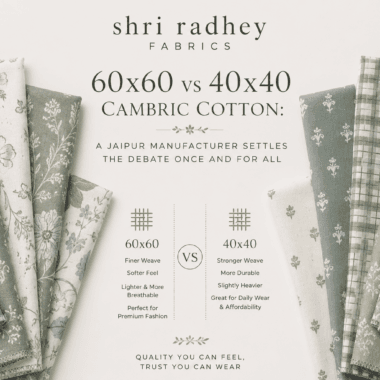
The 60×60 specification — 60-count fine yarn in both warp and weft, woven at approximately 92×88 threads per inch in a plain weave — was not designed specifically for summer wear. It was developed by fabric manufacturers over generations in response to what buyers wanted: a smooth, printable, affordable cotton fabric that felt refined against skin. But the properties that make 60×60 cambric excellent for printing are exactly the properties that make it excellent for summer wear. The two requirements reinforce each other in a way that is genuinely elegant.
Fine yarn means breathable weave.
A 60-count yarn is finer and thinner than a 40-count yarn. When finer threads are woven at similar density to coarser threads, the resulting fabric has a more refined pore structure — the gaps between threads are smaller, more numerous, and more uniformly distributed. This produces a fabric that has excellent air permeability in aggregate (the total airflow through the fabric per unit area) while maintaining opacity (because no individual pore is large enough to be visible to the naked eye).
The practical result: cambric 60×60 allows air to move through it freely without being sheer. Lightweight fabrics suitable for Indian summer should sit between 80–160 GSM for genuine comfort. At 80–95 GSM, cambric 60×60 sits in the lower half of that range — comfortably summer-appropriate — while its tight construction gives it the opacity of a heavier fabric.
Plain weave is the most thermally efficient weave structure.
Plain weave — where every thread alternately passes over and under every adjacent thread — creates the most balanced, most porous weave structure possible for a given thread density. More complex weave structures like twill or satin create longer “floats” where threads pass over multiple adjacent threads before interlacing again. These floats reduce porosity (the thread covers more of the fabric surface without gaps) and increase the thermal mass of the fabric surface.
Plain weave has no floats. Every thread interlaces with every adjacent thread, maximising the number of pore spaces per unit area. For summer breathability, plain weave is not a compromise — it is the optimal structure. And cambric 60×60 is, at its core, a fine-count plain weave.
Calendering creates a skin-friendly surface.
The calendering process — pressing the fabric through heavy heated rollers to create cambric’s characteristic smooth surface — does something for summer wear that is rarely discussed. It compresses and smooths the fibre ends on the fabric surface, eliminating the micro-fuzziness of untreated bleached cotton. That smooth surface is significantly more comfortable against skin in heat than a rough or fuzzy surface.
Here is why: when skin perspires in heat, it produces a thin film of moisture that can cause fabric to stick. A smooth calendered surface has lower surface friction and less mechanical interaction with perspiring skin than a textured or fuzzy surface. The result is that cambric 60×60 lifts slightly away from the skin as you move — never clinging, never dragging — in a way that coarser cotton fabrics do not.
This is the sensation that experienced buyers describe as cambric feeling “cool against the skin.” It is not an illusion. It is a specific consequence of the calendered surface reducing adhesion between damp skin and fabric.
The GSM Reality: Why 80–95 GSM Is the Summer Sweet Spot
One of the most important things fabric buyers and fashion brands need to understand about summer fabric is that GSM and breathability are not the same thing. GSM measures weight per area — how much fabric is packed into each square metre. Breathability measures how freely air moves through the fabric. A lightweight fabric can be poorly breathable if its weave is too tight. A heavier fabric can be surprisingly breathable if its weave structure is open.
Cambric 60×60 at 80–95 GSM sits in a summer-specific sweet spot that is not accidental.
It is light enough that the thermal mass of the fabric does not add meaningfully to the wearer’s heat load. When you wear a fabric, your body must warm the fabric from ambient temperature to body temperature. A heavier fabric requires more energy (and more of your body heat) to warm. A 90 GSM cambric warms to body temperature almost immediately — it adds negligible weight and warmth. A 200 GSM cotton twill takes longer to warm and retains more heat at the fabric-skin interface.
It is heavy enough that it drapes cleanly and maintains its shape through a full day’s wear. Fabrics significantly below 80 GSM — mulmul at 60–70 GSM — are beautiful and supremely light but can feel clingy in humidity because they have so little body that they follow the skin’s contours closely when damp. Cambric 60×60’s slight body means it maintains a small air space between the fabric and the skin even when warm, which is exactly the condition that allows the evaporative cooling mechanism to operate.
Organic cotton at 120–150 GSM also suits Indian regional summer conditions — this is true, and cambric 60×60 at 80–95 GSM is even lighter than that range, making it one of the most summer-optimised GSM specifications in the entire cotton fabric range.
The Print Factor: Why Block Print on Cambric 60×60 Is the Summer’s Perfect Garment
For Jaipur’s block-print manufacturers and the fashion brands that source from us, there is a specific reason why cambric 60×60 block print is the dominant product in India’s summer ethnic wear market.
It is not just the comfort of the base fabric. It is the way print and fabric combine to create a garment that is simultaneously the right weight, the right texture, the right visual language, and the right cultural reference for Indian summer wear.
The white or off-white ground of bleached cambric 60×60 is visually cooler than a dark-ground fabric. This is both psychology and physics. Lighter colours reflect more of the sun’s visible and near-infrared radiation rather than absorbing it — a white cotton garment in direct sunlight absorbs measurably less radiant heat than a dark one made of the same fabric. The traditional white or cream grounds of Sanganeri block print are not just aesthetically traditional. They are thermally intelligent choices for a culture that developed in Rajasthan’s intense sun.
The motifs — fine florals, delicate paisleys, botanical prints — are printed with reactive or natural dyes that penetrate the cotton fibre rather than sitting on its surface. This means the print does not create a surface barrier that interferes with the fabric’s breathability. A pigment-printed fabric has an acrylic binder coating on its surface that, at high coverage, can reduce air permeability compared to the unprinted base. A reactive-dyed block print on cambric 60×60 maintains full breathability because the colour is inside the fibre, not on top of it.
AZO-free reactive dyes, which bond chemically with the fibre rather than sitting on the surface, provide better colourfastness under prolonged sun exposure. In a country where garments are frequently worn in direct sun, reactive-dyed block prints on cotton hold their colour significantly better than pigment-printed alternatives under UV exposure — a practical summer advantage that translates directly into longer garment life and better customer satisfaction.
The Customer Experience: What Your Buyers Actually Feel
Fashion brands sourcing cambric 60×60 block print for their summer collections are ultimately selling a customer experience. Understanding what that experience is — at the sensory level — helps brands communicate it correctly and set the expectations that lead to loyal customers.
The first touch. When a customer picks up a cambric 60×60 garment, the first sensation is the smooth, slightly cool surface of the calendered cotton. At room temperature, the fabric feels noticeably cooler than synthetic fabrics because cotton is a better thermal conductor than polyester — it draws heat away from the fingertips more quickly, producing the sensation of coolness. This is a genuine physical difference, not a perception.
Putting it on. A well-cut kurta in cambric 60×60 sits away from the body slightly — the fabric has enough body to maintain shape without draping directly onto the skin. In the first moments of wearing, the fabric feels light, clean, and cool. There is no clinging. There is no immediate warmth of the kind synthetic fabrics produce by trapping body heat.
Through the day. As the wearer perspires in summer heat, the cambric absorbs moisture into its fibres. The evaporation of that moisture cools the skin. The wearer may feel the fabric become slightly damp in areas of high perspiration, but because cotton’s absorption capacity is high, the surface does not feel wet to others — the moisture is absorbed into the fibre structure, not sitting on the surface. After several hours in Indian summer heat, a good cambric 60×60 kurta feels noticeably more comfortable than it would in a synthetic equivalent — the synthetic traps heat and moisture against the skin; the cotton has been managing both all day.
After washing. Pure cotton cambric 60×60 garments soften slightly with every wash cycle, becoming progressively more comfortable over time. The calendered surface relaxes after multiple washes into a softer, more draping character — still smooth, but warmer and more yielding. Customers who wear a cambric 60×60 kurta for three summers find it more comfortable at the end than at the beginning. This is the property that drives genuine brand loyalty — the garment that improves with ownership.
What the 2026 Summer Fashion Market Is Telling Us
India’s summer fashion market in 2026 is moving in three directions simultaneously, and cambric cotton 60×60 sits perfectly at the intersection of all three.
Direction 1: Quiet Luxury and Investment Dressing.
Investment dressing — buying fewer, better things in natural fabrics that last years rather than seasons — is now the dominant philosophy among fashion-forward Indian consumers. The practical case: a ₹5,000 linen or cotton kurta that lasts five years and improves with wear is a better financial decision than a ₹1,200 polyester shirt replaced every season. The quiet luxury consumer has done the math and the conclusion is clear.
Cambric 60×60 fits this philosophy. It is not the cheapest cotton. It is the quality cotton — the specification that serious buyers choose when they want to build a collection that customers wear for years, not seasons.
Direction 2: Fabric Literacy Among Consumers.
Consumers are becoming more fabric-aware. People now check labels, fabric blends, GSM weight, and sourcing before buying clothing. This shift toward fabric literacy means that fashion brands whose product is genuinely good cotton — certified, specified, documented — have a marketing advantage that did not exist five years ago.
When your product page says “100% pure cotton cambric 60×60, 90 GSM, AZO-free reactive block print, Sanganer Jaipur” — a fabric-literate customer in 2026 knows exactly what that means and why it is worth paying for. That specificity is itself a trust signal.
Direction 3: Sustainable and Natural Fibre Preference.
Sustainable fabrics are dominating Summer 2026 because they combine comfort with conscious living. Linen, hemp, organic cotton, and natural-fibre blends are the preferred choices for consumers moving away from synthetic fast fashion. Cotton is the most accessible and most versatile of these alternatives — and for Indian summer specifically, it remains the most climate-appropriate natural fibre available at scale.
Cambric 60×60’s story — long-staple Indian cotton, spun fine, woven tight, finished smooth, printed by hand in Jaipur’s centuries-old craft workshops — is precisely the sustainability narrative that resonates with Summer 2026’s conscious consumer. It is natural, traceable, artisanal, and made to last.
The Brand Argument: Why Stocking Cambric 60×60 Builds Customer Loyalty
For boutique owners, fashion brands, and online retailers building summer collections, cambric 60×60 block print does something that lower-specification cotton fabrics cannot do. It creates customer experiences that bring people back.
Here is how the loyalty loop works:
A customer buys a block-printed cambric 60×60 kurta for a summer wedding or festival. She wears it in 38°C heat. She is comfortable when she expected to be uncomfortable. She gets compliments on the print. After the occasion, she washes it at home — it washes easily, dries quickly, and looks as good as before. Six months later, she wears it again and it has softened slightly — more comfortable than it was new. A year later, she comes back to your brand specifically because of how that kurta felt, and she buys more.
This does not happen with synthetic fabric. It does not happen with lower-specification cotton that fades in two seasons. It happens with genuine, well-sourced cambric 60×60 printed with quality dyes.
The Indian fabric care market is growing at 4.8% annually because consumers are increasingly willing to invest in caring for quality fabric. They are making this investment because quality fabric has given them experiences worth protecting.
Cambric 60×60 is that fabric.
Regional Fit: Which Summer Climate Does Cambric 60×60 Serve Best?
Rajasthan, Gujarat, and dry-heat inland India (45°C+ dry heat): Cambric 60×60 at 80–90 GSM is ideal. Light enough to not trap body heat. Smooth enough to feel cool against skin. The white-ground block-print aesthetic is culturally native to this region and the colour reflects rather than absorbs solar radiation. This is where cambric 60×60 was effectively born as a block-print fabric, and this climate is where it performs most naturally.
Delhi, Lucknow, and transitional heat (dry then humid): Cambric 60×60 handles both phases well because its moisture absorption works in both conditions. In dry heat it allows evaporative cooling. In humidity it absorbs perspiration before it accumulates at the skin surface. The medium-body drape of cambric 60×60 prevents the fabric from clinging when humidity rises.
Mumbai, Chennai, and high-humidity coastal zones: For the most humid coastal conditions, mulmul (60–70 GSM) may be slightly more comfortable at peak humidity because its greater openness allows more air movement. However, cambric 60×60 at 80–90 GSM is entirely appropriate for coastal summer wear and has the advantage of better print quality and shape retention than mulmul — making it the better choice for printed garments in coastal markets.
Bangalore, Hyderabad, and mild summer zones: Perfect cambric 60×60 territory. The moderate temperatures of India’s plateau cities are exactly the conditions where cambric 60×60’s combination of light weight, crisp drape, and print quality performs without any compromise.
What Your Customers Will Actually Say
In our years of supplying cambric 60×60 to fashion brands across India and internationally, we have heard the same things from their customers, across different markets and different price points.
“It doesn’t feel like I’m wearing anything in the heat.”
“I’ve washed it twenty times and the colour is still there.”
“I bought three more in different prints because the first one was so comfortable.”
“The print looks so clean and precise — much better than other block-print fabrics I’ve bought.”
“It gets better every time I wash it.”
These are not the things customers say about synthetic fabric. They are not even the things customers say about ordinary cotton. They are what they say specifically about well-made cambric 60×60, sourced from a manufacturer who gets the specification right — the yarn count, the construction, the calendering, the dye quality.
When a fashion brand’s customer says things like this, that brand has done something rare and commercially valuable. It has created a product experience that is genuinely hard to replicate. The customer cannot buy the same experience from a fast-fashion competitor using polyester at half the price. The product experience is tied to the fabric specification — and the fabric specification is cambric 60×60.
A Note on Getting the Specification Right
Not all cambric 60×60 is equal. This is the final and most commercially important point of this article.
A fabric sold as cambric 60×60 but woven from carded rather than combed yarn will feel slightly rougher and perform slightly less well in summer wear — the surface micro-fuzz of carded yarn creates more skin adhesion in perspiration conditions.
A fabric sold as cambric 60×60 but under-calendered will lack the smooth, slightly cool surface that makes cambric so distinctive in summer heat.
A fabric sold as cambric 60×60 but printed with low-quality pigment paste and cheap binder will hold up less well through a summer of repeated washing in the conditions Indian summers demand.
The specification is the starting point. The manufacturer is the guarantee. When sourcing cambric 60×60 for a summer collection, ask for combed yarn confirmation, GSM certificate, and wash fastness rating. Ask whether the calendering is done in-house or subcontracted. Ask about the dye type — reactive for maximum breathability retention in printed areas, AZO-free for export markets and safety-conscious domestic customers.
At Shri Radhey Fabrics, our cambric 60×60 comes with complete specification documentation. Combed yarn. Tested GSM. AZO-free reactive dyes. Full calendering in our Sanganer production process. Because we know that the customer loyalty your brand builds depends entirely on the fabric quality underneath the print.
The Bottom Line
Indian summers are not a problem that cambric cotton 60×60 manages. Indian summers are the environment that cambric cotton 60×60 was built for — through five centuries of practical refinement by artisans, weavers, and manufacturers who lived in those summers and dressed people who needed to work, celebrate, and live in them comfortably.
The science supports what tradition knew. Fine yarn. Plain weave. Light GSM. Smooth calendered surface. Natural cellulose fibre that absorbs, releases, and breathes. Reactive dye that penetrates the fibre without blocking its pores.
Your customers will love it because it will make them feel, on the hottest days of the Indian year, that someone built their garment with their comfort in mind. And in a market increasingly moving toward quality, sustainability, and fabric literacy — that feeling is worth more than any amount of marketing spend.
Shri Radhey Fabrics is a fabric manufacturer and wholesale supplier based in Sanganer, Jaipur — the heart of India’s block-print textile tradition. We supply cambric cotton 60×60 in bleached, dyed, and block-printed form to fashion brands across India, the UK, UAE, USA, and beyond. Low MOQ for new brands. Complete technical documentation on all fabric supplied. Visit shriradheyfabrics.com or DM us on Instagram @shriradheyfabrics for fabric samples and bulk enquiries.