Here is something that most fabric manufacturers never say out loud, but every experienced production team knows.
The fabric that leaves our unit in Sanganer is made to last. The cotton is pure. The dyes are tested. The block printing is done by hands that have spent years learning to read how colour sits on fibre. And then — in the first three washes at a customer’s home — a significant portion of that careful work is undone.
Not because the fabric was poor. Because the care was wrong.
Hot water. A harsh detergent. Fifteen minutes in a tumble dryer. Folding into a plastic bag for storage. Any one of these, repeated a few times, can take a beautifully printed cotton fabric from vibrant to faded, from crisp to limp, from something customers return for again and again to something they quietly give away.
This article is about preventing exactly that. It is the complete, honest, manufacturer’s guide to caring for cotton printed fabric — written from the perspective of people who make it, not people who sell detergent. It covers washing, drying, ironing, stain removal, storage, and the specific differences between caring for block-printed, screen-printed, and digitally printed cotton. It also covers what the global fabric care industry is telling us in 2026 about how washing habits are changing and why some of those changes are directly relevant to how you should be treating your Indian cotton prints.
Why Cotton Printed Fabric Needs a Different Approach
Cotton printed fabric is not just cotton. It is cotton plus chemistry — the chemistry of dye or pigment bonded to the fibre, plus the chemistry of any finishing agents applied after printing, plus the chemistry of the binder in pigment-printed fabrics. Each of these chemical relationships has a specific enemy. Hot water. Alkaline detergents. Mechanical agitation. Chlorine bleach. UV radiation from direct sunlight. Knowing which enemy attacks which part of the fabric’s chemistry is the foundation of caring for it correctly.
There is also a 2026 reason to care more carefully than previous generations did. India’s cotton printed fabric exports reached USD 9.36 billion in FY 2025-26, with block-print and hand-craft textiles among the fastest-growing export categories. The global fabric wash and care market reached USD 109 billion in 2025 and is projected to reach USD 190 billion by 2033 — driven partly by growing consumer awareness that premium and artisan fabrics require premium care. Consumers in the UK, UAE, Germany, and Japan — the fastest-growing markets for Jaipur’s block-print fabric — are increasingly educated about fabric care and increasingly likely to blame the brand when a garment fades or loses its crispness prematurely.
For fashion brands building collections around Indian cotton prints, your fabric care instructions are not an afterthought. They are part of your product quality promise.
Understanding What “Printed” Means for Care
Before the practical tips, a short explanation of what printing does to cotton — because the care differences between printing types are real and matter.
Block-printed cotton uses dye pressed onto the fabric surface by carved wooden blocks. In Jaipur’s Sanganer tradition, this typically involves reactive or pigment dyes — sometimes natural dyes in Bagru block printing. Reactive dyes chemically bond with the cotton fibre, so the colour penetrates the fibre and becomes part of it. These prints are generally wash-fast after the first few washes but sensitive to temperature extremes and harsh chemistry. Natural dyes used in Bagru printing — indigo, madder, iron mordants — are the most sensitive of all, because natural dye molecules are inherently less stable than synthetic ones. They age beautifully with gentle care, but they fade unevenly with rough handling.
Screen-printed cotton uses dye or pigment paste pushed through a mesh screen under squeegee pressure. Reactive screen printing behaves similarly to reactive block printing in care terms. Pigment screen printing — where the colour is held on the fabric surface by an acrylic binder rather than chemically bonded to the fibre — is more vulnerable to cracking and peeling under harsh mechanical wash conditions.
Digitally printed cotton uses inkjet pigment or reactive inks applied by machine. The care requirements are similar to their analogue equivalents — digital reactive prints care like reactive screen prints, digital pigment prints care like pigment screen prints.
The single most important thing to know: pigment-printed fabric — the most common printing method in volume cotton production — is the most care-sensitive of the three, because the colour sits on the surface held by a binder, and that binder can be weakened by alkaline detergents, high-temperature washing, and excessive mechanical agitation.
The First Wash: The Most Important Wash You Will Ever Do
The first wash of a new cotton printed fabric or garment sets the pattern for everything that follows. Done correctly, it stabilises the colour, removes any residual finishing chemicals from production, and conditions the fabric for long wear. Done incorrectly, it can cause irreversible colour bleeding, premature fading, and dimensional distortion.
Always wash new cotton printed fabric alone in the first wash. Not with whites. Not with other colours. Alone, or with very similar colours from the same fabric. This is not overcaution — it is the reality of how dye molecules behave in the first wash. Both reactive and pigment dyes release a small amount of unfixed dye in the first wash. This is normal. It is called “bleeding,” and a little bleeding in the first wash is a sign of normal, properly dyed fabric — not a defect. If that bleeding water is shared with your white cotton kurta, you will understand the problem.
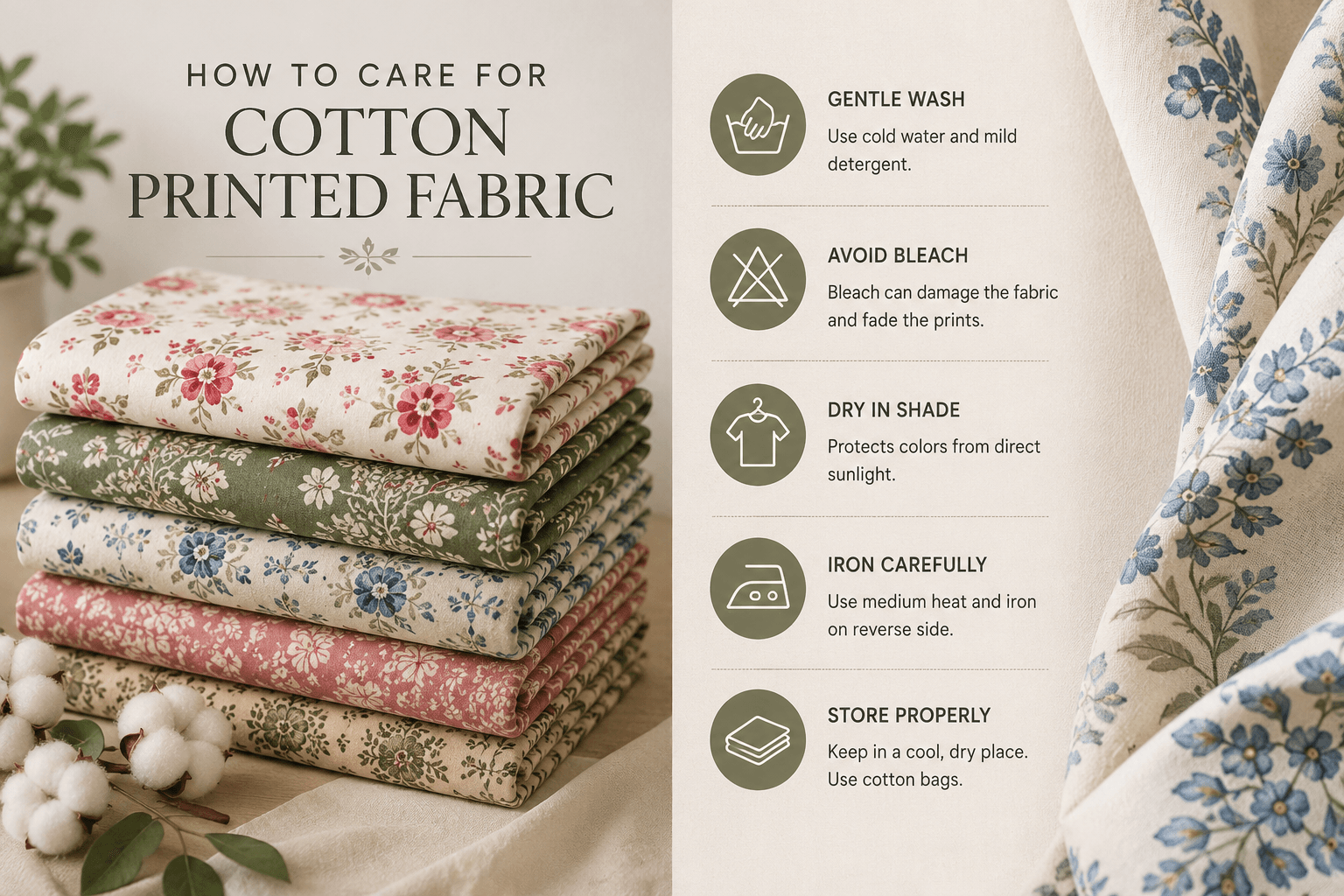
Use cold water for the first wash. Cold water — below 30°C — slows down the rate of dye migration from the fibre into the wash water. It minimises colour bleed, minimises fibre swelling (which drives initial shrinkage), and is gentler on pigment binders than warm or hot water.
Use a small amount of mild, pH-neutral detergent. More on detergent choice below — but for the first wash, use less than you think you need. Excess detergent in the first wash is one of the leading causes of surface fading in pigment-printed fabrics, because high detergent concentrations accelerate binder degradation.
Add a tablespoon of white vinegar to the wash water. This is an old textile-preservation trick that still works. White vinegar is mildly acidic and helps set reactive dyes by temporarily acidifying the wash environment. It also removes any residual alkaline sizing or finishing chemicals from the fabric surface. Use one tablespoon per litre of water. The smell dissipates completely in drying.
Turn the garment inside out. This is the single most effective simple measure for protecting the printed surface during washing. When the print faces the inside of the drum, it has less contact with other fabric surfaces and less exposure to agitation forces. Make it a permanent habit, not just a first-wash precaution.
The Right Water Temperature: Warm Is Not Your Friend
The India fabric wash and care market reached USD 5.7 billion in 2024, growing at nearly 5% annually — and one of the most significant consumer behaviour shifts driving this growth is the move toward cold-water washing. The global fabric care market is seeing cold-wash detergent formulations growing faster than any other segment, because consumers and brands are increasingly aware that most fabric damage happens in hot water.
For cotton printed fabric, the temperature guidance is simple and non-negotiable:
Cold water (below 30°C): Best for all printed cotton. Minimises colour bleed, minimises shrinkage, minimises binder degradation in pigment prints. Use this for all regular washes.
Warm water (30–40°C): Acceptable for heavily soiled cotton or if cold-water washing doesn’t adequately clean the garment. Still safe for most reactive-printed and block-printed cotton. Avoid for natural-dye Bagru prints.
Hot water (above 40°C): Avoid for all printed cotton. Hot water swells cotton fibres, accelerating dye release. It degrades acrylic pigment binders, causing cracking and colour loss. It dramatically increases shrinkage beyond the first-wash norm. There is no benefit to hot washing printed cotton that outweighs these risks.
This is consistent with the global trend toward cold-water washing for sustainability reasons. Unilever’s Wonder Wash — designed for 15-minute, cold-water cycles — expanded to 20 markets within 20 months of launch, reflecting a genuine consumer shift. For Indian cotton printed fabric, cold-water washing is simultaneously the most sustainable and the most fabric-preserving choice.
Choosing the Right Detergent: This Matters More Than You Think
Walk through the detergent aisle in any Indian supermarket in 2026 and you will find dozens of products making competing claims. Which one is right for your cotton printed fabric?
The chemistry to understand is simple. Cotton is made of cellulose — a neutral natural fibre. The dyes and pigments bonded to it are sensitive to two things: alkalinity and oxidising agents.
Most standard laundry detergents are alkaline (pH 9–11). This alkalinity helps remove oil and protein stains — the things household detergents are primarily designed to tackle. But that same alkalinity gradually attacks the reactive dye molecules bonded to cotton, breaking their chemical bonds with the fibre and causing gradual, irreversible colour loss. It also degrades acrylic pigment binders, weakening the adhesion of pigment colour to the fabric surface.
What to look for:
- pH-neutral or mild detergents (pH 6–8): Brands positioned as “gentle” or “delicate fabric” formulations. Liquid detergents are generally milder than powder detergents at the same dosage. In India, brands like Ezee and Surf Excel Liquid for Colours are formulated for gentler fabric care.
- Colour-protection formulations: Detergents containing colour-fixing agents or lower pH are increasingly available in India as the fabric care market shifts toward premium products.
- Cold-water enzyme formulations: Enzyme-based detergents that work effectively at low temperatures are gentler on printed cotton than high-temperature-optimised alkaline formulations.
What to avoid:
- Detergents containing bleach or “whitening” agents: Optical brighteners and chlorine bleach actively destroy colour in printed fabric. Never use bleach on any printed cotton.
- Excess detergent quantity: More detergent does not mean cleaner fabric. Excess detergent increases the effective pH of the wash water and leaves alkaline residue in the fabric after rinsing. Use the minimum recommended quantity — for printed cotton, slightly less than recommended.
- Bio-enzyme detergents for protein stains: Some heavy-duty biological detergents contain proteases and lipases that are effective on stains but aggressive toward certain natural dyes.
For Bagru natural-dye block prints specifically: use the mildest possible detergent or simply wash with plain cold water for regular cleaning. Natural indigo and madder dyes are more sensitive to chemical intervention than synthetic reactive dyes, and most washing they need can be accomplished without detergent at all.
Machine Wash vs Hand Wash: Which Is Better for Printed Cotton?
This is one of the most common questions fabric buyers and garment customers ask — and the honest answer is more nuanced than most care labels communicate.
Hand washing is better for:
- Natural-dye Bagru block prints
- Very delicate or sheer printed cottons (mulmul, voile under 80 GSM)
- Garments with intricate block-print details where mechanical agitation could cause registration shift in subsequent wears
- Any printed cotton you want to last as long as possible
Machine washing is acceptable for:
- Regular reactive-printed and pigment-printed cotton in cambric, poplin, and similar medium-weight constructions
- Screen-printed cotton with good quality binder and wash fastness ratings above 3
- Higher-GSM home textiles like bedsheets and curtains
The machine wash settings that matter:
Select the gentle or delicate cycle — this reduces drum rotation speed and agitation intensity, which is the mechanical force most responsible for print surface abrasion and premature binder degradation.
Select cold water as discussed above.
Load the machine to no more than two-thirds capacity. An overloaded drum means fabrics rub against each other with more force. Printed fabrics rubbing against each other is essentially sandpaper on a print surface, particularly for pigment-printed fabrics.
Do not spin at high speed. A maximum spin of 800 RPM is sufficient for cotton. High-speed spinning (1200–1400 RPM) causes physical stress on printed fabric surfaces through centrifugal force and fabric-on-fabric friction in the final spin.
Drying: The Step Most People Get Completely Wrong
Fabric damage from drying is substantially underestimated compared to damage from washing. In reality, the drying stage — specifically heat drying — is responsible for more colour fading and fabric degradation in cotton printed textiles than almost any other factor.
Tumble drying: Avoid for printed cotton.
The combination of high heat and mechanical tumbling in a dryer is the fastest way to degrade printed cotton. The heat weakens pigment binders, causes reactive dye molecules to migrate and concentrate unevenly as the fabric dries, and causes mechanical surface abrasion as the fabric tumbles. If you must tumble dry, use the lowest heat setting available — but air drying is genuinely better.
Air drying in shade: The correct method.
Hang cotton printed fabric in the shade, not in direct sunlight. This is important — direct sunlight is the primary cause of UV-induced fading in textile dyes. Both reactive dyes and pigment colours fade under extended UV exposure, but the rate of fading in direct outdoor sunlight can be 5–10 times faster than in shade-drying.
The practical implication: hang your printed cotton kurta on a hanger inside the house near an open window, or under a covered outdoor area with good airflow. Not on the terrace in afternoon sun.
Inside out for drying too. The outside-facing surface of a garment is more exposed to UV in drying. Turn printed garments inside out for drying — the same as for washing.
Lay flat for delicate prints. For very fine block-print voile or mulmul garments, hanging while wet causes the weight of the wet fabric to stretch the fabric at the hanger points. Lay flat on a clean, dry surface in the shade instead.
Ironing Printed Cotton: Temperature and Direction Both Matter
Cotton printed fabric irons beautifully — it is one of the fabric’s most practical attributes. But the right ironing technique protects the print while the wrong approach damages it.
Iron temperature: Medium heat (cotton setting, typically 150–200°C) is correct for plain cotton. For printed cotton, reduce this slightly — especially for pigment-printed surfaces. Excessive heat on a pigment print can soften and smear the binder, causing the print surface to stick slightly to the iron plate or to adjacent fabric when pressed together.
Iron on the reverse side. For most printed cotton, ironing on the reverse side (inside out) protects the print surface from direct iron contact. This is especially important for pigment-printed fabrics and for block-printed fabrics with raised tactile print surfaces.
Steam setting: Steam is safe for reactive-printed cotton and block-printed cotton. For pigment-printed cotton, use a drier iron setting — steam can cause minor surface softening of acrylic binder, particularly when combined with direct heat on the print face.
Ironing direction: Always iron in the direction of the warp (lengthwise along the fabric), not across it. Ironing aggressively across the fabric grain can distort the weave structure slightly over repeated washes, particularly at lower GSM. This matters more for fine mulmul and voile than for cambric or poplin.
Never iron directly on a block-print surface. For block-printed fabrics with natural dyes — particularly Bagru dabu prints with indigo backgrounds — direct iron contact on the print surface can cause the iron plate to pick up colour residue and transfer it unevenly. Always iron inside out, or use a pressing cloth between the iron and the print.
Stain Removal: Act Fast and Act Gently
Stain removal on printed cotton is an area where instinct often makes things worse. The instinct is to rub hard with a strong product. The correct approach is nearly the opposite.
The golden rule: Act immediately, act gently.
Fresh stains are always easier to remove than set stains. The moment a spill happens on a printed cotton garment, blot — do not rub — the excess with a clean cloth. Rubbing a fresh stain spreads it and drives it deeper into the fibre. Blotting lifts the surface excess without spreading.
For food and beverage stains: Blot the excess, then treat the area from the reverse side of the fabric with cold water, pushing the stain out through the front rather than deeper in. Apply a small amount of mild liquid detergent to the stain and let it sit for five minutes. Rinse with cold water. Repeat if necessary. Do not use hot water, which sets many food stains permanently.
For oil-based stains: Dust with cornstarch or talcum powder immediately — this absorbs the oil before it penetrates the fibre. Let sit for 30 minutes, then brush off gently. Follow with a small amount of mild liquid detergent applied gently with a soft cloth. Rinse with cold water.
For ink stains: Apply a small amount of rubbing alcohol (isopropyl alcohol) to a clean cloth and blot gently from the outside edges of the stain inward. Do not rub. This is one of the few cases where a product stronger than mild detergent is appropriate — but apply it to the cloth first, never directly to the print surface.
What never to do: Never apply bleach to any printed cotton. Never scrub a stain on a block-print or pigment-print surface — you will lift the print along with the stain. Never use very hot water to try to “boil out” a stain — you will set it permanently.
On natural-dye Bagru prints: Stain removal is more challenging because many chemical treatments that would not affect synthetic dye prints can affect natural dye colours. For Bagru prints, test any stain treatment on an inconspicuous area first. Cold water blotting and mild soap are the only safe universal approach.
Storage: The Part Nobody Talks About (But Should)
The majority of long-term colour damage to stored printed cotton happens not during washing but during storage. Specifically, it happens from three causes: UV exposure, moisture, and the wrong storage containers.
The enemy of stored printed cotton is plastic. Plastic storage bags and containers trap moisture, creating micro-humid environments that accelerate mould, mildew, and chemical degradation of dyes. Natural dyes — indigo and madder in particular — are especially vulnerable to mould attack in humid storage. Switch to breathable cotton storage bags for printed cotton garments and fabric rolls.
Fold, don’t hang, for long-term storage. Hanging printed cotton garments long-term causes gravitational stress at the shoulder and collar points, gradually distorting the fabric grain. For seasonal storage, fold neatly and store flat. For shorter storage periods (weekly wear), hanging is fine.
Store away from light. Even indirect UV exposure through a window can cause measurable colour loss in stored fabric over weeks and months. Close drawers, use opaque storage boxes, or hang in wardrobes away from direct window light.
Add a dry lavender sachet or neem leaves. This is a traditional Indian textile preservation practice that remains genuinely effective. Dried neem leaves are a natural insect repellent and have mild antifungal properties. Lavender sachets deter moths. Neither damages cotton or printed colours. Both are preferable to mothballs (naphthalene), which leave a persistent smell and whose chemical vapours can affect certain natural dyes.
For fabric rolls: Roll printed fabric with the print facing outward around a cardboard tube, with tissue paper between layers to prevent colour transfer. Store horizontally in a cool, dark, dry place. This is how professional fabric retailers and manufacturers store long yardage, and it prevents the fold-crease marks and pressure fading that stacked, folded rolls develop over time.
Caring for Specific Printed Cotton Types
Different printing methods and fabric weights need slightly different approaches. Here is the quick reference guide.
Jaipur Block Print (Sanganer style — reactive dye on white cambric): Cold water hand wash or gentle machine wash. Mild pH-neutral detergent. Shade dry, inside out. Iron inside out on medium heat. Vinegar in first wash. Will achieve full colour stability after 2–3 washes. Expect slight colour softening in first wash — this is normal and the final colour will remain vibrant.
Bagru Dabu Natural Dye Block Print: Cold water hand wash only. No detergent for regular cleaning — plain cold water removes everyday soiling on natural-dye cotton. Shade dry inside out. Do not iron directly on print surface. Colours will evolve and deepen with age — this is the character of natural dye. Store in breathable cotton, away from moisture.
Screen Printed Cotton (pigment): Cold water gentle machine wash. Inside out. Maximum 30°C. Low spin. Mild detergent, minimum quantity. Air dry in shade. Iron inside out on low-medium heat, never on print surface. Pigment prints are most vulnerable to cracking with high-heat drying and alkaline detergent — these two factors cause 90% of pigment print failure.
Screen Printed Cotton (reactive): Similar to block print reactive. Cold water, mild detergent, shade dry. More wash-fast than pigment after the first wash. Can tolerate gentle machine wash on cold regularly.
Digitally Printed Cotton: Follow the same guidance as its dye equivalent — digital reactive prints follow reactive care guidelines, digital pigment prints follow pigment care guidelines. Check with your supplier or look at the reverse side — if the colour shows on the reverse, it is reactive. If the reverse is white, it is pigment.
The Bigger Picture: Why Fabric Care Is a Brand Issue in 2026
For fashion brands sourcing and selling Indian cotton printed fabric, fabric care is not just the customer’s problem. It is part of your brand experience.
The India fabric wash and care market is growing at 4.8% annually and is expected to reach USD 8.7 billion by 2033. The global market is heading toward USD 190 billion by the same year. This growth reflects a fundamental shift in consumer attitude: people are willing to invest in caring for quality fabric because they increasingly understand that quality fabric is worth caring for.
The global trend toward cold-water washing, plant-based detergents, and sustainable laundry practices aligns perfectly with the care requirements of Indian cotton printed fabric. These fabrics — block-printed, natural-dyed, hand-crafted — are the original slow fashion. They are built to last decades with correct care. The shift toward sustainable laundry habits in 2026 is, in a sense, the culture catching up to what these fabrics have always needed.
As a brand selling Indian cotton prints, include care instructions with every garment or fabric order. Make them specific — not just “cold wash” but “cold water, mild detergent, shade dry, inside out.” Include them in hang tags, packaging, website product pages, and Instagram content. Customers who know how to care for their purchases have better experiences and become loyal customers. Customers who ruin a beautiful block-print kurta in their first wash become disappointed ones.
Your care instructions are an extension of your quality commitment. Treat them that way.
The Complete Care Quick Reference
| Action | Recommendation |
|---|---|
| First wash | Cold water, alone, inside out, mild detergent + 1 tbsp vinegar |
| Regular washing | Cold water (below 30°C), gentle cycle, inside out |
| Detergent | pH-neutral or colour-care liquid, minimum quantity, no bleach |
| Machine settings | Gentle/delicate cycle, max 800 RPM spin, max two-thirds load |
| Drying | Air dry in shade, inside out, never tumble dry in high heat |
| Ironing | Medium heat, reverse side, no steam on pigment prints |
| Stain removal | Blot immediately, cold water from reverse, mild detergent |
| Storage | Breathable cotton bags, fold flat, away from light and moisture |
| Natural dye prints | Cold water only, no detergent, air dry, no direct iron contact |
| Pigment prints | Extra-gentle — low heat, mild detergent, no tumble dry |
Final Thought: Fabric That Lasts Is Fabric That Is Cared For
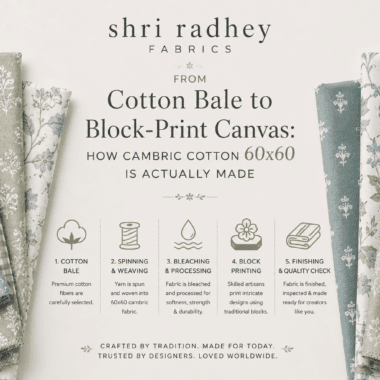
Cotton printed fabric from Jaipur’s block-print workshops is not made to be disposable. It is made by hands that have spent years developing a skill, on cotton that has been grown, spun, woven, bleached, and printed across fourteen manufacturing stages before it ever reaches a buyer.
The fabrics that age beautifully — the block-print kurta that looks better at five years than at five months, the printed cotton bedsheet that softens with every wash while keeping its colour — are not special fabrics. They are ordinary fabrics that were cared for correctly. Cold water. Mild detergent. Shade drying. Thoughtful storage.
Good fabric care is not complicated. It mostly asks you to do less — less heat, less detergent, less agitation — and to do it more patiently. The reward is fabric that honours the craft that made it by lasting long enough for that craft to be fully appreciated.
Shri Radhey Fabrics is a fabric manufacturer and wholesale supplier based in Sanganer, Jaipur. We manufacture pure cotton, rayon, block-print, screen-print, and digitally printed fabrics for fashion brands and garment manufacturers across India, the UK, UAE, USA, and beyond. Every fabric we supply comes with complete care guidance. Visit shriradheyfabrics.com or DM us on Instagram @shriradheyfabrics for samples and bulk enquiries.